Exposure and Response Prevention (ERP): How Evidence-Based Therapy Breaks the OCD Cycle
Obsessive-Compulsive Disorder (OCD) is not a problem of weak willpower or overthinking. It is a disorder of false alarms—where the brain repeatedly signals danger even when none exists.
One of the most effective, research-backed treatments for OCD is Exposure and Response Prevention (ERP). ERP is designed to help you regain control by breaking the vicious cycle that keeps OCD going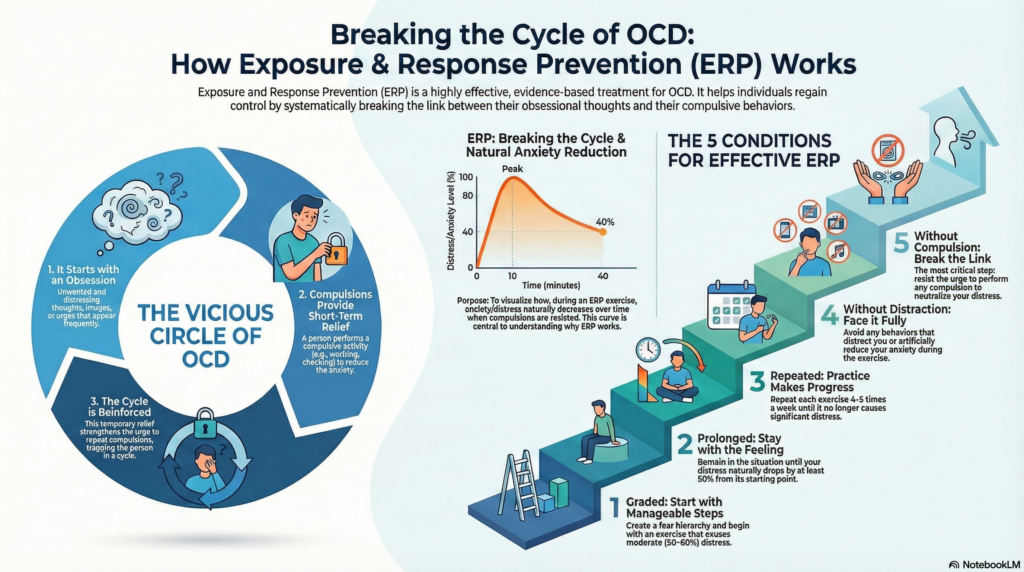 .
.
Understanding the Vicious Cycle of OCD
OCD operates through a self-reinforcing loop that becomes stronger over time:
Obsessions
These are unwanted, intrusive thoughts, images, or urges—such as fears of contamination, harm, mistakes, or moral wrongdoing.
Anxiety
The obsession triggers intense distress or a sense of threat, even when the danger is unrealistic.
Compulsions
To reduce this distress, the person performs repetitive actions or mental rituals—washing, checking, counting, reassurance-seeking, or avoiding triggers.
Short-Term Relief
The anxiety drops briefly, which teaches the brain that the compulsion “worked.” Unfortunately, this strengthens the obsession and makes the cycle harder to resist the next time.
OCD persists not because the obsessions are true, but because the brain learns that rituals are necessary for safety.
How Exposure and Response Prevention (ERP) Breaks the Link
ERP works by targeting the learning mechanism that keeps OCD alive.
It involves:
-
Exposure: Gradually and intentionally facing situations, thoughts, or sensations that trigger obsessions.
-
Response Prevention: Resisting the urge to perform compulsions or mental neutralizing rituals.
When you stay with anxiety without performing the ritual, something important happens:
your distress reduces on its own.
Over time, the brain learns:
-
anxiety is uncomfortable but not dangerous,
-
compulsions are unnecessary,
-
obsessions lose their power.
ERP doesn’t remove thoughts—it changes your relationship with them.
The Five Conditions for Successful ERP Treatment
For ERP to work effectively, it must be done in a structured and precise way. These five conditions are essential.
1. Graded Exposure
ERP follows a hierarchy of fears, starting with moderately challenging situations (about 50–60% distress) and gradually moving to harder ones.
Starting too easy doesn’t teach the brain enough.
Starting too hard increases dropout.
The goal is manageable discomfort, not overwhelming distress.
2. Prolonged Exposure
Exposure must be continued until anxiety drops by at least 50% from its peak.
Stopping too early teaches the brain:
“I escaped because the danger was real.”
Staying long enough teaches:
“I stayed, and nothing bad happened.”
Time is a critical ingredient in learning.
3. Repeated Practice
ERP works through repetition.
Exercises should be practiced 4–5 times per week.
Each step is repeated until starting anxiety drops consistently (usually below 40%) before moving up the hierarchy.
One-time bravery does not rewire the brain.
Repeated learning does.
4. Without Distraction or Safety Behaviours
During exposure, avoid:
-
distraction,
-
reassurance,
-
neutralizing thoughts,
-
“coping tricks” meant to reduce anxiety.
These behaviours may feel helpful, but they silently reinforce OCD by preventing full learning.
ERP works best when anxiety is experienced, not escaped.
5. Without Compulsions (and Undoing Slips)
Compulsions must be resisted—both physical and mental.
If a compulsion does occur, it should be undone by immediately re-exposing yourself to the trigger and staying with it until anxiety reduces again.
This prevents OCD from “winning” through partial rituals.
A Simple Analogy to Understand ERP
Think of OCD like a false fire alarm.
Every time the alarm rings (the obsession), you rush outside (the compulsion) to feel safe. Because you never stay inside, you never learn that there is no fire.
ERP is like staying in the room while the alarm blares.
It is uncomfortable at first.
The noise feels intense.
But by staying and not running, you learn the truth: the alarm is faulty.
Eventually, the alarm becomes easier to ignore—and sometimes stops mattering altogether.
Why ERP Is Considered the Gold Standard Treatment for OCD
Decades of research show that ERP:
-
reduces OCD severity significantly,
-
produces lasting improvement,
-
works across different OCD subtypes,
-
addresses the core mechanism of the disorder.
ERP does not suppress thoughts.
It restores freedom of choice.
Final Takeaway
OCD survives on avoidance and rituals.
ERP works by teaching the brain that uncertainty can be tolerated and anxiety does not need to be neutralized.
Recovery is not about feeling calm all the time.
It is about living fully even when discomfort shows up.
That is what ERP is designed to help you do.
About the Author
Dr. Srinivas Rajkumar T, MD (AIIMS), DNB, MBA (BITS Pilani), is a Consultant Psychiatrist and Neurofeedback Specialist at Mind & Memory Clinic, Apollo Clinic Velachery, Chennai. He specializes in the treatment of Obsessive-Compulsive Disorder, anxiety disorders, behavioural addictions, and ADHD, using evidence-based therapies such as ERP alongside neuroscience-informed interventions.
📍 Apollo Clinic Velachery (Opp. Phoenix Mall)
✉️ srinivasaiims@gmail.com
📞 +91-8595155808