Broken Windows and Broken Bonds
A psychologist once placed two identical cars in two very different neighborhoods.
One sat in the Bronx.
The other in Palo Alto.
The Bronx car was stripped within hours. The Palo Alto car remained untouched for days—until the psychologist smashed a single window. After that, the destruction was swift and total.
Nothing else changed.
Just one broken window.
The theory that emerged was simple and unsettling: visible neglect changes behaviour. A broken window doesn’t invite destruction directly—it signals that no one is paying attention anymore.
Relationships work the same way.
They don’t fall apart because of one catastrophic event. They unravel when small breaches go unattended and start sending the wrong message.
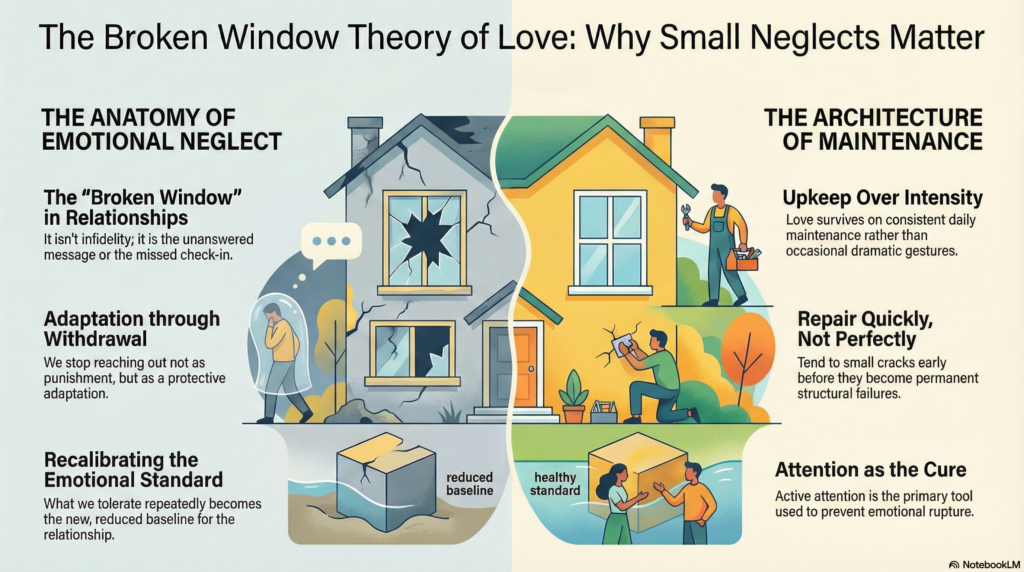
In relationships, the broken window isn’t infidelity or abandonment.
It’s the unanswered message that used to get a reply.
The distracted presence.
The missed check-in after a hard day.
The irritation that never gets repaired, only avoided.
Each one feels too minor to address. Too petty to raise. Too exhausting to fix right now.
So it’s left there.
And slowly, the relationship learns something important: care is optional here.
Human beings are exquisitely sensitive to emotional signals. We don’t consciously keep score, but our nervous systems do. When responsiveness drops, when repair is delayed, when attentiveness becomes inconsistent, something inside recalibrates.
We stop reaching out as much.
We stop explaining ourselves fully.
We stop expecting to be met.
Not as a punishment—but as an adaptation.
The relationship continues, but in a reduced form. Functional. Polite. Less alive.
This is how intimacy erodes quietly.
Healthy relationships aren’t built on dramatic gestures. They’re built on maintenance. On noticing small cracks early and tending to them before they become structural. On repairing misattunements quickly, not perfectly.
Attention is the opposite of neglect.
Repair is the opposite of rupture.
What we tolerate repeatedly becomes the emotional standard of the relationship.
Broken windows don’t end relationships overnight.
They teach people, slowly, how much care is required—and how much can safely be withdrawn.
And the uncomfortable truth is this:
love survives not on intensity, but on upkeep.
Dr. Srinivas Rajkumar T, MD (AIIMS), DNB, MBA (BITS Pilani)
Consultant Psychiatrist
Mind & Memory Clinic – Apollo Clinic Velachery
📞 +91-8595155808 | ✉️ srinivasaiims@gmail.com