Emotional Dysregulation and Rejection Sensitivity in ADHD
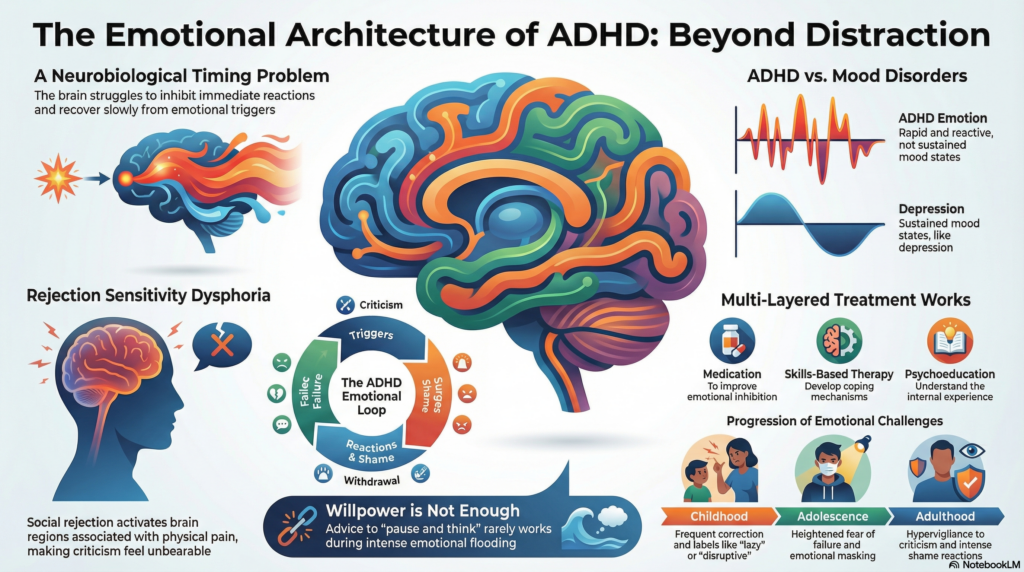 When people think of ADHD, they usually imagine distraction, restlessness, or poor concentration. What is far less recognised—but often far more distressing for patients—is emotional dysregulation and rejection sensitivity.
For many adolescents and adults with ADHD, emotional pain is not a side issue. It is the core of their daily suffering.
ADHD Is Not Just an Attention Disorder
Modern neuropsychological models describe ADHD primarily as a disorder of self-regulation, not attention alone.
Attention difficulties are visible and measurable.
Emotional dysregulation is quieter, internal, and often misunderstood.
In ADHD, the brain struggles to:
-
regulate emotional intensity
-
inhibit immediate reactions
-
recover quickly from emotional triggers
As a result, emotions tend to rise faster, feel stronger, and settle slower than in neurotypical individuals.
This is not emotional weakness or immaturity.
It is a neurobiological timing problem.
What Is Emotional Dysregulation in ADHD?
Emotional dysregulation refers to difficulty modulating emotional responses in proportion to the situation.
Common experiences include:
-
sudden anger or irritation
-
intense frustration over small setbacks
-
feeling overwhelmed by criticism
-
emotional “flooding” during conflicts
-
lingering emotional pain long after an event has passed
Importantly, these reactions are reactive and situational, not sustained mood states. This distinction helps differentiate ADHD-related emotional dysregulation from mood disorders such as depression or bipolar disorder.
Rejection Sensitivity: Why Small Comments Hurt So Much
Many individuals with ADHD describe an extreme emotional response to perceived rejection, criticism, or disapproval—often called rejection sensitivity.
This does not mean they are overly sensitive by choice.
From a neurobiological perspective:
-
social rejection activates brain regions associated with physical pain
-
poor prefrontal modulation in ADHD amplifies this response
-
past experiences of criticism are rapidly reactivated
The result is an intense emotional surge that occurs before rational thinking has time to intervene.
Patients often describe this as:
-
“It feels unbearable”
-
“I shut down completely”
-
“I know it’s not logical, but it hurts physically”
These descriptions are clinically accurate, not exaggerated.
How Rejection Sensitivity Develops Over Time
Childhood
-
frequent correction and negative feedback
-
labelled as careless, lazy, or disruptive
-
repeated experiences of “getting it wrong”
Adolescence
-
heightened peer awareness
-
fear of embarrassment or failure
-
emotional masking and overcompensation
Adulthood
-
hypervigilance to criticism
-
people-pleasing or avoidance
-
intense shame reactions
-
misdiagnosis as personality or mood disorders
Understanding this developmental trajectory helps reduce self-blame and restores compassion—for both patients and families.
Why Emotional Dysregulation in ADHD Is Often Misdiagnosed
Because emotional symptoms are prominent, individuals with ADHD are frequently mislabelled as having:
-
mood disorders
-
anxiety disorders
-
anger problems
-
borderline personality traits
The key difference lies in pattern and duration:
-
ADHD emotions are rapid, reactive, and situation-linked
-
mood disorders involve sustained, pervasive emotional changes
Missing this distinction can lead to ineffective treatment and unnecessary stigma.
What Actually Helps (And What Doesn’t)
What rarely works on its own
-
willpower
-
insight alone
-
advice to “pause and think”
-
reassurance during emotional flooding
Patients have usually tried these repeatedly—and failed—leading to frustration and shame.
What helps when layered properly
-
appropriate medication (when indicated), improving emotional inhibition
-
skills-based psychotherapy focusing on emotion regulation
-
psychoeducation that names and normalises the pattern
-
environmental and relational restructuring to reduce triggers
Treatment works best when emotional dysregulation is recognised as a core feature, not an afterthought.
A Simple Framework: The ADHD Emotional Loop
A useful way to understand this process is the ADHD Emotional Loop:
Trigger → Emotional surge → Negative interpretation → Behavioural reaction → Shame → Memory reinforcement
Once patients and families recognise this loop, blame reduces and change becomes possible.
Why This Matters
Emotional dysregulation and rejection sensitivity explain:
-
relationship difficulties
-
workplace burnout
-
repeated treatment failures
-
low self-esteem despite high intelligence
Addressing these aspects often leads to greater improvement than focusing on attention alone.
ADHD is not just about productivity.
It is about emotional safety and self-trust.
Final Thoughts
When emotional dysregulation is understood through a neurodevelopmental lens, patients stop seeing themselves as “too sensitive” or “broken”. They begin to see patterns—and patterns can be worked with.
This shift alone can be profoundly therapeutic.
About the Author
Dr. Srinivas Rajkumar T, MD (AIIMS), DNB, MBA (BITS Pilani)
Consultant Psychiatrist & Neurofeedback Specialist
Mind & Memory Clinic, Apollo Clinic Velachery (Opp. Phoenix Mall)
Dr. Srinivas specialises in adult ADHD, emotional dysregulation, neuropsychiatric assessment, and brain-based interventions including QEEG-guided evaluations. His clinical work integrates evidence-based psychiatry with neurodevelopmental and cognitive frameworks, tailored to Indian clinical contexts.
✉ srinivasaiims@gmail.com
📞 +91-8595155808