ADHD vs Emotionally Unstable Personality Disorder: A State–Trait Analysis
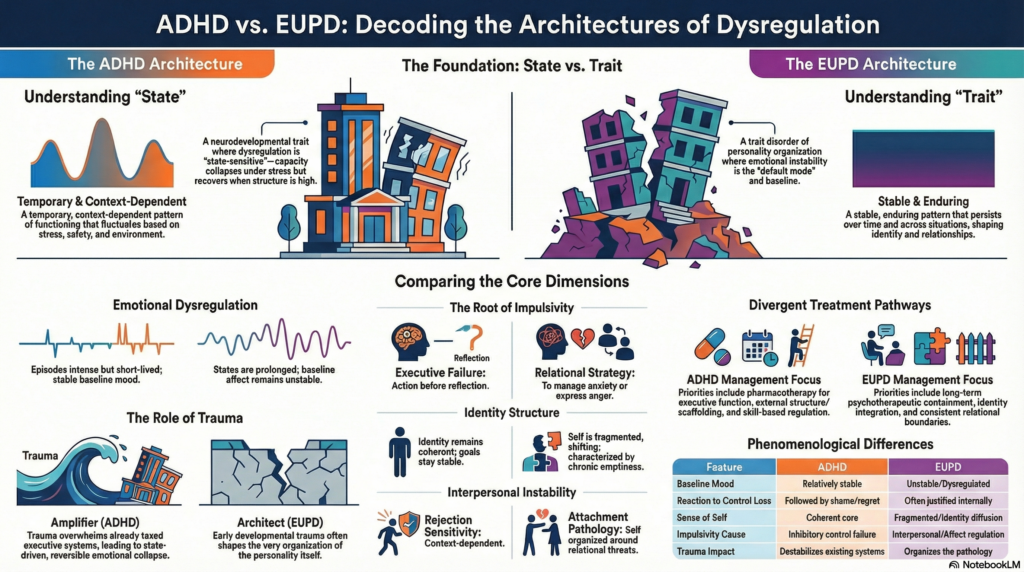 In clinical practice, few diagnostic dilemmas generate as much confusion—and harm—as the overlap between Attention-Deficit/Hyperactivity Disorder (ADHD) and Emotionally Unstable Personality Disorder (EUPD). Both conditions may present with emotional volatility, impulsivity, interpersonal instability, and functional impairment. Yet they arise from fundamentally different psychological architectures.
The central error lies in mistaking state-dependent dysregulation for trait-based pathology.
A state–trait framework offers a way out of this diagnostic fog.
State and Trait: A Conceptual Clarification
A state refers to a temporary, context-dependent pattern of functioning. States fluctuate with stress, safety, fatigue, relationships, and environmental demands.
A trait refers to a relatively stable, enduring pattern that persists across situations and over time, shaping identity, relationships, and self-experience.
ADHD is best understood as a trait neurodevelopmental condition with state-sensitive expression.
EUPD is fundamentally a trait disorder of personality organisation, with relatively stable patterns of affect, identity, and relationships.
Failure to distinguish between these leads to overdiagnosis of personality pathology in neurodevelopmental conditions.
ADHD: A Trait of Neurodevelopment, Dysregulated by State
ADHD is present from early development, though its manifestations change across the lifespan. Its core deficit lies in self-regulation, particularly executive control over attention, impulse, emotion, and time.
Crucially, individuals with ADHD often function well when:
-
Structure is high
-
External regulation is available
-
Stress is manageable
-
Relationships feel secure
Under these conditions, emotional regulation may appear intact.
However, when stress, trauma, or interpersonal threat is introduced, regulatory capacity collapses. The resulting emotional lability and impulsivity are state-dependent expressions of an underlying neurodevelopmental trait, not evidence of a disordered personality.
EUPD: A Trait Disorder of Personality Organisation
Emotionally Unstable Personality Disorder reflects a pervasive disturbance in how the self and others are experienced. Emotional instability is not merely reactive; it is embedded in the individual’s internal structure.
Key features include:
-
Chronic identity diffusion
-
Persistent fear of abandonment
-
Stable patterns of intense and unstable relationships
-
Maladaptive emotion regulation as a default mode
These patterns persist even in the absence of acute stress and often originate in early relational trauma.
In contrast to ADHD, emotional dysregulation in EUPD is not episodic—it is baseline.
Emotional Dysregulation: Similar Surface, Different Depth
At a phenomenological level, both conditions may show emotional intensity, rapid mood shifts, and difficulty tolerating distress. The difference lies in modulation and recovery.
In ADHD:
-
Emotional reactions are intense but short-lived
-
Baseline mood between episodes is relatively stable
-
Shame follows loss of control
-
Insight is usually preserved
In EUPD:
-
Emotional states are prolonged
-
Baseline affect is unstable
-
Emotions are experienced as identity-defining
-
Splitting and externalisation are common
What looks similar externally arises from different internal processes.
Impulsivity: Executive Failure vs Relational Strategy
Impulsivity in ADHD reflects executive control failure. Actions occur before reflection due to delayed inhibitory control.
In EUPD, impulsivity often serves an interpersonal or affect-regulatory function—to reduce abandonment anxiety, express anger, or regain connection.
This distinction is subtle but critical. ADHD impulsivity is typically followed by regret; EUPD impulsivity is often justified internally as necessary or deserved.
Interpersonal Instability: Rejection Sensitivity vs Attachment Pathology
Many individuals with ADHD experience heightened sensitivity to rejection. This sensitivity is reactive and context-dependent, intensifying under stress or perceived criticism.
In EUPD, interpersonal instability reflects attachment pathology. Relationships are central to identity and regulation, leading to cycles of idealisation and devaluation.
ADHD patients may struggle in relationships, but their sense of self usually remains intact. In EUPD, the self is organised around relational proximity and threat.
Identity: Preserved Core vs Diffusion
Identity is a decisive differentiator.
In ADHD:
-
Sense of self is coherent
-
Values and goals are stable
-
Self-esteem fluctuates but identity remains intact
In EUPD:
-
Identity is unstable and fragmented
-
Values, goals, and self-image shift
-
Chronic emptiness is common
Misdiagnosis often occurs when clinicians focus on behaviour rather than identity structure.
The Role of Trauma: Amplifier vs Architect
Trauma interacts differently with each condition.
In ADHD, trauma amplifies dysregulation by overwhelming already taxed executive systems. Regression and emotional collapse are state-driven and reversible.
In EUPD, trauma is often developmental and constitutive, shaping personality organisation itself.
Thus, trauma in ADHD destabilises; trauma in EUPD organises pathology.
Why Misdiagnosis Is Common
Several factors contribute:
-
Superficial symptom overlap
-
Lack of developmental history
-
Overreliance on cross-sectional assessment
-
Failure to distinguish state reactions from trait patterns
Labeling ADHD-related dysregulation as EUPD risks inappropriate treatment, increased stigma, and therapeutic pessimism.
Treatment Implications
Correct diagnosis transforms management.
ADHD-dominant presentations benefit from:
-
Pharmacotherapy targeting executive function
-
External structure and scaffolding
-
Trauma-informed psychotherapy
-
Skill-based emotion regulation
EUPD requires:
-
Long-term psychotherapeutic containment
-
Focus on identity integration
-
Consistent relational boundaries
-
Careful, limited use of medication
Confusing the two leads to suboptimal outcomes for both.
Conclusion
ADHD and Emotionally Unstable Personality Disorder may look alike in moments of crisis, but they represent distinct psychological realities. ADHD reflects a neurodevelopmental trait whose expression is profoundly state-dependent. EUPD reflects a trait-level disturbance in personality organisation.
A state–trait analysis moves psychiatry away from moral judgment and toward developmental understanding. It reminds clinicians to ask not just what the patient is doing, but when, why, and under what conditions those behaviours emerge.
Precision here is not academic—it is ethical.
Dr. Srinivas Rajkumar T, MD (AIIMS), DNB, MBA (BITS Pilani)
Consultant Psychiatrist & Neurofeedback Specialist
Mind & Memory Clinic, Apollo Clinic Velachery (Opp. Phoenix Mall)
✉ srinivasaiims@gmail.com 📞 +91-8595155808