Body Dysmorphic Disorder (BDD): An Indian Perspective
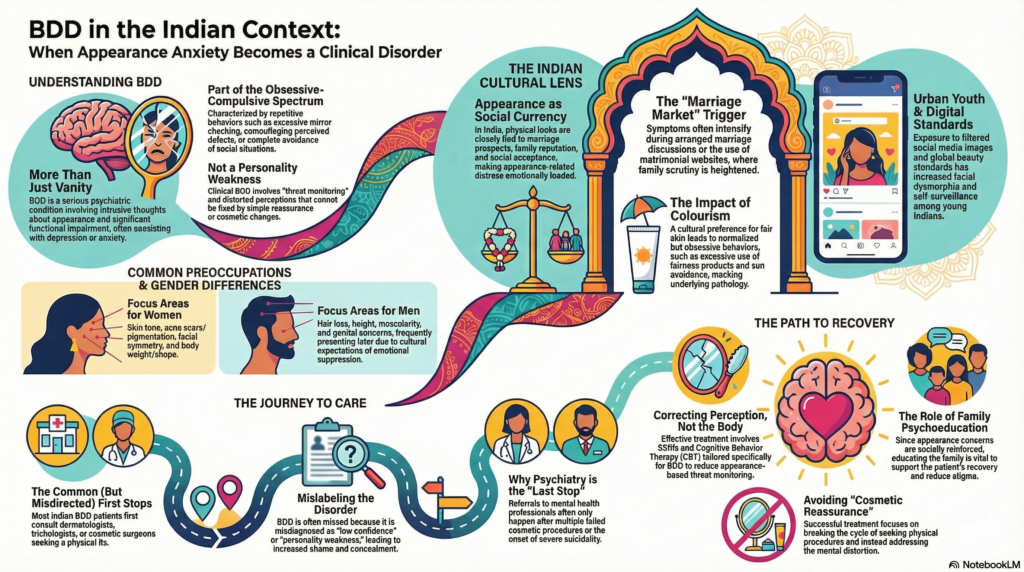 Body Dysmorphic Disorder (BDD) is a serious psychiatric condition characterised by persistent preoccupation with perceived defects in physical appearance that are minimal or not visible to others. While BDD is universally recognised, its presentation in India is strongly shaped by cultural values, social expectations, and stigma around mental health.
As a result, BDD in India is frequently missed, normalised, or misdirected into cosmetic pathways, delaying appropriate psychiatric care.
What Is Body Dysmorphic Disorder?
BDD involves:
-
Intrusive, repetitive thoughts about appearance
-
Excessive mirror checking, camouflaging, or avoidance
-
Significant distress, shame, and functional impairment
It is not vanity and not simply low self-confidence. BDD belongs to the obsessive–compulsive spectrum and often coexists with depression, anxiety, and suicidal ideation.
Why BDD Looks Different in India
1. Appearance Is Linked to Social Worth
In Indian society, physical appearance is closely tied to:
-
Marriage prospects
-
Family reputation
-
Social acceptance
This makes appearance concerns more emotionally loaded and less likely to be questioned.
2. Common BDD Preoccupations in India
Indian patients with BDD commonly focus on:
-
Skin colour and texture (colourism, acne scars, pigmentation)
-
Facial features (nose shape, symmetry)
-
Hair loss (especially in men)
-
Weight and body shape (especially in women)
-
Height and build
These concerns reflect cultural beauty standards, not true physical abnormality.
3. Marriage Pressure Intensifies Symptoms
BDD often worsens during:
-
Arranged marriage discussions
-
Matrimonial website use
-
Family scrutiny of appearance
Many patients equate perceived defects with being “unmarriageable”, reinforcing obsessive beliefs and avoidance.
4. Colourism and Skin-Focused Dysmorphia
India’s long-standing preference for fair skin strongly influences BDD presentation. Excessive use of fairness products, avoidance of sunlight, and repeated dermatology visits are common.
Because these behaviours are socially accepted, pathology is often overlooked.
5. Social Media and Urban Youth
Urban Indian adolescents and young adults are increasingly exposed to:
-
Filtered images
-
Global beauty standards
-
Influencer-driven aesthetics
For vulnerable individuals, this leads to facial dysmorphia, photo avoidance, and constant self-surveillance.
Pathway to Care: Psychiatry Is Often the Last Stop
In India, most BDD patients first consult:
-
Dermatologists
-
Cosmetic surgeons
-
Trichologists
-
Aesthetic clinics
Psychiatric referral usually occurs only after:
-
Multiple failed procedures
-
Severe distress
-
Depression or suicidality
Stigma and lack of awareness delay appropriate treatment.
Gender Differences in the Indian Context
-
Women: skin tone, facial features, weight, body shape
-
Men: hair loss, muscularity, height, genital concerns
Men often present later due to cultural expectations around emotional suppression.
Why BDD Is Commonly Missed in India
BDD is often mislabelled as:
-
Vanity
-
Overthinking
-
Low confidence
-
Personality weakness
This moral framing increases shame and concealment, worsening outcomes.
Treatment Considerations in India
Effective treatment focuses on:
-
SSRIs at adequate doses
-
Cognitive Behaviour Therapy tailored for BDD
-
Avoidance of cosmetic reassurance
-
Family psychoeducation
-
Reducing appearance-based threat monitoring
Treatment is not about fixing the body, but about correcting distorted perception.
BDD is not a cultural weakness.
It is a treatable psychiatric disorder shaped by society.
About the Author
Dr. Srinivas Rajkumar T, MD (AIIMS), DNB, MBA (BITS Pilani)
Consultant Psychiatrist & Neurofeedback Specialist
Dr. Srinivas Rajkumar T is a Chennai-based psychiatrist with clinical expertise in obsessive–compulsive spectrum disorders, body image disturbances, anxiety disorders, and mood disorders. His work integrates evidence-based psychiatry with culturally informed psychoeducation tailored to Indian patients.
📍 Mind & Memory Clinic, Apollo Clinic Velachery (Opp. Phoenix Mall)
✉ srinivasaiims@gmail.com
📞 +91-8595155808