Schadenfreude: Why We Sometimes Enjoy Another Person’s Misfortune
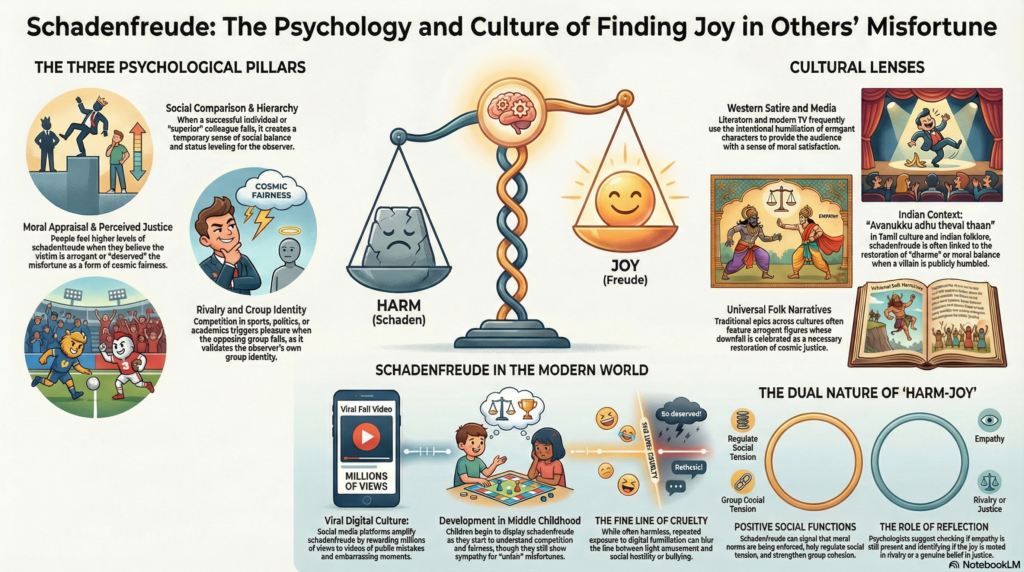 A Psychological and Cultural Exploration
Human emotions are rarely simple. Alongside compassion, empathy, and kindness, there exists a more uncomfortable emotion—schadenfreude. The word comes from German: Schaden meaning “harm” and Freude meaning “joy.” Together, it describes the feeling of pleasure when someone else experiences misfortune.
At first glance, this emotion seems morally troubling. Yet psychologists increasingly recognize that schadenfreude is a universal human experience, deeply tied to social comparison, fairness, and cultural narratives.
Understanding this emotion can reveal much about human psychology, social structures, and even modern digital culture.
The Psychology Behind Schadenfreude
Schadenfreude does not arise randomly. It usually appears in specific social contexts.
Three psychological factors are commonly involved.
1. Social Comparison
Humans constantly compare themselves with others. When someone perceived as superior or successful experiences failure, it may temporarily restore a sense of balance.
For example:
-
A top-performing colleague makes a mistake.
-
A rival sports team loses unexpectedly.
In such situations, people may feel a subtle satisfaction—not necessarily cruelty, but a momentary leveling of the social hierarchy.
2. Perceived Justice
Schadenfreude often depends on the perception that the person “deserved” the outcome.
Psychologists call this moral appraisal.
People feel less sympathy when misfortune happens to someone seen as:
-
arrogant
-
unfair
-
morally wrong
This is why public scandals involving powerful figures often trigger widespread schadenfreude.
3. Rivalry and Group Identity
The emotion is particularly strong in competitive settings.
Examples include:
-
sports rivalries
-
academic competition
-
political conflicts
When members of an opposing group fail, individuals may experience pleasure because the group identity itself feels validated.
Schadenfreude in Everyday Life
Despite sounding like a rare emotion, schadenfreude appears frequently in daily experiences.
Common examples include:
-
laughing at harmless mishaps in comedy shows
-
enjoying blooper videos
-
reacting to celebrity failures in gossip media
-
feeling relief when a competitor underperforms
In many cases, the emotion is mild, fleeting, and socially regulated. Most people still feel empathy simultaneously.
Cultural Representations of Schadenfreude
Different cultures recognize this emotion in their own ways.
Western Literature and Media
In Western storytelling, schadenfreude often appears in satire and comedy.
Characters who display arrogance are intentionally humiliated to create humor. The audience experiences satisfaction because the narrative restores moral balance.
Classic examples appear in:
-
Shakespearean comedy
-
political satire
-
modern television comedy.
Indian Cultural Context
Although the German term is widely used in psychology, the emotion itself is not foreign to Indian culture.
Indian languages contain expressions that capture similar feelings.
In Tamil conversations, phrases like “avanukku adhu thevai thaan” (“he deserved it”) often accompany reactions to someone’s failure. The emotional tone may blend justice, rivalry, and moral judgment.
Traditional storytelling also contains elements of schadenfreude.
In many epics and folklore narratives:
-
arrogant characters experience downfall
-
villains are humiliated publicly
-
justice is restored dramatically.
The audience experiences satisfaction not merely because someone suffered, but because cosmic or moral balance has been restored.
Social Hierarchies and Cultural Dynamics
In societies with strong social hierarchies, schadenfreude may also arise when authority figures lose status.
For instance:
-
a corrupt official exposed publicly
-
a powerful leader embarrassed in public discourse.
Such reactions reflect collective emotional responses to power structures.
The emotion becomes intertwined with social justice narratives.
Schadenfreude in the Age of Social Media
Modern digital culture has amplified this emotion.
Platforms that reward viral content often circulate videos of:
-
public mistakes
-
accidents
-
embarrassing moments.
These clips attract millions of views because they trigger a mixture of:
-
curiosity
-
humor
-
schadenfreude.
However, the digital environment also raises ethical questions.
When people are repeatedly exposed to others’ humiliation, the boundary between harmless amusement and cruelty can blur.
The Development of Schadenfreude in Children
Psychological studies show that children begin displaying schadenfreude relatively early.
By middle childhood, children start to understand:
-
fairness
-
deservedness
-
social competition.
For example, a child might feel pleased when a class rival fails a test. But if the misfortune appears unfair, the same child may show sympathy instead.
This suggests that schadenfreude is closely linked to moral reasoning and social evaluation.
Is Schadenfreude Always Negative?
Interestingly, the emotion is not always harmful.
In certain contexts, it may serve psychological and social functions.
Restoring Perceived Fairness
When individuals believe justice has been served, schadenfreude may signal that moral norms are being enforced.
Emotional Release
In competitive environments, minor episodes of schadenfreude may help regulate social tension.
Reinforcing Group Identity
Shared reactions to rival failures can strengthen group cohesion.
However, when the emotion becomes excessive or malicious, it can contribute to bullying, humiliation, and social hostility.
Cultivating Awareness
Recognizing schadenfreude in ourselves can be uncomfortable, but it offers an opportunity for reflection.
Instead of suppressing the emotion entirely, psychologists suggest examining the underlying thought process:
-
Is the reaction linked to rivalry?
-
Is there a belief that the person deserved the outcome?
-
Is empathy still present?
Such reflection can help balance natural emotional reactions with compassion and fairness.
Conclusion
Schadenfreude reminds us that human emotions are complex and sometimes contradictory. The same mind that feels deep empathy can also experience fleeting pleasure at another’s misfortune.
Across cultures—from Western satire to Indian moral storytelling—the emotion often reflects deeper concerns about justice, hierarchy, and social comparison.
Understanding schadenfreude does not mean celebrating it. Instead, it offers insight into how humans navigate fairness, rivalry, and morality in social life.
Awareness of these emotional dynamics can help individuals respond more thoughtfully—choosing empathy where possible, while acknowledging the strange and fascinating complexity of human emotion.
Dr. Srinivas Rajkumar T, MD (AIIMS), DNB, MBA (BITS Pilani)
Consultant Psychiatrist & Neurofeedback Specialist
Mind & Memory Clinic, Apollo Clinic Velachery (Opp. Phoenix Mall)
✉ srinivasaiims@gmail.com 📞 +91-8595155808