Autism – A Guide for Parents
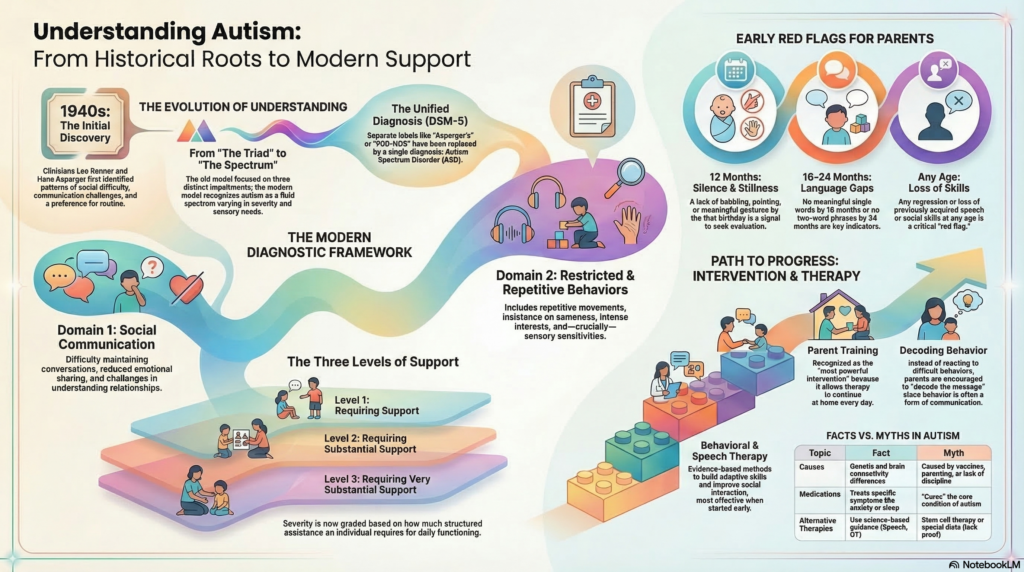 From First Recognition to Modern Diagnosis: Classic Symptoms, DSM-5, and ICD-11 Explained
Parenting already asks you to decode a growing brain. Autism adds a twist—the signals are there, but they arrive in a different language.
The goal is not to panic.
The goal is to understand early, act early, and act wisely.
The Story of Autism: How We Learned to See It
Medicine rarely “discovers” conditions overnight. They exist quietly until patterns become visible.
Autism is one such story.
In the 1940s, clinicians Leo Kanner and Hans Asperger described children who seemed different in a strikingly consistent way:
-
A preference for being alone
-
Difficulty with communication
-
Repetitive, rigid behaviors
-
Strong attachment to routines
Kanner called it early infantile autism.
Asperger described a milder form—children with normal intelligence but social difficulty.
For decades, these were treated as separate conditions.
The Classic Symptoms: The Old Model
Traditionally, autism was understood through three domains—the “triad of impairment”:
1. Social Interaction Difficulties
-
Poor eye contact
-
Limited interest in peers
-
Reduced emotional sharing
2. Communication Problems
-
Delayed speech
-
Echolalia (repeating words)
-
Difficulty using language socially
3. Repetitive Behaviors
-
Hand flapping, rocking
-
Strict routines
-
Narrow, intense interests
This model worked—but only partially.
Because reality is rarely neat.
Why the Model Changed
Clinicians began noticing inconsistencies:
-
Some children had good language but poor social skills
-
Sensory sensitivities were common but not included
-
Many had overlapping conditions like ADHD
The conclusion became unavoidable:
Autism was not a fixed category—it was a spectrum.
What is Autism Today?
Autism Spectrum Disorder (ASD) is a neurodevelopmental condition that affects:
-
Social interaction
-
Communication
-
Behavior and adaptability
It begins early in childhood and varies widely in severity.
Some individuals function independently.
Others require structured, lifelong support.
Modern Diagnosis: DSM-5 Framework
The DSM-5 made a crucial shift:
Instead of separate diagnoses (Autism, Asperger’s, PDD-NOS),
everything was unified under Autism Spectrum Disorder.
Two Core Domains (Not Three)
1. Social Communication & Interaction
-
Difficulty in conversations
-
Reduced sharing of emotions
-
Poor understanding of relationships
2. Restricted & Repetitive Behaviors
-
Repetitive movements or speech
-
Insistence on sameness
-
Highly focused interests
-
Sensory sensitivities (a major addition)
This inclusion of sensory symptoms was a turning point—clinicians had long observed it, but now it became central.
Additional DSM-5 Criteria
-
Symptoms begin early in development
-
They impair daily functioning
-
Severity is graded into Levels 1, 2, and 3 based on support needs
ICD-11: A Functional Perspective
The ICD-11 aligns with DSM-5 but emphasizes real-world functioning.
It focuses on:
-
Social communication deficits
-
Repetitive and inflexible behavior patterns
But adds important clinical nuance:
-
Presence or absence of intellectual disability
-
Level of language impairment
This matters because two children with “autism” can have entirely different needs.
The Big Shift in Thinking
Old question:
“What type of autism is this?”
New question:
“Where is this child on the spectrum, and what support do they need?”
That shift—from labels to profiles—is one of the most important advances in modern psychiatry.
Early Signs Parents Should Watch For
The brain signals early. These are not “wait and see” signs.
-
No babbling by 12 months
-
No pointing or gestures by 12 months
-
No meaningful words by 16 months
-
No two-word phrases by 24 months
-
Loss of previously acquired skills at any age
Early detection changes outcomes.
How Autism Appears in Daily Life
Social & Emotional
-
Avoids eye contact
-
Does not respond to name
-
Prefers solitary play
-
Difficulty understanding emotions
Communication
-
Delayed speech
-
Repeats words without context
-
Difficulty maintaining conversation
Behavior
-
Repetitive movements
-
Strong need for routine
-
Distress with change
Sensory Features
-
Sensitive to sounds, textures, or lights
-
Unusual response to pain
-
Seeking or avoiding sensory input
Associated Conditions
Autism often coexists with:
-
ADHD
-
Learning difficulties
-
Anxiety or mood problems
-
Sleep disturbances
-
Feeding issues
-
Seizures
A proper evaluation always looks at the whole child—not just the diagnosis.
What Causes Autism?
There is no single cause.
Current understanding points to:
-
Brain connectivity differences
-
Genetic influences
-
Neurochemical variations
Important clarity:
Autism is not caused by parenting, vaccines, or lack of discipline.
How is Autism Diagnosed?
Autism is a clinical diagnosis based on:
-
Developmental history
-
Direct observation
-
Standardized criteria
There is no single test that confirms autism.
Brain scans or EEG are done only when clinically indicated.
Treatment: What Actually Works
There is no cure—but there is effective help.
1. Behavioral Therapy
-
Builds communication and adaptive skills
-
Most effective when started early
2. Speech Therapy
-
Improves communication and social interaction
3. Occupational Therapy
-
Addresses sensory processing and daily functioning
4. Structured Teaching
-
Visual schedules
-
Predictable routines
-
Step-by-step learning
5. Parent Training
The most powerful intervention.
When parents understand the child’s brain,
therapy continues every day—not just in sessions.
Role of Medications
Medications do not treat autism itself.
They may help with:
-
Hyperactivity
-
Aggression
-
Anxiety
-
Sleep problems
Treatment is always individualized.
Therapies to Approach with Caution
-
Stem cell therapy → Experimental
-
Special diets → Limited evidence
-
Supplements → Only if deficiency
-
Alternative therapies → No strong proof
Science should guide decisions—not desperation.
Managing Difficult Behaviors
Behavior is communication.
Instead of reacting, decode the message.
Principles:
-
Stay calm and consistent
-
Reinforce positive behavior
-
Avoid punishment
-
Teach alternative skills
Progress comes from structure—not force.
Practical Tips for Parents
-
Use visual instructions
-
Keep routines predictable
-
Reduce sensory overload
-
Encourage strengths
-
Be patient—progress takes time
Prognosis: What Lies Ahead?
Autism is lifelong—but outcomes vary.
With early intervention:
-
Communication improves
-
Independence increases
-
Quality of life improves
The earlier the support, the better the trajectory.
A Perspective That Changes Everything
A child with autism is not refusing to connect.
They are often unable to process the world in the usual way.
When we change how we communicate and structure the environment—
the child begins to change too.
Why This Evolution in Diagnosis Matters
Modern frameworks allow us to:
-
Identify autism earlier
-
Detect subtle (Level 1) cases
-
Avoid mislabeling children
-
Plan individualized interventions
Most importantly, they help us see children who were previously invisible.
When Should You Seek Help?
If you notice:
-
Speech delay
-
Social difficulties
-
Repetitive behaviors
Do not wait.
Early evaluation can change the entire developmental path.
Comprehensive Autism Evaluation & Therapy in South Chennai
At our clinic, we provide:
-
Detailed developmental assessment
-
DSM-5 aligned diagnosis
-
Functional and cognitive profiling
-
Individualized therapy planning
-
Parent-guided intervention models
Dr. Srinivas Rajkumar T, MD (AIIMS), DNB, MBA (BITS Pilani)
Consultant Psychiatrist & Neurofeedback Specialist
Mind & Memory Clinic, Apollo Clinic Velachery (Opp. Phoenix Mall)
✉ srinivasaiims@gmail.com 📞 +91-8595155808