Classical German Terms in Psychiatry
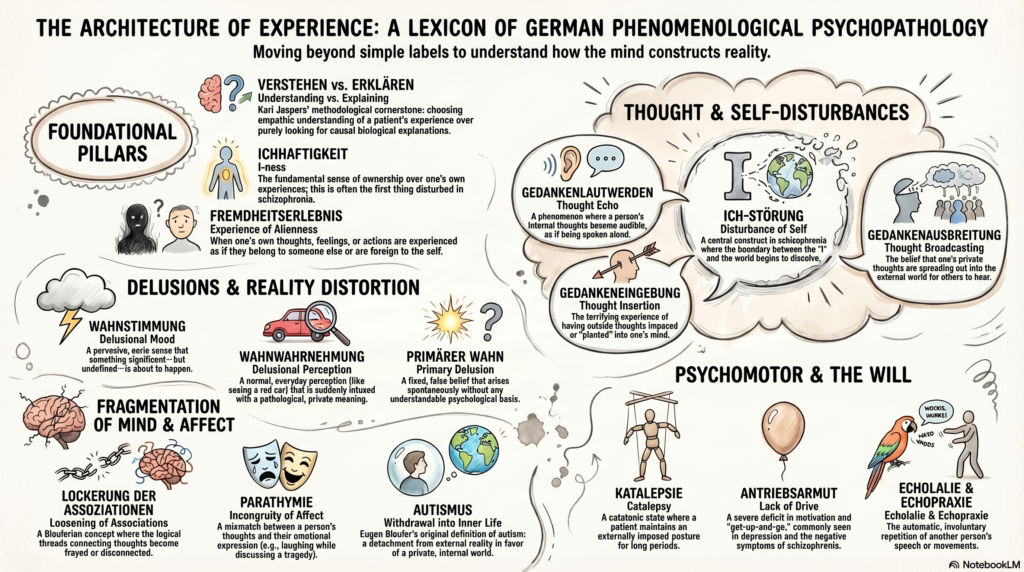 (An Excerpt from the Upcoming “Digital Handbook of Psychiatry”)
The language of psychiatry, as we use it today, is deeply indebted to the German phenomenological tradition of the late 19th and early 20th centuries. This tradition, shaped by meticulous clinical observation and philosophical rigor, sought not merely to label disorders but to understand the structure of subjective experience.
Pioneers such as Karl Jaspers (1913), Eugen Bleuler (1911), Kurt Schneider (1939), and Karl Ludwig Kahlbaum (1874) developed a vocabulary that continues to shape modern psychopathology.
What makes these terms enduring is their precision:
they describe not just symptoms, but how experience itself is altered.
🧠 I. Foundational Concepts of Self and Consciousness
Ichhaftigkeit (ikh-haf-tig-kite)
Sense of “I-ness” or ownership of experience.
➡️ Disturbed in schizophrenia, especially in passivity phenomena.
Lineage: Jaspers (1913), later expanded by contemporary phenomenologists.
Bewusstsein (beh-VOOST-zine)
Consciousness—encompassing awareness, clarity, and responsiveness.
Usage: Classical descriptive psychiatry.
Selbstbewusstsein (zelbst-beh-VOOST-zine)
Self-awareness—the capacity to experience oneself as a distinct subject.
Fremdheitserlebnis (fremt-hite-ser-LEB-nis)
Experience of alienness.
➡️ Thoughts, feelings, or actions are experienced as not one’s own.
Lineage: Bleuler (1911), Jaspers (1913)
Verstehen vs. Erklären (fer-SHTEH-en vs. air-KLAIR-en)
Empathic understanding vs. causal explanation.
➡️ A methodological cornerstone of psychiatry.
Author: Jaspers (1913)
🧠 II. Thought and Self-Disturbances
Gedankenlautwerden (geh-DAN-ken-lout-VAIR-den)
Thought echo—thoughts becoming audible.
Author: Schneider (1939)
Gedankenentzug (geh-DAN-ken-ent-TSOOG)
Thought withdrawal—thoughts being taken away.
Author: Schneider (1939)
Gedankeneingebung (geh-DAN-ken-EYE-n-geh-boong)
Thought insertion—thoughts imposed from outside.
Author: Schneider (1939)
Gedankenausbreitung (geh-DAN-ken-OWS-bry-tung)
Thought broadcasting—thoughts spreading into the external world.
Author: Schneider (1939)
Ich-Störung (ikh SHTUR-oong)
Disturbance of the self.
➡️ A central construct in schizophrenia.
Lineage: Jaspers (1913), Schneider (1939)
🧠 III. Delusions and Reality Distortion
Wahn (vahn)
Delusion—a fixed, false belief held with conviction.
Refined by: Jaspers (1913)
Primärer Wahn (pree-MAIR-er vahn)
Primary delusion—arising without understandable psychological basis.
Author: Jaspers (1913)
Wahnwahrnehmung (VAHN-vahr-NAY-moong)
Delusional perception—a normal perception with immediate pathological meaning.
Author: Schneider (1939)
Wahneinfall (VAHN-eye-n-fall)
Sudden delusional idea.
Author: Jaspers (1913)
Wahnstimmung (VAHN-shtim-moong)
Delusional mood—a pervasive sense that something significant is about to happen.
Author: Jaspers (1913)
🧠 IV. Formal Thought Disorder
Lockerung der Assoziationen (LOK-er-oong der ah-so-tsee-ah-TSEE-o-nen)
Loosening of associations.
Author: Bleuler (1911)
Gedankenabreißen (geh-DAN-ken-ab-RY-sen)
Thought blocking—sudden interruption of thought.
Author: Bleuler (1911)
Inkohärenz (in-ko-heh-RENTS)
Incoherence—severely disorganized thinking.
Author: Bleuler (1911)
Zerfahrenheit (tser-FAH-ren-hite)
Derailment or fragmentation of thought.
Author: Bleuler (1911)
🧠 V. Affect and Emotional Experience
Affektverflachung (ah-FEKT-fer-FLA-khoong)
Blunted affect.
Author: Bleuler (1911)
Affektlabilität (ah-FEKT-la-bee-lee-TAIT)
Affective lability—rapid emotional shifts.
Parathymie (pa-ra-THOO-mee)
Incongruity between affect and thought.
Author: Bleuler (1911)
Ambivalenz (am-bee-va-LENTS)
Coexistence of opposing emotions.
Author: Bleuler (1911)
Angst (ahngst)
Anxiety with existential depth.
Philosophical lineage: Kierkegaard; adopted into psychiatry.
🧠 VI. Will, Drive, and Motivation
Antrieb (AN-treeb)
Drive or motivation.
Antriebsarmut (AN-treebs-ar-moot)
Lack of drive—seen in depression and negative symptoms.
Willenshandlung (VIL-ens-hand-loong)
Act of will—the translation of intention into action.
Willensfreiheit (VIL-ens-fry-hite)
Freedom of will—disturbed in passivity phenomena.
🧠 VII. Catatonia and Psychomotor Phenomena
Katatonie (ka-ta-TOH-nee)
Catatonia.
Author: Kahlbaum (1874)
Negativismus (neh-ga-TEE-vis-moos)
Negativism—opposition or lack of response.
Author: Kahlbaum (1874)
Katalepsie (ka-ta-LEP-see)
Catalepsy—maintenance of imposed posture.
Author: Kahlbaum (1874)
Echolalie (ek-oh-la-LEE)
Echolalia—repetition of speech.
Author: Kahlbaum (1874)
Echopraxie (ek-oh-prak-SEE)
Echopraxia—imitation of movements.
Author: Kahlbaum (1874)
🧠 VIII. Schizophrenia and Personality Concepts
Spaltung (SHPAL-toong)
Splitting of psychic functions.
Author: Bleuler (1911)
Autismus (OW-toos-moos)
Withdrawal into inner life (original meaning).
Author: Bleuler (1911)
Schizophrenie (SHIT-so-freh-NEE)
Schizophrenia.
Author: Bleuler (1911)
🧠 IX. Insight and Reality Testing
Krankheitseinsicht (KRANK-hite-EYE-n-zikht)
Insight into illness.
Realitätsprüfung (reh-ah-li-TAYTS-proo-foong)
Reality testing.
🧩 Closing Reflection
The enduring value of these German terms lies in their ability to articulate something that modern psychiatric language often struggles to capture:
The structure of lived experience.
They remind us that psychiatry is not merely about diagnosis, but about understanding how the mind constructs—and sometimes loses—its sense of reality, self, and meaning.
📘 About the Author
Dr. Srinivas Rajkumar T, MD (AIIMS), DNB, MBA (BITS Pilani)
Consultant Psychiatrist & Neurofeedback Specialist
Mind & Memory Clinic, Apollo Clinic Velachery (Opp. Phoenix Mall)
✉ srinivasaiims@gmail.com 📞 +91-8595155808