Phase-Oriented Treatment of Dissociation
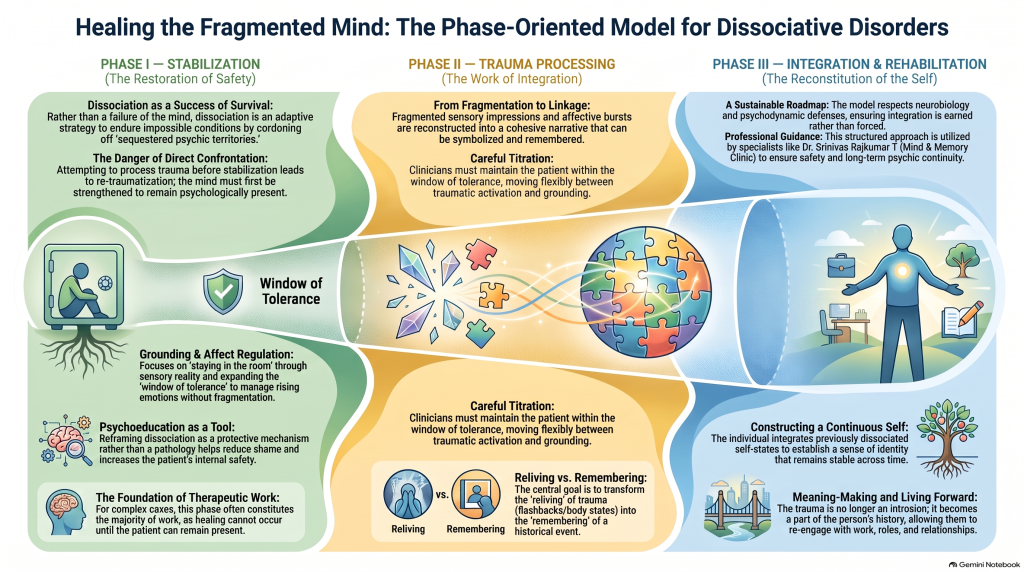 The treatment of dissociative disorders demands a fundamental shift in clinical attitude. One is not merely addressing a symptom, but engaging with a mind that has adapted to overwhelming experience by fragmenting its own continuity. Any attempt to directly confront trauma without first understanding this adaptive structure risks not only failure, but harm.
It is within this context that the phase-oriented model of treatment, most clearly articulated by Judith Herman, has emerged as the gold standard. This model does not treat dissociation as an isolated phenomenon, but as part of a dynamic system involving neurobiology, affect regulation, memory processing, and identity organization. It recognizes that healing cannot occur in a single step, but must unfold in sequential, interdependent phases, each with its own goals, techniques, and risks.
🟢 Phase I: Stabilization — The Restoration of Safety
The first phase begins not with the trauma, but with the patient’s capacity to remain present.
Dissociation reflects, at its core, a failure of the mind to contain and regulate internal experience. When affect exceeds tolerance, the system defaults to disconnection—from the body, from memory, from the sense of self. In such a state, the individual cannot process trauma because they cannot remain psychologically available to experience it.
Thus, the initial task is deceptively simple, yet profoundly complex:
👉 to help the patient stay in the room, both literally and psychologically.
This involves establishing external safety—ensuring that the patient is not currently exposed to ongoing trauma or destabilizing environments—but more importantly, internal safety. The patient must develop the capacity to recognize the early signs of dissociation, to ground themselves in the present, and to regulate rising affect without resorting to fragmentation.
Clinical work in this phase is often skill-based:
- Grounding techniques re-anchor the patient in sensory reality
- Affect regulation strategies expand the window of tolerance
- Psychoeducation reframes dissociation as protective rather than pathological
Yet beneath these techniques lies a deeper process. The therapist offers a regulating presence, a mind that can hold what the patient’s mind cannot yet hold. Over time, this facilitates the gradual internalization of regulatory capacity.
There is a temptation, particularly among less experienced clinicians, to move quickly toward trauma processing. This is a critical error. Without stabilization, exposure to traumatic material leads not to integration, but to re-traumatization or further dissociation.
Phase I, therefore, is not preparatory—it is foundational. In many patients, especially those with complex dissociation, it may constitute the majority of therapeutic work.
🟡 Phase II: Trauma Processing — The Work of Integration
Only when the patient demonstrates sufficient stability does the therapy move toward the second phase: the processing of traumatic experience.
Dissociated material is not absent; it is unintegrated. It exists in fragmented forms—sensory impressions, affective bursts, bodily states—without narrative cohesion. The task of Phase II is to transform this material into something that can be remembered, thought about, and symbolized.
This is not simply recollection. It is reconstruction.
Trauma processing requires careful titration. The clinician must maintain the patient within the window of tolerance—a zone in which affect is sufficiently activated to allow processing, but not so intense as to trigger dissociation. This requires constant monitoring and flexibility, often moving back and forth between activation and grounding.
Multiple therapeutic modalities may be employed:
- Trauma-focused cognitive approaches help restructure maladaptive beliefs
- EMDR facilitates adaptive reprocessing of traumatic memory networks
- Psychodynamic work links dissociated affect to meaning and personal history
In psychodynamic terms, this phase involves the gradual reclamation of what Salman Akhtar evocatively describes as “sequestered psychic territories.” These are regions of experience that have been cordoned off for survival, but at the cost of psychic continuity.
In patients with more complex dissociation, particularly those conceptualized within the framework of structural dissociation (as described by Onno van der Hart), therapy may involve working with distinct self-states or parts. These parts must not be confronted or eliminated, but rather recognized, engaged, and gradually brought into communication.
The central movement of Phase II is from:
- fragmentation → linkage
- sensation → symbolization
- reliving → remembering
🔵 Phase III: Integration and Rehabilitation — The Reconstitution of the Self
If Phase II is the work of integration, Phase III is the work of living with that integration.
By this stage, traumatic material has been sufficiently processed such that it no longer intrudes in dissociated form. However, the individual must now construct a coherent identity that can encompass these experiences.
This involves several interrelated tasks:
- Establishing a continuous sense of self across time
- Integrating previously dissociated self-states
- Developing stable interpersonal relationships
- Re-engaging with roles, work, and meaning
The trauma is no longer something that happens to the patient—it becomes something that has happened in their life. This distinction marks a profound psychological shift.
There is also a movement toward meaning-making. The patient begins to ask not only “What happened?” but “What does this mean for who I am?” and “How do I live forward?”
🔷 Why the Phase-Oriented Model Endures
The enduring value of this model lies in its alignment with multiple levels of understanding:
- Neurobiologically, it respects the limits of affect regulation and prevents overwhelming activation of stress systems
- Psychodynamically, it acknowledges dissociation as a defense that must be respected before it can be relinquished
- Clinically, it provides a structured yet flexible roadmap that prioritizes safety and sustainability
Above all, it recognizes that integration cannot be forced. It must be earned through the gradual expansion of the mind’s capacity to hold experience.
🌱 Closing Reflection
Dissociation is often misunderstood as a failure. Yet, from a therapeutic standpoint, it is better seen as a success of survival under impossible conditions.
The phase-oriented model honors this reality. It does not seek to dismantle dissociation abruptly, but to render it unnecessary by strengthening the very capacities that were once overwhelmed.
What was once split off returns, not as intrusion, but as part of a coherent, continuous self.
✍️ About the Author
Dr. Srinivas Rajkumar T, MD (AIIMS, New Delhi), DNB, MBA (BITS Pilani)
Consultant Psychiatrist & Neurofeedback Specialist
At the Mind & Memory Clinic, Apollo Clinic Velachery (Opp. Phoenix Mall), dissociative disorders are approached using structured phase-oriented trauma therapy, integrated with psychodynamic formulation and objective assessment tools where indicated.
✉ srinivasaiims@gmail.com 📞 +91-8595155808