Etifoxine: An Underutilized Anxiolytic Worth Revisiting?
 Anxiety disorders remain among the most common psychiatric conditions encountered in clinical practice. While benzodiazepines continue to be widely prescribed because of their rapid onset of action, concerns regarding sedation, cognitive impairment, falls, dependence, tolerance, and withdrawal have driven the search for safer alternatives.
One such alternative that periodically resurfaces in psychiatric discussions is Etifoxine, an anxiolytic that has been used in several countries for decades but remains relatively unfamiliar to many clinicians.
What is Etifoxine?
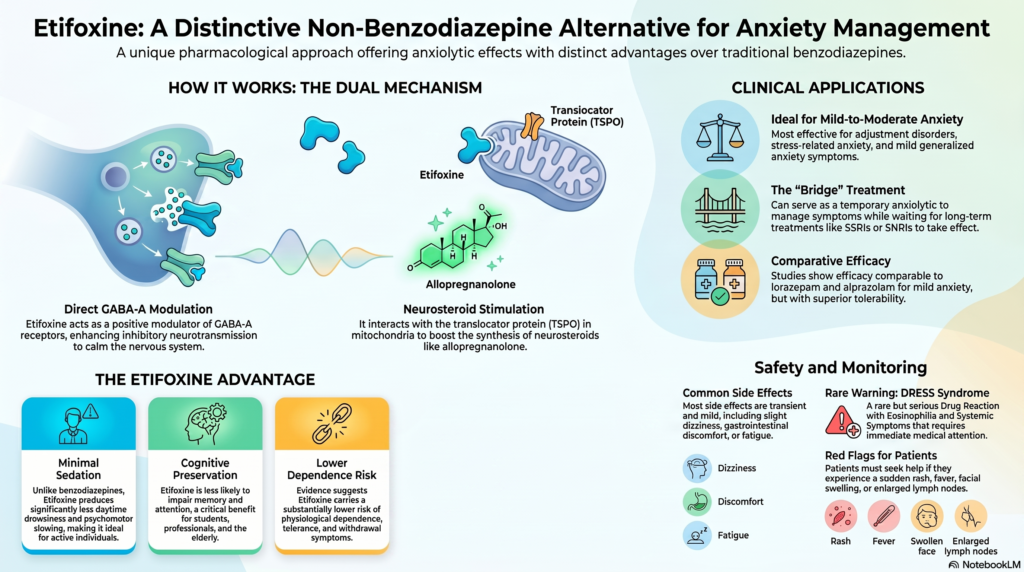
Etifoxine is a non-benzodiazepine anxiolytic developed in France. Unlike benzodiazepines, which act directly on the benzodiazepine site of the GABA-A receptor, etifoxine works through a dual mechanism:
- Direct positive modulation of GABA-A receptors
- Stimulation of neurosteroid synthesis, particularly allopregnanolone, through interaction with the translocator protein (TSPO) in mitochondria.
This unique mechanism enhances inhibitory neurotransmission while avoiding many of the drawbacks associated with benzodiazepines.
Why the Interest?
The primary attraction of etifoxine lies in its ability to reduce anxiety with:
- Less sedation
- Lower risk of cognitive impairment
- Minimal psychomotor slowing
- Absence of significant dependence liability
- Reduced withdrawal concerns
For working professionals, students, and older adults where sedation can be particularly problematic, these characteristics are appealing.
What Does the Evidence Show?
Several studies have compared etifoxine with benzodiazepines such as lorazepam and alprazolam.
The overall findings suggest:
- Superior to placebo in generalized anxiety symptoms.
- Comparable efficacy to some benzodiazepines in mild-to-moderate anxiety states.
- Better tolerability profile with less daytime drowsiness.
- Lower rates of treatment discontinuation due to sedation.
However, it is important to note that etifoxine has not accumulated the same volume of evidence as SSRIs, SNRIs, or benzodiazepines.
Current evidence supports its use primarily in:
- Adjustment disorders with anxiety
- Stress-related anxiety
- Mixed anxiety states
- Mild to moderate generalized anxiety symptoms
It is generally not considered a first-line treatment for severe anxiety disorders, panic disorder, obsessive-compulsive disorder, or anxiety associated with major depressive disorder.
Clinical Advantages
1. Minimal Sedation
Many patients discontinue benzodiazepines because they feel “slowed down” or mentally dull.
Etifoxine appears to produce less psychomotor impairment and daytime somnolence.
2. Lower Dependence Risk
One of the major limitations of benzodiazepines is physiological dependence.
Available evidence suggests etifoxine carries substantially lower abuse and dependence potential.
3. Better Cognitive Preservation
Particularly relevant in older adults and working professionals, etifoxine appears less likely to impair memory and attention compared to traditional benzodiazepines.
4. Useful Bridge Treatment
In selected patients, etifoxine may serve as a temporary anxiolytic while waiting for SSRIs or SNRIs to become effective.
Safety Profile
Overall, etifoxine is generally well tolerated.
Common adverse effects include:
- Mild drowsiness
- Dizziness
- Gastrointestinal discomfort
- Fatigue
Most are transient and self-limiting.
The Important Caveat: Rare Severe Skin Reactions
Although uncommon, clinicians should be aware of rare reports of:
- DRESS syndrome (Drug Reaction with Eosinophilia and Systemic Symptoms)
- Severe cutaneous adverse reactions
- Hepatic injury
DRESS is particularly important because it can be potentially life-threatening.
Patients should be educated to seek immediate medical attention if they develop:
- Rash
- Fever
- Facial swelling
- Enlarged lymph nodes
- Unexplained malaise
Fortunately, these reactions appear to be very rare in routine clinical practice.
Where Does Etifoxine Fit in Modern Psychiatry?
Etifoxine occupies an interesting niche.
It is unlikely to replace:
- SSRIs for long-term anxiety management
- Benzodiazepines for acute severe anxiety
- Evidence-based psychotherapies
However, it may be a reasonable option for:
- Mild to moderate anxiety
- Patients intolerant to benzodiazepines
- Individuals concerned about dependence
- Situations where sedation must be minimized
Practical Clinical Takeaway
Etifoxine is neither a miracle drug nor an obsolete curiosity.
It represents a pharmacologically distinct anxiolytic with a favorable balance between efficacy and tolerability in selected patients.
For psychiatrists seeking alternatives to benzodiazepines, particularly in mild-to-moderate anxiety states, etifoxine deserves consideration. The key is appropriate patient selection, counselling regarding rare but serious adverse reactions, and ongoing monitoring.
As with all anxiolytics, medication works best when combined with psychological interventions, lifestyle modifications, and treatment of underlying psychiatric conditions.
Dr. Srinivas Rajkumar T
MD (AIIMS, New Delhi), DNB, MBA (BITS Pilani)
Senior Consultant Psychiatrist
Apollo Clinic Velachery, Chennai(Opp. Phoenix Mall)
Email: srinivasaiims@gmail.com
Phone: +91-8595155808