Guanfacine vs Atomoxetine: Which Non-Stimulant Fits ADHD Better?
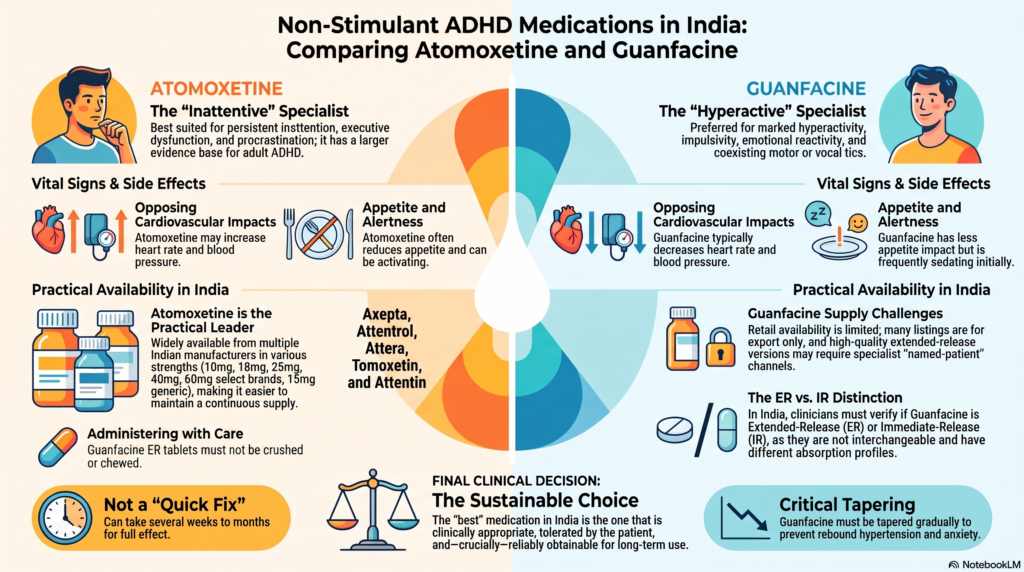 Stimulants such as methylphenidate are usually the most effective medicines for attention-deficit/hyperactivity disorder. However, some patients have an incomplete response, troublesome adverse effects, coexisting tics, sleep problems or concerns about stimulant misuse.
Atomoxetine and guanfacine are two non-stimulant options, but they suit different clinical profiles.
How do they work?
Atomoxetine
Atomoxetine is a selective norepinephrine reuptake inhibitor. It increases noradrenergic signalling in brain networks responsible for attention, planning, organisation and impulse control.
It is particularly useful when ADHD presents with:
- Persistent inattention
- Distractibility
- Procrastination
- Poor organisation
- Executive dysfunction
- A need for all-day symptom control
- Concern about stimulant misuse or diversion
Atomoxetine has a substantially larger evidence base for adult ADHD than guanfacine.
Guanfacine
Guanfacine is an alpha-2A adrenergic receptor agonist. It strengthens prefrontal regulation while reducing excessive sympathetic and behavioural arousal.
It may be particularly useful when ADHD includes:
- Marked hyperactivity
- Impulsivity
- Emotional reactivity
- Aggressive or oppositional behaviour
- Difficulty calming down
- Motor or vocal tics
- Stimulant-related insomnia
- Residual impulsivity despite stimulant treatment
Guanfacine may sometimes be added to a stimulant when attention has improved but behavioural overactivation remains.
The main differences
| Feature | Atomoxetine | Guanfacine |
|---|---|---|
| Best-established role | Inattentive and executive symptoms | Hyperactivity and impulsive dysregulation |
| Adult ADHD evidence | Better established | More limited |
| Alertness | Can be activating or sedating | Frequently sedating initially |
| Blood pressure | May increase | Usually decreases |
| Heart rate | May increase | May slow |
| Appetite | May reduce appetite | Usually less appetite suppression |
| Stimulant combination | Sometimes used clinically | Established adjunctive role in some countries |
| Sudden discontinuation | Usually no major rebound syndrome | Must be tapered to prevent rebound hypertension |
These are clinical tendencies rather than rigid rules. Either medicine can improve the overall symptoms of ADHD.
Which works faster?
Neither acts as rapidly as methylphenidate.
Guanfacine may produce an early calming effect, but the dose must be increased gradually. Atomoxetine commonly requires several weeks before clear improvement becomes apparent, with further benefit sometimes developing over two to three months.
A medication should not be declared ineffective before:
- An adequate dose has been reached
- Sufficient time has been allowed
- Adherence has been confirmed
- Functional outcomes have been assessed
Atomoxetine formulations available in India
Atomoxetine is widely prescribed in India and is available from several Indian manufacturers.
Common Indian brands currently listed include:
- Axepta
- Attentrol
- Attera
- Tomoxetin
- Attentin
- Other generic atomoxetine products
Commonly listed strengths include 10 mg, 18 mg, 25 mg and 40 mg. Some brands, including Axepta, are also listed in 60 mg strength. Depending on the manufacturer, atomoxetine may be supplied as a tablet or capsule. Some brands also market less standard strengths, such as 15 mg.
Availability varies between cities, pharmacies and manufacturers. A particular brand or strength may be temporarily unavailable even when it remains listed in Indian medicine databases.
For adults, the usual target dose is approximately 80 mg daily, with a labelled maximum of 100 mg daily. In India, reaching 80–100 mg may therefore require combinations of the locally available strengths rather than a single 80 mg or 100 mg unit.
Atomoxetine capsules should generally be swallowed whole. They should not be opened because the contents may irritate the eyes.
Guanfacine formulations and availability in India
The formulation distinction is especially important with guanfacine.
Immediate-release guanfacine
Immediate-release guanfacine was originally developed as an antihypertensive medicine. Although it has sometimes been used off-label in ADHD internationally, the strongest ADHD evidence relates to the extended-release formulation.
Extended-release guanfacine
Extended-release guanfacine is specifically designed to provide sustained delivery throughout the day. Internationally, it is commonly available in 1 mg, 2 mg, 3 mg and 4 mg extended-release tablets.
In India, guanfacine is currently much less readily available through ordinary retail pharmacies than atomoxetine. Indian manufacturers advertise extended-release guanfacine in 1–4 mg strengths, but some of these products are primarily manufacturing or export listings rather than evidence of dependable retail availability across India.
Imported Intuniv XR 2 mg is also listed by an Indian specialist pharmaceutical supplier through enquiry or named-patient supply channels, with the listed product originating from Canada. This is different from routine availability at a neighbourhood pharmacy.
Therefore, before prescribing guanfacine in India, the clinician should confirm:
- Whether the product is immediate-release or extended-release
- Whether it is legally and reliably obtainable
- The exact strength and manufacturer
- Continuity of future supply
- Whether the product has been sourced through a licensed pharmacy or authorised importer
A manufacturer’s online product page does not automatically establish routine Indian retail marketing or approval for every claimed indication.
Immediate-release and extended-release guanfacine are not interchangeable
The two formulations have different absorption profiles.
They should not be substituted milligram-for-milligram.
Extended-release tablets must be swallowed whole and should not be crushed, chewed or divided. Changing between formulations requires fresh titration and monitoring.
This practical issue makes atomoxetine considerably easier to prescribe and continue in India at present.
Side effects of atomoxetine
Common adverse effects include:
- Nausea or abdominal discomfort
- Reduced appetite
- Dry mouth
- Headache
- Sleepiness or insomnia
- Increased sweating
- Increased pulse or blood pressure
- Urinary hesitation
- Sexual adverse effects in some adults
Atomoxetine requires caution with strong CYP2D6 inhibitors such as fluoxetine, paroxetine and bupropion. Blood pressure, pulse, appetite, weight and mood should be monitored.
Side effects of guanfacine
Common adverse effects include:
- Sleepiness
- Fatigue
- Dizziness
- Low blood pressure
- Slower heart rate
- Headache
- Dry mouth
- Constipation
Sedation should not be mistaken for successful ADHD treatment. The goal is better regulation without making the patient excessively quiet, tired or emotionally flattened.
Blood pressure and pulse should be monitored before treatment and after dose increases.
Guanfacine must not be stopped suddenly
Abrupt discontinuation can produce:
- Rebound hypertension
- Increased pulse
- Headache
- Anxiety or agitation
It should therefore be tapered gradually under medical supervision.
This is an important contrast with atomoxetine, which does not generally produce the same rebound hypertensive syndrome.
Which medicine makes more sense in India?
Atomoxetine may be preferred when:
- The patient is an adult
- Inattention and executive dysfunction predominate
- A consistently available Indian formulation is required
- Sedation or low blood pressure would be problematic
- Long-term continuity of supply is important
Guanfacine may be considered when:
- Hyperactivity and impulsivity are prominent
- Emotional and behavioural overactivation dominate
- Tics coexist with ADHD
- Stimulants improve attention but not impulsivity
- Stimulant-associated insomnia or appetite loss is problematic
- Reliable access to an appropriate extended-release product has been confirmed
The practical conclusion
Atomoxetine is currently the more practical non-stimulant ADHD medication in India, particularly for adults, because it is available from multiple Indian manufacturers in several strengths.
Guanfacine may offer a better symptom fit for hyperactivity, impulsivity, tics and emotional dysregulation, but access to an appropriate extended-release formulation remains less straightforward in India.
The choice should not be based solely on which medicine is theoretically better. It should reflect:
- The dominant ADHD symptoms
- Age
- Blood pressure and pulse
- Sleep and appetite
- Coexisting psychiatric or developmental conditions
- Previous medication response
- Reliable access to the correct formulation
The best non-stimulant is the one that is clinically appropriate, tolerated, available and sustainable.
About the Author
Dr. Srinivas Rajkumar T
MD Psychiatry (AIIMS New Delhi)
Senior Consultant Psychiatrist
Mind & Memory Clinic, Apollo Clinic Velachery, Chennai
Opposite Phoenix Marketcity
Email: srinivasaiims@gmail.com
Phone: +91-8595155808
This article is intended for educational purposes. Medication should be started, adjusted or discontinued only under the supervision of a qualified medical professional. Brand names and availability may change over time and vary between locations.