Diagnostic Psychometry in Psychiatry: Structured psychological assessments
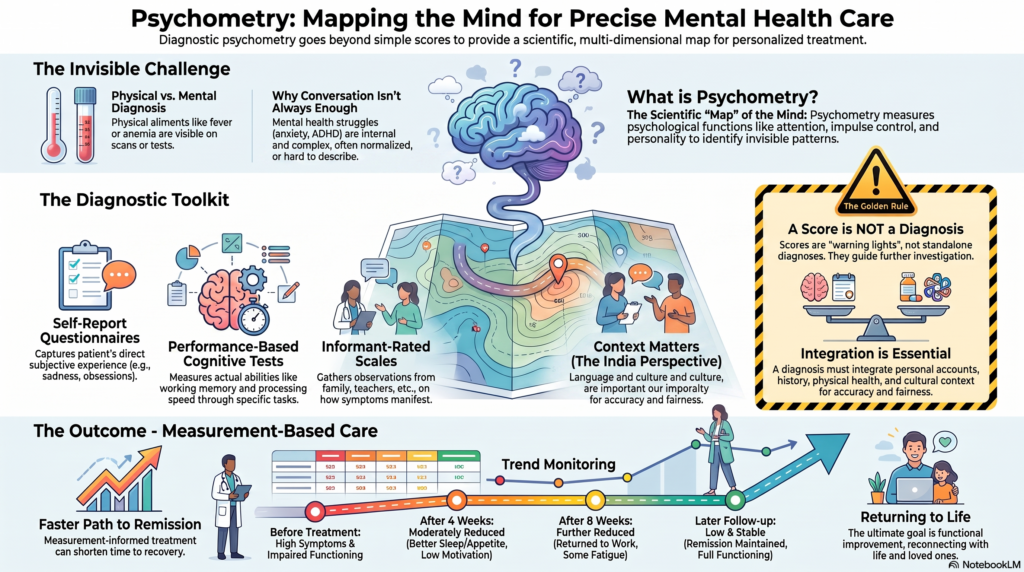 When a person visits a physician with fever, the doctor can check the temperature. For diabetes, there is a blood-glucose value. For anaemia, there is haemoglobin. For a fracture, there is an X-ray.
Psychiatric difficulties are different.
Depression cannot be weighed on a scale. Anxiety cannot be seen on an ordinary scan. Attention cannot be understood from a single blood test. Memory complaints cannot be evaluated merely by asking, “Are you forgetful?”
Yet these problems are real, measurable and often treatable.
This is where diagnostic psychometry becomes valuable.
Psychometry is the scientific measurement of psychological functions such as mood, anxiety, attention, memory, personality, behaviour, impulse control, executive functioning and day-to-day disability. It uses carefully developed questionnaires, structured interviews and performance-based tasks to convert complex human experiences into organised clinical information.
The purpose is not to reduce a person to a number.
The purpose is to ensure that important symptoms are not missed, vague complaints are clarified and treatment is planned more precisely.
What does “diagnostic psychometry” actually mean?
The term can sound technical, but the basic idea is simple.
Suppose someone says:
“I cannot concentrate anymore.”
That one statement could indicate many different possibilities:
- ADHD
- Depression
- Anxiety
- Sleep deprivation
- Burnout
- Obsessive thinking
- Trauma
- Substance use
- Medication effects
- Thyroid or other medical problems
- Early cognitive impairment
- Ordinary distraction caused by an overloaded lifestyle
A diagnostic interview helps the psychiatrist understand the story.
Psychometric assessment adds structure by asking:
- Which aspects of attention are affected?
- How severe is the difficulty?
- Did it begin in childhood or recently?
- Is it present across settings?
- Does another person notice it?
- Is memory also impaired?
- Is the problem stable, or does it vary with mood and sleep?
- How much does it affect work, education and relationships?
- Does performance on a structured task support the complaint?
Psychometry therefore does not replace the psychiatric consultation. It deepens and organises it.
Professional standards for psychological testing emphasise that tests must be selected and interpreted according to their intended purpose, supporting evidence, reliability, validity, fairness and the characteristics of the person being assessed.
A psychometric score is not the diagnosis
This is the single most important point.
A high depression score does not automatically prove major depressive disorder.
A positive ADHD screening result does not automatically establish ADHD.
A low memory-test score does not automatically mean dementia.
A personality questionnaire cannot, by itself, define someone’s personality or relationships.
Psychometric instruments answer a narrower question:
“How strongly does this person’s current pattern resemble the pattern measured by this test?”
The final diagnosis requires the psychiatrist to integrate:
- The person’s own account
- Symptom chronology
- Developmental history
- Functional impairment
- Physical and neurological health
- Medication and substance use
- Family observations
- Mental-status examination
- Psychometric findings
- Relevant medical investigations
- Alternative explanations
The American Psychiatric Association describes its cross-cutting symptom measures as aids that draw attention to clinically important domains and identify areas requiring further enquiry—not as substitutes for a comprehensive assessment.
Think of psychometry as a good map.
A map can show you the terrain, the possible routes and areas of concern. But a trained clinician must still understand where the person is standing and which route is appropriate.
Why ordinary conversation may not always be enough
A good psychiatric interview remains the foundation of diagnosis. However, even a detailed conversation has limitations.
1. People may struggle to describe internal experiences
A patient may say:
“My mind is not working.”
But this might mean:
- Slow thinking
- Forgetfulness
- Distractibility
- Mental fatigue
- Loss of motivation
- Intrusive thoughts
- Dissociation
- Poor sleep
- Emotional overload
A structured assessment separates these experiences.
2. Symptoms may have become normalised
Someone who has felt anxious for ten years may say:
“This is just my nature.”
An adult with lifelong ADHD may believe that chronic lateness, unfinished tasks and disorganisation are merely personal failures.
A family caring for someone with early cognitive decline may gradually adjust to the changes and fail to recognise how much functioning has deteriorated.
Psychometry helps make the invisible pattern more visible.
3. Memory is influenced by the present state
When depressed, people may remember their entire life more negatively.
During a period of elevated mood, a person may underestimate difficulties and overestimate functioning.
Parents and spouses may also remember events selectively.
Structured questions reduce, although they cannot completely eliminate, these biases.
4. Some important symptoms may not be mentioned spontaneously
A person may seek help for insomnia but not recognise associated anxiety, compulsive behaviour, hypomanic symptoms, trauma or substance use.
Broad symptom measures can alert the psychiatrist to areas that require further discussion. APA’s adult cross-cutting measure, for example, samples multiple domains rather than focusing on only one diagnosis.
What can psychometry help us understand?
1. Screening: Is further assessment required?
Screening tools are designed to identify people who may have a clinically significant problem.
Examples include brief questionnaires for:
- Depression
- Anxiety
- ADHD
- Alcohol use
- Obsessive-compulsive symptoms
- Trauma symptoms
- Cognitive concerns
- Sleep problems
A screening result is similar to a warning light on a vehicle dashboard.
It tells us to investigate. It does not tell us exactly what component has failed.
For example, the PHQ-9 was developed as a brief measure of depressive symptoms and severity. It can provide useful information, but its result must still be interpreted in relation to clinical history, functional impairment, bipolar symptoms, grief, medical illness and suicide risk.
The GAD-7 similarly provides an organised measure of anxiety severity, but anxiety scores can rise in several psychiatric and medical conditions.
2. Diagnostic clarification: Which explanation fits best?
Psychometry becomes especially useful when symptoms overlap.
Consider poor concentration.
A careful assessment may reveal different patterns:
In ADHD
- Difficulties began during childhood
- Problems occur across multiple settings
- There is disorganisation, procrastination or impulsivity
- Functioning improves temporarily with urgency, novelty or intense interest
- Similar difficulties may be reported by parents, teachers or a spouse
The Adult ADHD Self-Report Scale was developed as a screening measure and has been studied against clinician ratings, but it remains only one component of a comprehensive ADHD assessment.
In depression
- Concentration declined after mood symptoms began
- Thinking feels slow
- Motivation is reduced
- The person may be preoccupied with guilt, hopelessness or negative thoughts
In anxiety
- Attention is captured by worry
- The person repeatedly checks for danger or mistakes
- Concentration improves when anxiety reduces
In obsessive-compulsive disorder
- Mental energy may be consumed by intrusive thoughts and internal rituals
In sleep deprivation
- Attention and processing speed may fluctuate with fatigue
In cognitive disorders
- Memory, language, orientation or executive functioning may also be affected
The score does not make this distinction by itself. The pattern across history, tests and real-life functioning does.
3. Severity: How serious is the problem?
A diagnosis alone does not tell us how much someone is suffering.
Two people may both meet criteria for depression.
One is distressed but still working.
The other is unable to get out of bed, has stopped eating and is having persistent suicidal thoughts.
Both have depression, but their treatment urgency and intensity differ.
Psychometric scales help quantify symptom burden in a consistent way. They may classify symptoms broadly as minimal, mild, moderate or severe, although the meaning of each range must be interpreted clinically.
Severity measurement can guide decisions about:
- Frequency of follow-up
- Need for medication
- Need for psychotherapy
- Requirement for family supervision
- Workplace or academic accommodations
- Safety planning
- Whether hospital care should be considered
A number must never be allowed to override urgent clinical information. A person with a modest total score may still report a serious suicidal plan, psychosis or dangerous impulsivity requiring immediate attention.
4. Functional assessment: How is life being affected?
Symptoms and disability are not always proportional.
A person may have prominent anxiety but continue functioning through extraordinary effort.
Another may report only moderate symptoms but experience major impairment because their occupation requires sustained concentration, emotional regulation or rapid decision-making.
Psychometry can assess areas such as:
- Work performance
- Academic functioning
- Organisation
- Time management
- Relationships
- Parenting
- Social participation
- Self-care
- Financial management
- Driving
- Household responsibilities
- Quality of life
This distinction matters because successful treatment should not merely reduce a questionnaire score.
It should help the person return to life.
A patient with panic disorder may still feel some anxiety but become able to travel alone.
A person with ADHD may still be distractible but start completing assignments on time.
A patient with depression may move from “feeling slightly better” to returning to work, exercising and reconnecting with family.
Those functional changes are often more meaningful than the number alone.
5. Treatment monitoring: Is the treatment actually working?
Human memory is not an ideal monitoring instrument.
At follow-up, a person may say:
“I think I am somewhat better.”
But how much better?
Which symptoms improved?
What remains unchanged?
Did sleep improve while motivation remained poor?
Did anxiety reduce but emotional numbness increase?
Repeated psychometric assessments can create a clinical trend.
For example:
| Stage | Depression score | Interpretation alongside consultation |
|---|---|---|
| Before treatment | High | Marked symptoms and impaired functioning |
| After four weeks | Moderately reduced | Sleep and appetite better; motivation still poor |
| After eight weeks | Further reduced | Returned to work; residual fatigue remains |
| Later follow-up | Low and stable | Remission maintained with improved functioning |
The trend is usually more informative than any single score.
This approach is often called measurement-based care: symptoms, adverse effects and functioning are assessed systematically, and treatment is adjusted when improvement is insufficient. Randomised trials in depression have found that measurement-informed treatment can shorten the time to response and remission compared with ordinary care in some settings.
Psychometry therefore helps answer an essential question:
“Are we continuing this treatment because it is familiar, or because we can demonstrate that it is helping?”
The major types of psychometric assessment
1. Self-report questionnaires
The patient answers questions about their own experiences.
These are useful because the patient has direct access to internal symptoms such as sadness, anxiety, guilt, obsessions or loss of pleasure.
Examples include measures of:
- Depression
- Anxiety
- ADHD symptoms
- Trauma
- Sleep
- Quality of life
- Functional impairment
- Medication side effects
Strengths
- Efficient
- Structured
- Easy to repeat
- Captures subjective experience
- Helps patients describe difficult symptoms
Limitations
The result may be affected by:
- Current mood
- Interpretation of questions
- Desire to appear well
- Desire to emphasise distress
- Limited self-awareness
- Language difficulties
- Fear of stigma
- Misunderstanding of terms
A self-report measure is valuable, but it is not automatically objective merely because it produces a number.
2. Informant-rated scales
A parent, spouse, teacher, caregiver or another person who knows the patient well provides information.
These are particularly helpful in:
- Childhood ADHD
- Autism assessments
- Dementia
- Mania
- Psychosis
- Substance use
- Conditions where insight may be limited
For a child, the parent may describe behaviour at home while the teacher describes functioning at school.
For an older adult, the patient may report normal memory while the family notices repeated questions, financial errors or getting lost.
For an adult with ADHD, a spouse may observe unfinished tasks and forgetfulness that the patient has normalised.
What happens when accounts differ?
Differences are common and clinically useful.
The patient may experience internal distress that the family cannot see.
The family may notice behavioural changes that the patient does not recognise.
A teenager may function differently at school and at home.
Disagreement does not necessarily mean that someone is lying.
It may reveal that the problem is situation-specific, concealed, compensated for or interpreted differently by different observers.
The clinician’s task is to understand the discrepancy—not simply choose one side.
3. Clinician-rated scales
These are completed by a trained professional after interviewing and observing the patient.
They may assess:
- Depression
- Mania
- Psychosis
- Anxiety
- Movement-related side effects
- Overall illness severity
- Level of functioning
Clinician ratings can incorporate context and clinical judgement. However, they also require training and consistent administration.
A scale used casually or scored differently by different clinicians loses much of its value.
4. Performance-based cognitive tests
These require the patient to perform specific tasks rather than describe symptoms.
They may examine:
- Attention
- Working memory
- Processing speed
- Learning
- Delayed recall
- Language
- Executive functioning
- Visuospatial skills
- Response inhibition
- Cognitive flexibility
For example, a patient may be asked to remember information, sustain attention, switch between rules or complete tasks within a time limit.
The Montreal Cognitive Assessment was developed as a brief cognitive screening tool for mild cognitive impairment, but its score must be interpreted in the context of education, language, sensory limitations, mood, effort and daily functioning.
A low score may occur because of:
- Dementia
- Depression
- Poor sleep
- Anxiety during testing
- Language mismatch
- Limited formal education
- Hearing or visual impairment
- Medication effects
- Acute illness
- Fatigue
- Low effort
A normal brief screening score also does not rule out every subtle cognitive difficulty.
5. Computerised attention and executive-function tests
Computerised tasks can measure:
- Reaction time
- Missed targets
- Impulsive responses
- Variability in performance
- Sustained attention
- Inhibitory control
They may provide useful information in selected ADHD or neurocognitive assessments.
However, poor performance is not specific to ADHD. Anxiety, sleep deprivation, depression, medication effects, unfamiliarity with computers, low motivation and other neurological or psychiatric conditions can also affect results.
Conversely, a highly intelligent or motivated person with ADHD may perform adequately during a short, novel and closely supervised task while struggling substantially in ordinary life.
This is why a computerised attention test should support—not replace—the developmental history and evidence of real-world impairment.
6. Personality assessment
Personality assessments examine long-standing patterns in areas such as:
- Identity
- Emotional regulation
- Interpersonal relationships
- Impulsivity
- Self-esteem
- Trust
- Coping style
- Attachment
- Behaviour under stress
These assessments should not be used to place people into simplistic boxes.
A person is not merely “a narcissist,” “a borderline” or “an introvert” because of an online score.
A responsible personality assessment integrates:
- Developmental history
- Relationship patterns
- Behaviour over time
- Clinical interview
- Structured instruments
- Trauma and cultural context
- Current mood state
Depression, anxiety, acute relationship conflict and trauma can temporarily alter how someone answers personality questions. Therefore, interpretation must distinguish enduring traits from state-dependent reactions.
The goal is not labelling.
The goal is to understand which treatment relationship and therapeutic approach may be most helpful.
Understanding reliability and validity in simple language
A test can look scientific without actually being useful.
A polished report, colourful graph or computer-generated percentile does not guarantee accuracy.
Two basic questions must be asked.
Reliability: Does the instrument measure consistently?
Imagine a weighing machine that shows 70 kg, 82 kg and 65 kg within five minutes.
It is not reliable.
A psychological measure should produce reasonably consistent results when the underlying condition has not changed.
Reliability may include:
- Consistency among items
- Agreement between raters
- Stability across time
- Consistency across equivalent test versions
Reliability does not mean that the score must never change. A good clinical measure should change when the patient genuinely improves or deteriorates.
Validity: Does the score support the interpretation we are making?
A machine may consistently show the wrong weight.
It is reliable—but not valid.
Validity asks whether the available evidence supports using a test score for a particular purpose.
A questionnaire validated for screening university students may not automatically be suitable for diagnosing dementia in an older adult.
A tool developed in one language may not retain the same meaning after literal translation.
A scale validated in the general population may perform differently in a specialist addiction clinic.
A test can be valid for screening but insufficient for making a stand-alone diagnosis.
Modern testing standards treat validity as evidence supporting the intended interpretation and use of scores, rather than as a permanent label attached to the test itself.
Sensitivity and specificity: why cut-off scores are imperfect
Patients sometimes believe:
“My score crossed the cut-off, so I definitely have the disorder.”
A cut-off is not a biological boundary. It is a decision point chosen to balance two kinds of error.
Sensitivity
How well does the test identify people who genuinely have the condition?
A highly sensitive screening test misses fewer genuine cases, but it may flag some people who do not ultimately have the disorder.
Specificity
How well does the test identify people who do not have the condition?
A highly specific test produces fewer false alarms, but it may miss some genuine cases.
No psychiatric questionnaire has perfect sensitivity and specificity across every population.
The meaning of the result also depends on where it is used.
A positive ADHD screener among people attending a specialist ADHD clinic means something different from the same result obtained in a random online survey.
That is why cut-offs guide clinical thinking; they do not replace it.
Raw scores, percentiles and standard scores
Psychometric reports may contain several different types of numbers.
Raw score
The total number directly obtained from the answers or performance.
For example, a patient may score 18 on a questionnaire.
By itself, 18 means little unless we know the instrument and its interpretation.
Standard score
The raw score is converted into a common scale based on a reference population.
This helps compare performance across different tests.
Percentile
A percentile describes the person’s position relative to a comparison group.
The 25th percentile does not mean that the person answered 25% correctly.
It means the score was equal to or higher than that of approximately 25% of people in the relevant reference group.
Clinical range
Some measures group scores into categories such as:
- Average
- Below expected
- Mild
- Moderate
- Severe
- Clinically significant
These categories should be interpreted with caution. A one-point difference around a cut-off rarely represents a dramatic change in the person.
Why the reference population matters
Suppose a memory test compares a 70-year-old Tamil-speaking person with postgraduate education to a group of young English-speaking adults.
The comparison would be meaningless.
Psychometric interpretation must consider:
- Age
- Education
- Language
- Cultural background
- Urban or rural exposure
- Literacy
- Occupation
- Sensory impairment
- Familiarity with technology
- Socioeconomic context
This is particularly important in India, where educational opportunity, language proficiency and test familiarity vary widely.
A person may know an answer in Tamil but struggle to retrieve it in English.
Someone who never handled formal test sheets may be slower without having a cognitive disorder.
An older adult who managed a household and finances skilfully for decades may have limited schooling but excellent practical intelligence.
Testing standards emphasise fairness, accessibility and caution when instruments are used with people from different linguistic, cultural or disability backgrounds.
The test must adapt to the patient’s context—not demand that every patient fit the test.
State versus trait: is this temporary or long-standing?
One of the most valuable functions of psychometry is helping distinguish a state from a trait.
State
A temporary condition that may change with circumstances.
Examples:
- Current depression
- Acute anxiety
- Sleep deprivation
- Grief
- Medication effects
- Examination stress
Trait
A more enduring pattern.
Examples:
- Lifelong attentional difficulties
- Long-standing emotional regulation patterns
- Stable personality characteristics
- Persistent learning difficulties
This distinction is essential in adult ADHD evaluation.
A person may score highly on an ADHD questionnaire during severe depression or burnout. To diagnose a neurodevelopmental condition, the psychiatrist must look for childhood onset, persistence across life stages, impairment in multiple contexts and explanations other than the present crisis.
Similarly, personality assessment performed during an acute relationship breakdown may reflect temporary distress rather than the person’s usual way of functioning.
Why testing conditions matter
Psychometric assessment is not conducted in a vacuum.
Results can be influenced by:
- Poor sleep the previous night
- Hunger
- Pain
- Fever
- Alcohol or substance use
- Sedating medicines
- Severe anxiety
- Visual or hearing problems
- Language difficulty
- Fatigue
- Distraction
- Lack of motivation
- Fear of failure
- Excessive effort to appear normal
- Attempt to exaggerate impairment
Before interpreting the score, the clinician should ask whether the assessment provides a fair sample of the person’s usual functioning.
Sometimes the most responsible decision is to postpone or repeat part of the assessment.
Can someone intentionally manipulate a psychometric test?
It is possible to answer in a way that exaggerates or minimises symptoms.
However, most real-life cases are more complex than deliberate deception.
A person may under-report symptoms because of:
- Shame
- Fear of medication
- Fear of hospitalisation
- Concern about employment
- Family pressure
- Limited insight
- Desire to appear strong
A person may over-report because of:
- Severe distress
- Catastrophic interpretation
- Need to be taken seriously
- Misunderstanding of questions
- Current conflict
- Seeking documentation or accommodations
Some longer instruments contain consistency or response-style indicators, but these must also be interpreted carefully. An unusual profile does not automatically prove dishonesty.
Clinical judgement, behavioural observation, collateral history and consistency across sources remain essential.
Psychometry in common psychiatric conditions
Depression
Assessment may examine:
- Sadness
- Loss of interest
- Sleep
- Appetite
- Energy
- Guilt
- Concentration
- Psychomotor changes
- Thoughts of death
- Functional impairment
Repeated measurement can help distinguish partial response from remission and identify residual symptoms that increase relapse risk.
But bipolar disorder, grief, medical illness, substance use and medication effects must be considered before interpreting a depression score.
Anxiety disorders
Psychometry may clarify:
- Generalised worry
- Panic attacks
- Social anxiety
- Health anxiety
- Phobias
- Physical symptoms
- Avoidance
- Reassurance seeking
- Functional impact
The total anxiety score is useful, but the pattern of fear and avoidance determines the diagnosis and therapy plan.
Obsessive-compulsive disorder
Assessment can measure:
- Time occupied by obsessions
- Distress
- Interference
- Resistance
- Control
- Compulsions
- Avoidance
- Family accommodation
This helps distinguish ordinary preferences or habits from clinically significant OCD and provides a baseline for exposure and response-prevention treatment.
ADHD
A comprehensive evaluation may combine:
- Adult self-report
- Childhood history
- Parent or spouse observations
- School records when available
- Functional impairment scales
- Executive-function assessment
- Computerised attention testing in selected cases
- Screening for anxiety, depression, sleep disorders, substance use and learning difficulties
No single ADHD scale or computer task should be treated as definitive.
The most important question is not merely whether the person has some ADHD-like traits.
It is whether there is a persistent neurodevelopmental pattern producing meaningful impairment.
Bipolar disorder
Mood questionnaires may help detect:
- Elevated or irritable mood
- Increased activity
- Reduced need for sleep
- Rapid speech
- Racing thoughts
- Impulsivity
- Risk-taking
- Depressive symptoms
However, a positive “mood-swing” questionnaire does not establish bipolar disorder. Emotional reactivity, ADHD, trauma, personality patterns, substance use and ordinary fluctuations can produce superficially similar responses.
Chronology and episode structure are crucial.
Memory disorders and dementia
Psychometry may examine:
- Learning
- Delayed recall
- Recognition
- Attention
- Language
- Planning
- Visuospatial ability
- Orientation
- Daily functioning
The pattern may help differentiate:
- Normal ageing
- Mild cognitive impairment
- Dementia
- Depression-related cognitive difficulties
- Delirium
- Medication effects
- Neurological conditions
Brief screening is only the beginning. Diagnosis also requires functional history, medical evaluation, neurological examination and relevant investigations.
Child and adolescent assessments
Children behave differently in different environments.
Assessment may therefore include:
- Parent ratings
- Teacher ratings
- Child or adolescent self-report
- Developmental history
- Academic assessment
- Observation
- Attention or learning tests
- Emotional and behavioural scales
A child may appear settled in the clinic for thirty minutes but struggle during a six-hour school day.
Conversely, academic pressure, bullying, anxiety, sleep deprivation or an unsuitable learning environment can resemble ADHD.
The goal is to understand the child comprehensively, not merely generate a label for school documentation.
Psychometry, neuropsychology and brain-based tests are not identical
These terms are often mixed together.
Psychometry
Broadly refers to the scientific measurement of psychological characteristics using standardised instruments.
Neuropsychological assessment
Uses detailed cognitive testing to understand relationships between brain functioning and abilities such as attention, memory, language and executive control.
Computerised cognitive or attention testing
Measures performance on structured digital tasks.
qEEG
Measures electrical activity recorded from the scalp. It is a physiological assessment, not a psychometric questionnaire.
Brain imaging
Examines brain structure or function using techniques such as MRI, CT, PET or functional imaging.
These approaches may sometimes complement one another, but they answer different questions.
No brain map, questionnaire or computer test should be marketed as a magical stand-alone test that can diagnose every psychiatric condition.
Good assessment depends on convergence: several independent sources of information pointing towards the same clinical explanation.
What should a good psychometric report contain?
A useful report should not merely display a table of scores.
It should explain:
-
Why the assessment was requested
What clinical question are we trying to answer?
-
Which instruments were used
Why were those particular tools selected?
-
Behaviour during testing
Was the patient tired, anxious, distracted, cooperative or limited by language or sensory problems?
-
The pattern of results
Which areas were stronger and which were weaker?
-
Clinical interpretation
What do the findings suggest when combined with the history?
-
Limitations
What can the assessment not establish?
-
Real-world implications
How might the findings affect work, education, relationships or independent functioning?
-
Recommendations
What treatment, therapy, accommodations, rehabilitation or further investigations may help?
A high-quality report translates numbers back into the person’s life.
Instead of merely saying:
“Executive functioning is impaired.”
It should explain:
“The findings are consistent with difficulty holding several steps in mind, organising complex tasks and maintaining accuracy during repetitive work. This may contribute to missed deadlines, incomplete documentation and reliance on last-minute urgency.”
That is when psychometry becomes clinically meaningful.
What psychometry should never become
Diagnostic psychometry should not become:
- A conveyor belt of questionnaires
- A substitute for listening
- A way to impress patients with complex graphs
- An automatic diagnosis generated by software
- An expensive package given to everyone
- A method of labelling personality without context
- A report that ignores language, education and culture
- A tool for giving certainty where uncertainty remains
More testing is not automatically better testing.
Every assessment should answer a specific clinical question.
The correct question is not:
“How many tests can we administer?”
It is:
“Which assessment will meaningfully change our understanding or treatment plan?”
Why online mental-health quizzes are different
Online quizzes can sometimes encourage people to seek appropriate help.
But several problems arise when they are treated as diagnostic.
The user may not know:
- Whether the questionnaire is scientifically validated
- Whether it is being scored correctly
- Whether the cut-off applies to their population
- Whether another disorder produces similar symptoms
- Whether an urgent safety issue is present
- Whether the website is collecting sensitive data
- Whether the test is designed mainly to sell a service
A score obtained online can be brought to the consultation and discussed.
But it should not become a self-imposed life sentence.
“I scored highly on an autism quiz.”
“An app says I have severe ADHD.”
“A personality test says I am borderline.”
These results may indicate that further assessment is worthwhile. They do not constitute a final diagnosis.
What does the patient experience during an assessment?
Depending on the purpose, an assessment may take a few minutes or several sessions.
You may be asked to:
- Complete questionnaires
- Describe childhood and current functioning
- Perform attention or memory tasks
- Answer questions about relationships
- Bring previous reports or school records
- Allow a family member to provide observations
- Return for feedback after scoring and interpretation
You do not need to “perform well.”
This is not an examination of intelligence or character.
You should answer honestly rather than trying to guess the “correct” response.
Before beginning, tell the clinician about:
- Language preference
- Reading difficulty
- Hearing or visual impairment
- Poor sleep
- Pain or illness
- Medication taken that day
- Significant anxiety about testing
These details improve interpretation.
The most valuable part is the feedback session
Psychometric assessment should not end when the last questionnaire is scored.
The findings should be explained in understandable language.
A useful feedback discussion may include:
“Your difficulties are not due to lack of intelligence.”
“Your attention is adequate during short, engaging tasks but becomes inconsistent during prolonged repetitive work.”
“The memory pattern appears more related to poor attention and depression than to a primary storage problem.”
“You report significant ADHD symptoms, but we need more childhood evidence before confirming the diagnosis.”
“The anxiety score has reduced, but avoidance is still limiting your life.”
“The assessment suggests that treatment should focus not only on symptoms but also on planning, sleep and workplace structure.”
Good feedback replaces judgement with understanding.
For many patients, receiving a coherent explanation is itself therapeutic.
From diagnosis to personalised treatment
The real value of diagnostic psychometry lies in what happens next.
The findings may help guide:
- Choice of medication
- Type of psychotherapy
- ADHD coaching and organisational strategies
- Cognitive remediation
- Memory rehabilitation
- Family education
- School or workplace accommodations
- Sleep interventions
- Addiction treatment
- Exercise planning
- Follow-up frequency
- Safety planning
- Referral for neurological or medical assessment
Two people with the same diagnosis may receive different recommendations because their psychometric profiles, strengths and functional needs differ.
One person with ADHD may mainly need help with time blindness and procrastination.
Another may need treatment for impulsivity and emotional dysregulation.
A third may have prominent anxiety and sleep problems that must be addressed before medication decisions are made.
The diagnostic label opens the door.
The profile tells us where to go.
The person must remain larger than the report
It is important to remember that psychometry captures only part of a human being.
A score cannot fully measure:
- Courage
- Kindness
- Creativity
- Moral judgement
- Love
- Cultural identity
- Wisdom
- Personal meaning
- Resilience
- Future potential
Someone may score poorly on attention testing after years of struggle yet have developed remarkable creativity and crisis-management skills.
An older adult may perform below a numerical cut-off but retain meaningful relationships, practical wisdom and independence in familiar activities.
The assessment should help us recognise difficulties without erasing strengths.
That is why I prefer to begin the consultation by asking about the person:
“Tell me some good things about yourself.”
“What did you study?”
“What work have you done?”
“What are you proud of?”
Only after understanding the person should we begin measuring the problem.
In conclusion
Diagnostic psychometry brings scientific structure to experiences that are often difficult to describe.
Used properly, it can help us:
- Detect symptoms that may otherwise be missed
- Clarify overlapping conditions
- Quantify severity
- Understand real-world impairment
- Identify strengths and weaknesses
- Monitor treatment response
- Personalise recommendations
- Communicate findings clearly to patients and families
But psychometry is most useful when it remains part of a larger clinical process.
The questionnaire is not the consultation.
The score is not the diagnosis.
The computer printout is not the person.
The best psychiatric assessment combines careful listening, clinical expertise, standardised measurement, cultural understanding and collaborative treatment planning.
Numbers can make the invisible more visible.
Human understanding gives those numbers meaning.
About the Author
Dr. Srinivas Rajkumar T
MD Psychiatry — AIIMS, New Delhi
Senior Consultant Psychiatrist
Mind & Memory Clinic
Apollo Clinic, Velachery, Chennai
Opposite Phoenix Marketcity
At Mind & Memory Clinic, diagnostic assessment is selected according to the person’s concerns rather than offered as a fixed package. Clinical interviews may be complemented, when appropriate, by structured symptom measures, ADHD assessment, cognitive and memory evaluation, computerised attention testing, functional assessment and personalised treatment planning.
The objective is not merely to give a diagnostic label. It is to understand what the person is experiencing, why it is happening, how it affects everyday life and what can realistically help.