An Advanced Neurofeedback Paradigm: Integrating fNIRS, qEEG and Continuous Performance Testing
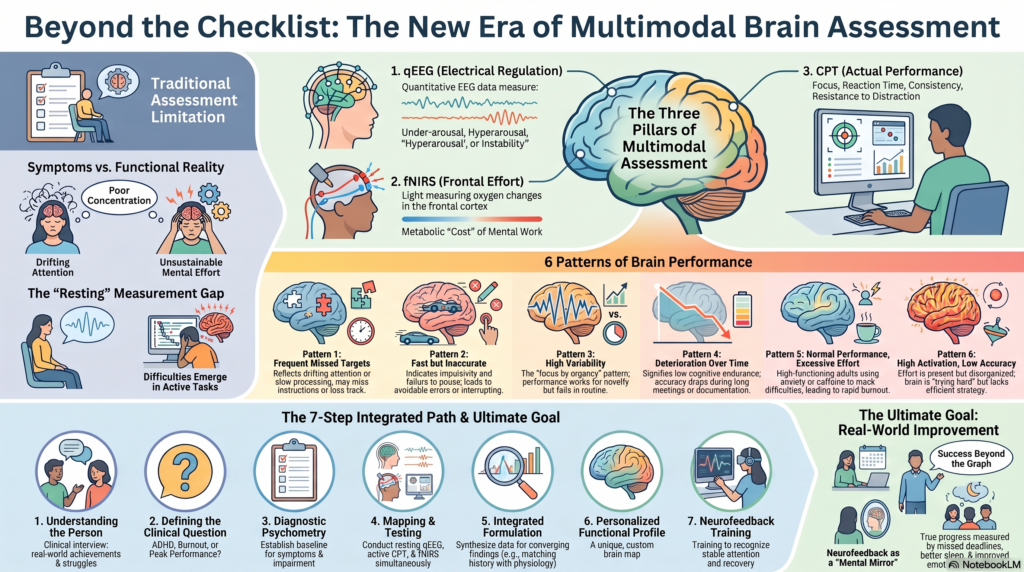 Moving beyond symptom checklists towards multimodal functional brain assessment, personalised neurofeedback and measurable real-world improvement
Mental healthcare has traditionally depended heavily on conversation.
A patient may report:
“I cannot concentrate.”
“My mind is always active.”
“I become mentally exhausted very quickly.”
“I can work only when there is urgency.”
“I understand everything, but I cannot complete anything.”
A careful psychiatric interview remains the foundation of diagnosis. It helps us understand when the difficulty began, what makes it better or worse, how it affects everyday life and whether it could arise from ADHD, anxiety, depression, poor sleep, burnout, substance use or another condition.
However, symptoms alone do not always reveal how the brain performs under cognitive demand.
Two people may both say that they cannot concentrate, yet their underlying functional patterns may be very different.
One may miss important information because attention drifts.
Another may respond too quickly and make impulsive errors.
A third may perform accurately but require enormous mental effort to do so.
A fourth may begin well but deteriorate as the task becomes repetitive.
A fifth may perform normally in a quiet clinic while struggling severely in a distracting classroom or office.
Modern neurofeedback therefore needs to move beyond one questionnaire, one brainwave ratio or one resting EEG recording.
A more advanced paradigm combines three complementary sources of information:
- qEEG, which analyses the brain’s electrical activity
- fNIRS, which estimates changes in frontal cortical oxygenation during mental effort
- Continuous Performance Testing, which measures attention, response control and consistency during a structured task
When integrated with diagnostic psychometry, developmental history and real-world functioning, these technologies can provide a richer picture of how a person’s brain regulates attention, effort, arousal and recovery.
Why conventional neurofeedback may be incomplete
Traditional neurofeedback often begins with a resting EEG assessment.
The patient sits quietly, usually with eyes open and eyes closed, while electrical activity is recorded. Selected brainwave patterns are then used to design a training protocol.
This can be clinically useful, but resting measurements answer only one question:
“What is the electrical activity of the brain while the person is sitting quietly?”
Many difficulties do not appear clearly at rest.
They emerge when the person is asked to:
- Remain attentive after novelty disappears
- Resist visual or auditory distraction
- Respond quickly without becoming impulsive
- Hold information in mind
- Continue working despite boredom
- Shift between activation and relaxation
- Maintain accuracy as mental fatigue develops
A student with ADHD may sit calmly for ten minutes during an assessment but lose track during a forty-minute lecture.
A highly intelligent professional may perform well during a short task but require anxiety, caffeine and last-minute pressure to maintain performance.
A person experiencing burnout may have normal resting electrical activity yet show rapidly increasing cognitive effort during sustained work.
A comprehensive neurofeedback assessment should therefore examine not only the brain at rest, but also the brain in action.
The three dimensions of the advanced paradigm
The simplest way to understand the model is:
qEEG examines electrical regulation.
fNIRS examines the haemodynamic response associated with mental effort.
CPT examines actual cognitive performance.
No single dimension is sufficient.
The value lies in examining how they relate to one another.
1. qEEG: Understanding the electrical organisation of brain activity
EEG records tiny electrical signals produced by groups of neurons.
Quantitative EEG, or qEEG, applies mathematical analysis to this recording. Instead of examining only the raw electrical tracing, the system can calculate measures such as:
- Activity within different frequency bands
- Relative and absolute power
- Differences between recording locations
- Patterns across eyes-open and eyes-closed conditions
- Changes associated with alertness, relaxation or cognitive engagement
- Comparison with age-referenced normative information
The Myndlift clinical platform supports EEG-based brain mapping, cognitive testing and standardised questionnaires. Its portable setup uses a compatible Muse device with an additional movable electrode, allowing selected regions of the scalp to be assessed and used in protocol planning.
What qEEG may help us explore
Depending on the recording quality and clinical question, qEEG may help identify patterns associated with:
- Under-arousal or excessive drowsiness
- Hyperarousal
- Difficulty maintaining a stable state
- Excessive muscle or movement artefact
- Differences between resting and active conditions
- Potential targets for neurofeedback training
However, a qEEG pattern is not equivalent to a psychiatric diagnosis.
There is no single electrical pattern that proves:
- ADHD
- Anxiety
- Depression
- Autism
- Bipolar disorder
- OCD
- Dementia
People with the same diagnosis can show different EEG patterns. People without a psychiatric disorder may also show variations from a normative average.
qEEG should therefore be understood as a functional measurement that contributes to formulation and protocol selection, not as an automatic diagnostic machine.
Portable mapping versus conventional laboratory qEEG
A wearable assessment should not be confused with a full medical EEG or high-density research recording.
Traditional clinical qEEG may record many scalp locations simultaneously, often using a conventional electrode cap. Portable systems may use fewer built-in sensors and sample additional locations using a movable electrode.
Portable assessment offers advantages in accessibility, repeat measurement and longitudinal monitoring. But it also has limitations in spatial coverage, source localisation and artefact management.
The correct question is not:
“Is this as detailed as a hospital EEG?”
It is:
“Does this measurement provide reliable information that meaningfully contributes to this person’s assessment and training plan?”
2. fNIRS: Measuring the frontal brain’s response to cognitive effort
Functional near-infrared spectroscopy, or fNIRS, uses near-infrared light to estimate changes in oxygenated and deoxygenated haemoglobin near the surface of the brain.
When a cortical area becomes more active, its metabolic demand and local blood supply usually change. fNIRS attempts to measure this haemodynamic response.
Muse S Athena combines EEG with fNIRS sensing and is designed to monitor electrical brain activity alongside changes in frontal oxygenation. The device includes seven EEG sensors, while its fNIRS component is positioned to examine the prefrontal region during cognitive-effort training.
Why fNIRS adds a different kind of information
EEG responds very rapidly. It can detect changes over milliseconds.
fNIRS changes more slowly because it reflects the blood-flow and oxygenation response that follows neural activity.
Simultaneous EEG–NIRS research has demonstrated this complementarity during cognitive tasks: EEG provides high temporal resolution, while NIRS contributes information about slower metabolic and haemodynamic changes. Hybrid recordings have been studied during working-memory, response-selection and language tasks.
In simple language:
EEG helps us observe how the brain’s electrical activity is changing.
fNIRS helps us estimate how the frontal cortex is supporting sustained mental work.
More oxygenation does not always mean better performance
This is a crucial point.
Higher frontal activation may indicate effective engagement.
But it may also indicate that the person is struggling and recruiting excessive effort for a relatively simple task.
Lower activation may indicate disengagement.
But it may also indicate that the person has become more efficient and no longer requires the same degree of effort.
The meaning depends on what the person is doing and how well they are doing it.
That is why fNIRS becomes more useful when interpreted alongside:
- Task accuracy
- Reaction time
- Response consistency
- Subjective effort
- Fatigue
- Sleep
- Anxiety
- Medication
- Repeated assessments
The aim is not to maximise brain oxygenation.
The aim is to understand the relationship between effort and performance.
3. Continuous Performance Testing: What does the person actually do?
A Continuous Performance Test, or CPT, is a computerised task designed to challenge sustained attention and response inhibition.
The Myndlift CPT is an approximately eight-minute, language-independent task using arrow-like visual stimuli. The person responds when a target appears and withholds the response when a non-target appears. Certain portions vary in speed, target frequency and audiovisual distraction. The platform reports measures related to focus, timing and overall task performance.
Although the task appears simple, it places several important functions under demand.
Sustained attention
Can the person remain attentive throughout a repetitive activity?
Response inhibition
Can they stop an automatic or premature response?
Processing speed
How rapidly can they recognise and respond to the target?
Consistency
Does reaction time remain relatively stable, or fluctuate substantially?
Resistance to distraction
What happens when irrelevant sounds or visual information appear?
Cognitive endurance
Does performance decline as the task continues?
These capacities are relevant to real-world activities such as:
- Listening in class
- Attending meetings
- Driving
- Completing documentation
- Reading repetitive material
- Monitoring machinery
- Reviewing financial details
- Following multistep instructions
A CPT does not reproduce an entire classroom, office or home environment. But it creates a standardised challenge involving several functions that matter in everyday life.
For that reason, it is better described as an objective performance measure with real-world relevance rather than a perfect simulation of real life.
From a resting brain map to task-based functional assessment
The major advance occurs when cognitive performance is interpreted together with electrical and haemodynamic signals.
Consider the difference between these assessment questions:
Resting assessment
“What is the brain doing while the person sits quietly?”
Performance assessment
“Can the person respond accurately and consistently during a repetitive task?”
Task-based physiological assessment
“What happens to electrical activity and frontal oxygenation while the person is trying to perform?”
This creates a multidimensional functional picture.
Researchers have successfully recorded EEG and fNIRS simultaneously while participants performed tasks involving working memory, response selection, attention, motivation and recognition. These studies demonstrate the technical and scientific value of examining neural and haemodynamic signals during active cognition rather than only at rest.
In clinical practice, the interpretation must remain cautious. A wearable system does not provide the anatomical detail of functional MRI, and its fNIRS coverage is largely limited to superficial frontal regions.
A scientifically responsible term is:
Task-based multimodal functional neuroassessment
It is portable functional assessment—not whole-brain diagnostic imaging.
Understanding different patterns of difficulty
The same complaint may produce very different combinations of qEEG, fNIRS and CPT findings.
Pattern 1: Frequent missed targets
The individual fails to respond to targets despite apparently understanding the instructions.
This may reflect:
- Attention drifting
- Reduced vigilance
- Slow information processing
- Fatigue
- Drowsiness
- Excessive internal preoccupation
- Reduced motivation
In everyday life, the person may miss instructions, overlook messages, lose track during meetings or fail to notice important details.
But missed responses do not automatically prove ADHD. Depression, anxiety, poor sleep, sedating medication and many other factors can produce similar difficulties.
Pattern 2: Fast but inaccurate performance
The person responds rapidly but repeatedly responds when they should not.
This may indicate:
- Difficulty inhibiting responses
- Impulsive decision-making
- A speed–accuracy trade-off
- Excessive activation
- Failure to pause and verify
In ordinary life, the person may:
- Interrupt conversations
- Send messages without checking
- Make avoidable errors
- Act before considering consequences
- Struggle to wait
- Abandon one task for another
The clinical meaning depends on developmental history, context and whether the pattern is present across settings.
Pattern 3: Large reaction-time variability
The person may be very fast during some trials and unusually slow during others.
The average reaction time can appear acceptable while the performance remains unstable.
This inconsistency may be especially relevant to people who say:
“I can focus sometimes, but I cannot decide when.”
They may function extremely well during urgency, novelty or high interest but struggle with routine tasks.
Variability is not specific to any single diagnosis. It can also be affected by sleep, stress, anxiety, mood and motivation.
Pattern 4: Performance declines over time
The person begins accurately but deteriorates during later portions of the task.
This may indicate difficulty with:
- Sustained attention
- Mental endurance
- Maintaining arousal
- Managing boredom
- Recovering from repeated cognitive effort
In real life, they may complete the first portion of work effectively but lose accuracy during long meetings, examinations or documentation.
Pattern 5: Normal performance with excessive effort
This is particularly important among high-functioning adults.
A person may obtain an apparently normal CPT result but report that maintaining performance was exhausting.
They may have survived academically or professionally through:
- Anxiety
- Perfectionism
- Last-minute urgency
- Repeated checking
- Excessive caffeine
- Working longer than colleagues
- Sacrificing sleep
- Avoiding tasks that reveal difficulty
When behavioural performance is adequate but the task appears to require disproportionate frontal effort, the assessment may help explore the cost of compensation.
This does not independently establish a disorder. It tells us that normal performance may not necessarily be effortless or sustainable.
Pattern 6: High activation without effective performance
A person may appear highly engaged physiologically yet continue to make errors.
This can occur when effort is present but poorly organised.
The problem may not be unwillingness.
It may involve:
- Inefficient strategy
- Excessive anxiety
- Cognitive overload
- Poor inhibitory control
- Difficulty allocating attention
- Working-memory limitations
The therapeutic goal is then not simply to “try harder.”
It is to learn how to regulate effort more efficiently.
The role of diagnostic psychometry
Brain-based assessment should not become disconnected from the person’s lived experience.
Before interpreting qEEG, fNIRS or CPT findings, the clinician must understand:
- Childhood development
- Education
- Occupational functioning
- Relationships
- Sleep
- Mood
- Anxiety
- Substance use
- Physical health
- Medication
- Strengths and compensatory strategies
Diagnostic psychometry adds structured information through questionnaires and rating scales.
Depending on the clinical question, these may measure:
- ADHD symptoms
- Depression
- Anxiety
- Emotional regulation
- Executive functioning
- Sleep
- Stress
- Functional impairment
- Quality of life
- Treatment response
The Myndlift clinician platform supports brain mapping, CPT assessment and more than 40 standardised questionnaires for baseline measurement and progress tracking.
The diagnostic process therefore contains several layers:
What the patient experiences
What the family or workplace observes
What standardised psychometry measures
How the patient performs during a cognitive task
How electrical activity changes
How frontal haemodynamics respond
How the problem affects real life
A diagnosis becomes stronger when several independent forms of evidence converge.
What an integrated assessment may look like
Step 1: Understanding the person
The consultation begins with the individual, not the equipment.
I usually want to know:
- What did you study?
- What work do you do?
- What are you good at?
- What have you achieved?
- What responsibilities do you manage?
- What has recently become difficult?
- What do you want to improve?
This prevents the person from being reduced to a brain map or questionnaire score.
Step 2: Establishing the clinical question
The assessment should answer a specific question.
For example:
- Is lifelong inattention consistent with ADHD?
- Is concentration worsening because of depression or sleep loss?
- Does the person show impulsive responding?
- Is mental endurance impaired?
- Is anxiety producing inefficient overactivation?
- Has treatment improved attention and functioning?
- Which neurofeedback target is clinically reasonable?
Testing without a defined question can produce large amounts of data without meaningful interpretation.
Step 3: Diagnostic psychometry
Selected symptom and functional measures establish a structured baseline.
The goal is not merely to determine whether a score crosses a cut-off.
We want to understand:
- Severity
- Pattern
- Associated symptoms
- Functional impact
- Change over time
Step 4: Resting EEG and qEEG-informed mapping
Electrical activity may be recorded under standardised conditions such as eyes open and eyes closed.
Recording conditions should be documented carefully because EEG can be affected by:
- Eye movements
- Blinking
- Jaw tension
- Facial muscles
- Movement
- Poor sensor contact
- Fatigue
- Drowsiness
- Medication
- Caffeine
Artefact must be distinguished from genuine cerebral activity.
Step 5: CPT-based performance assessment
The person completes the Continuous Performance Test.
The clinician evaluates not only the final score, but also the pattern:
- Did the person understand the task?
- Did performance fluctuate?
- Did errors increase with time?
- Did distraction alter performance?
- Was the person excessively fast or slow?
- How much effort did the person report?
- Was the behaviour during testing consistent with the results?
Step 6: fNIRS-informed effort assessment
Frontal oxygenation changes are considered during structured cognitive engagement or strength-training exercises.
The interpretation focuses on questions such as:
- Is effort sustained?
- Does engagement collapse quickly?
- Is excessive effort required?
- How does the person recover after cognitive demand?
- Does repeated practice change the effort–performance relationship?
Step 7: Integrated clinical formulation
No single graph is interpreted alone.
The clinician examines whether the different forms of information agree.
For example:
“The developmental history suggests lifelong attention-regulation difficulties. Psychometry shows significant executive dysfunction. CPT performance becomes inconsistent during repetitive sections. The physiological data suggest unstable regulation under cognitive demand. Together, these findings support—but do not independently establish—the clinical diagnosis.”
Alternatively:
“The patient reports severe concentration difficulty, but childhood functioning was normal. CPT performance is broadly stable. Symptoms began during a period of depression and sleep deprivation. The findings suggest that current cognitive complaints may be secondary to mood and sleep rather than primary ADHD.”
This is far more useful than declaring:
“Your brain scan says ADHD.”
From assessment to personalised neurofeedback
Neurofeedback should not be selected only because a particular brainwave appears above or below average.
The protocol should reflect the complete clinical formulation.
Possible training objectives may include:
- Sustaining attention
- Improving state stability
- Reducing excessive hyperarousal
- Increasing alertness without anxiety
- Strengthening inhibitory control
- Improving transition between effort and recovery
- Relaxing without becoming drowsy
- Developing cognitive endurance
- Reducing dependence on urgency
- Recognising early mental fatigue
Myndlift supports personalised clinician-guided protocols, live monitoring, repeated assessments and longitudinal progress tracking. The Muse S Athena is compatible with the platform’s EEG and fNIRS-enabled ecosystem.
The person receives feedback through visual, auditory or other changes linked to the selected signal.
The feedback works like a mirror.
It helps the person notice:
“This is what stable attention feels like.”
“This is when I am forcing too hard.”
“This is when I am becoming drowsy.”
“This is how I return after distraction.”
“This is how efficiently I recover after mental effort.”
Over repeated practice, the aim is to make regulation more voluntary and transferable.
The real outcome is not a better brain graph
A successful neurofeedback programme should not be judged only by changes in EEG power or an app-generated score.
Progress must be evaluated at several levels.
Symptoms
Is the person less distractible, anxious, impulsive or mentally overwhelmed?
Cognitive performance
Has CPT accuracy, timing or consistency improved?
Physiological regulation
Can the person maintain and shift the trained state more effectively?
Cognitive efficiency
Can the same task be completed with less exhaustion or excessive effort?
Real-world functioning
Is the person:
- Completing assignments?
- Missing fewer deadlines?
- Remaining attentive during meetings?
- Making fewer impulsive errors?
- Sleeping better?
- Managing emotional reactions?
- Returning to work?
- Functioning better within relationships?
A meaningful intervention must improve life outside the training application.
Can this paradigm diagnose ADHD?
It can strengthen an ADHD assessment, but it cannot diagnose ADHD by itself.
ADHD remains a clinical neurodevelopmental diagnosis.
The psychiatrist must establish:
- Symptoms beginning during childhood or the developmental period
- Persistence over time
- Difficulties across more than one setting
- Meaningful impairment
- Evidence that another condition does not better explain the presentation
CPT, qEEG and fNIRS findings can provide objective supporting information about attention, inhibition, consistency and cognitive effort.
But similar findings may occur in:
- Anxiety
- Depression
- Sleep deprivation
- Trauma
- Autism
- Learning disorders
- Substance use
- Medication effects
- Neurological conditions
- Severe stress
A person with genuine ADHD may also perform well during a short, novel and closely supervised test.
The correct claim is:
Multimodal assessment contributes to diagnostic formulation, documents functional patterns and supports personalised treatment planning.
It does not replace a comprehensive psychiatric evaluation.
Applications beyond ADHD
Anxiety and hyperarousal
The assessment may help distinguish calm alertness from tense overactivation.
Some people remain accurate only by maintaining excessive internal pressure. Neurofeedback may help them learn to sustain engagement without continuously activating a threat response.
However, disorders such as panic disorder and OCD still require appropriate evidence-based psychological interventions. The goal is not to use neurofeedback as avoidance or reassurance.
Burnout and cognitive fatigue
A person experiencing burnout may report that ordinary work requires disproportionate effort.
Combining task performance with physiological information may help explore:
- How quickly effort escalates
- When accuracy begins to decline
- Whether recovery is adequate
- Whether sleep loss worsens performance
- Whether shorter work–recovery cycles improve efficiency
Depression-related cognitive dysfunction
Depression can affect:
- Processing speed
- Attention
- Motivation
- Working memory
- Mental flexibility
Objective assessment may help separate subjective cognitive complaints from measurable performance difficulties and monitor whether cognitive functioning improves along with mood.
Sleep-related impairment
Insufficient or poor-quality sleep can resemble ADHD and contribute to reaction-time variability, missed targets and mental fatigue.
A patient should not be labelled with a neurodevelopmental disorder without examining sleep carefully.
Cognitive and memory concerns
In selected individuals, task-based assessment may provide information about attention and executive functioning.
However, suspected dementia, neurological disease, epilepsy or significant cognitive decline requires appropriate clinical examination and, when indicated, formal neuropsychological testing, medical EEG, imaging or neurological referral.
Peak mental performance
The same paradigm can be used outside illness-oriented assessment.
Professionals, athletes and students may want to understand:
- Attention stability
- Cognitive endurance
- Recovery after mental effort
- Performance under distraction
- Regulation before high-pressure events
The emphasis in such cases is optimisation rather than diagnosis.
Scientific and clinical limitations
Advanced technology must be accompanied by advanced caution.
Limited spatial coverage
Wearable EEG has fewer channels than a laboratory system. Frontal fNIRS measures only a limited superficial region and cannot provide a whole-brain image.
Artefact
EEG can be affected by blinking, jaw tension and movement.
fNIRS can be influenced by scalp blood flow, movement, breathing, cardiovascular changes and sensor contact.
CPT findings are not disorder-specific
Poor performance shows that difficulty occurred during the task. It does not independently explain why.
Normative comparison is not destiny
Being different from an average does not necessarily mean that the brain is diseased.
Individual strengths, education, culture, language, sleep and clinical context matter.
One session is not enough
An isolated recording may reflect a bad night’s sleep, stress, caffeine or unfamiliarity with the task.
Repeated measurement and clinical correlation are usually more informative than one dramatic graph.
Neurofeedback is an adjunct
Depending on the diagnosis, treatment may still require:
- Medication
- Psychotherapy
- Sleep correction
- Exercise
- ADHD organisational strategies
- Family intervention
- Addiction treatment
- Cognitive remediation
- Academic or workplace accommodations
Technology should expand good psychiatry—not replace it.
A more precise language for modern neurofeedback
Terms such as “brain scan,” “functional imaging” and “objective diagnosis” can attract attention, but they must be used responsibly.
The most accurate description of this model is:
A multimodal, task-based functional neuroassessment combining qEEG-informed electrical brain mapping, frontal fNIRS measures of cognitive effort and Continuous Performance Testing of attention and response control.
The findings are integrated with:
- A psychiatric interview
- Diagnostic psychometry
- Developmental history
- Clinical observation
- Real-world functional impairment
This provides diagnostic support and personalised treatment guidance.
It does not claim that a headband independently diagnoses psychiatric disorders.
The future: From labels to functional profiles
Traditional psychiatry often asks:
“Which diagnosis does this person have?”
That question remains important.
But modern assessment can also ask:
“How does this person regulate attention?”
“What happens when the task becomes boring?”
“Are errors due to impulsivity or missed information?”
“How stable is performance over time?”
“How much effort is required to remain accurate?”
“Can the brain recover after sustained cognitive demand?”
“Which skill should neurofeedback train?”
“Is treatment producing measurable functional change?”
Two people may receive the same diagnosis but require very different interventions.
One person with ADHD may primarily struggle with inhibition.
Another may struggle with under-arousal and initiation.
A third may perform well but rely on unsustainable levels of anxiety.
A fourth may have severe sleep deprivation rather than primary ADHD.
The future of neurofeedback lies not in giving everyone the same protocol.
It lies in identifying the person’s functional profile and designing treatment around that profile.
The central message
An advanced neurofeedback paradigm does not depend on a single device, signal or score.
Its strength comes from integration.
qEEG shows electrical regulation.
fNIRS adds information about frontal cognitive effort.
CPT shows what happens to actual performance.
Psychometry measures symptoms and functioning.
The psychiatric consultation explains the person behind the data.
Together, these tools can create a clearer baseline, guide personalised neurofeedback and monitor whether treatment is making a meaningful difference.
The goal is not merely to produce an impressive brain map.
The goal is to help the person understand:
- Why certain tasks are difficult
- How attention changes under demand
- Why normal performance may feel exhausting
- Which capacities can be trained
- Whether treatment is improving everyday life
The technology provides the measurements.
The cognitive task provides the challenge.
The patient provides the lived experience.
Clinical judgement brings them together.
About the Author
Dr. Srinivas Rajkumar T
MD Psychiatry — AIIMS, New Delhi
Senior Consultant Psychiatrist
Mind & Memory Clinic
Apollo Clinic, Velachery, Chennai
Opposite Phoenix Marketcity
At Mind & Memory Clinic, neurofeedback is integrated with comprehensive psychiatric assessment rather than offered as an isolated brain-training package. Selected evaluations may combine diagnostic psychometry, portable qEEG-informed brain mapping, Continuous Performance Testing and EEG–fNIRS-guided neurofeedback.
The aim is to move beyond diagnostic labels and understand how the individual’s brain performs under cognitive demand, what the performance costs them and how treatment can be personalised to improve attention, regulation, endurance and real-world functioning.