Neuropathic Pain: When the Nerves Hurt and the Brain Keeps the Pain Going
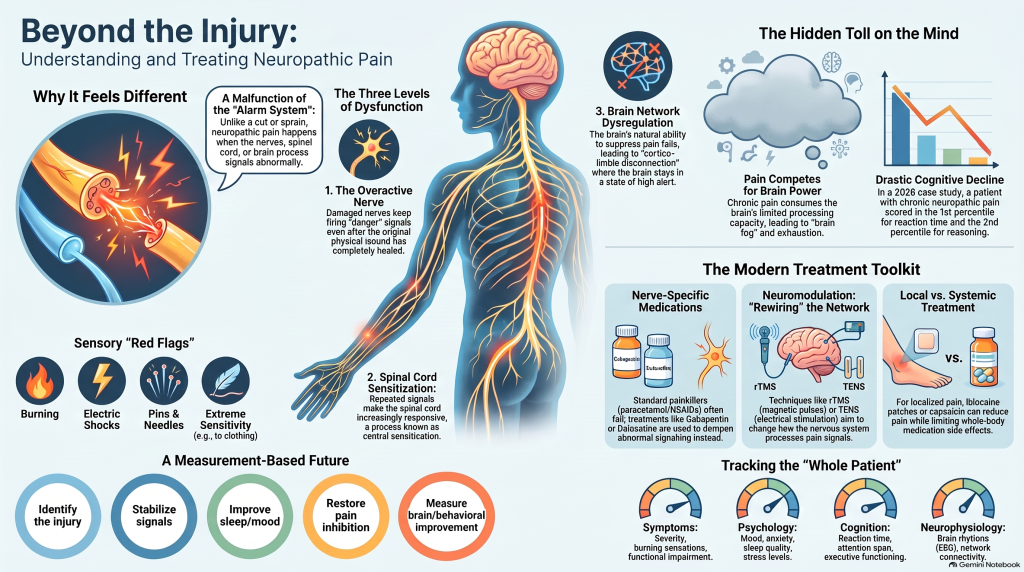 Neuropathic pain is a complex condition where the nervous system continues to send distress signals even after physical wounds have healed. Unlike standard injuries, this type of pain involves brain changes that can lead to cognitive impairment, emotional distress, and a heightened state of physiological arousal. Traditional painkillers are often ineffective, requiring specialized medications like gabapentin or duloxetine to stabilize abnormal nerve activity. Modern medical approaches also explore neuromodulation, such as magnetic brain stimulation and neurofeedback, to help the brain relearn how to regulate these signals. Ultimately, managing chronic pain requires a holistic assessment that monitors not just physical discomfort, but also sleep, mood, and mental processing speed.
Patients may describe it as:
- burning
- electric-shock-like pain
- pins and needles
- tingling
- numbness with pain
- extreme sensitivity to touch
- pain from something that normally should not hurt, such as clothing touching the skin
The important message is that chronic neuropathic pain is not always simply a problem at the site where it hurts.
Over time, the brain itself can change the way pain is processed.
Pain is felt in the body—but constructed by the nervous system
Imagine an alarm system in a house.
Normally, the alarm sounds when there is a genuine threat. Once the problem is over, the alarm switches off.
In neuropathic pain, three things can happen:
1. The nerve keeps sending abnormal signals.
A damaged nerve may continue firing even after the original injury has healed.
2. The spinal cord becomes more sensitive.
Repeated pain signals can make the nervous system increasingly responsive—a process often called central sensitisation.
3. The brain’s pain-control networks may become dysregulated.
Normally, parts of the brain help decide how important a painful signal is and can even suppress pain through descending control systems.
In chronic pain, these networks can stop working efficiently.
A recent 2026 case report illustrates this particularly well. A man developed persistent burning, tingling and severe sensitivity following major chemical burns. Even after the wounds healed, neuropathic pain continued for years. He also developed problems with concentration, mood and thinking speed.
What happens inside the brain in chronic neuropathic pain?
Researchers studied the patient’s brain using quantitative EEG, or qEEG, along with event-related potentials and cognitive testing.
Several abnormalities were identified.
Brain regions involved in regulating pain and emotion—including the anterior cingulate cortex, orbitofrontal cortex and anterior insula—showed reduced activity.
At the same time, some frontal brain regions showed excessive high-frequency activity associated with a state of hyperarousal. Communication between different brain networks also appeared inefficient.
The authors described this pattern as:
“Cortico-limbic disconnection with frontal hyperarousal.”
In simpler language, the systems that normally evaluate, regulate and suppress pain may become less efficient, while arousal and attention systems remain excessively activated.
This may partly explain why chronic pain can become exhausting.
The patient is not simply experiencing a painful body part. The brain may continually be allocating attention, emotional significance and physiological resources to the pain.
Why chronic pain affects concentration and mood
People living with chronic neuropathic pain frequently complain that they cannot concentrate as well as before.
That does not necessarily mean that they are imagining their symptoms.
Pain competes for the brain’s limited processing capacity.
In the published case, cognitive testing showed abnormalities in:
- reaction time
- executive functioning
- reasoning
- attention and processing speed
- visual memory
The patient’s reaction time was around the 1st percentile, executive function around the 7th percentile, reasoning around the 2nd percentile, and visual memory around the 10th percentile.
Chronic pain therefore needs to be understood as more than simply a sensory symptom.
It can affect sleep, mood, attention, thinking and day-to-day functioning.
How do medicines treat neuropathic pain?
An important mistake is to treat neuropathic pain exactly like ordinary pain.
Medicines such as paracetamol or anti-inflammatory drugs may help some accompanying musculoskeletal pain, but they often do relatively little for true neuropathic pain.
Instead, we commonly use medications that change abnormal nerve signalling.
1. Pregabalin and gabapentin
Gabapentin and pregabalin reduce excessive signalling from nerve cells.
They are particularly useful when patients describe:
- burning pain
- shooting pain
- electric sensations
- tingling
- severe touch sensitivity
- pain interfering with sleep
Gabapentin was used in the patient described in the paper at doses of up to 800 mg three times daily.
Together with duloxetine, it initially produced approximately 50% pain relief, although the improvement eventually plateaued.
Possible adverse effects include sleepiness, dizziness, swelling and cognitive slowing, so treatment needs to be individualised.
2. Duloxetine
Duloxetine is technically an antidepressant, but that description can be misleading when discussing pain.
It increases serotonin and noradrenaline activity in pathways that help the brain and spinal cord suppress incoming pain signals.
It is therefore commonly used for conditions such as:
- diabetic neuropathic pain
- chronic neuropathic pain
- fibromyalgia
- pain occurring together with depression or anxiety
A patient does not need to have depression for duloxetine to be useful for pain.
In chronic pain accompanied by depression or anxiety, however, treating both systems simultaneously can be particularly useful.
3. Amitriptyline and related medicines
Low-dose amitriptyline has been used for neuropathic pain for decades.
At the doses used for pain, its purpose is not necessarily to treat depression.
It can be especially useful when neuropathic pain is associated with poor sleep.
However, dry mouth, constipation, sedation, urinary problems and cardiac effects can limit its usefulness, particularly in older adults.
4. Local treatments
If the pain is confined to a clearly defined area, medications applied directly to the painful region may sometimes be preferable.
Options can include:
- lidocaine patches
- high-concentration capsaicin
- selected local injections
- botulinum toxin in carefully selected neuropathic pain conditions
These approaches can reduce pain while limiting whole-body medication exposure.
What happens when medication is only partly effective?
This is where neuromodulation becomes particularly interesting.
Neuromodulation means deliberately changing the activity of nerves or brain networks in order to improve symptoms.
Rather than simply blocking pain chemically, we attempt to change the way the nervous system processes pain.
There are several levels at which this can be done.
TENS: electrical stimulation through the skin
Transcutaneous electrical nerve stimulation, or TENS, uses small electrical currents delivered through electrodes placed on the skin.
It is inexpensive, non-invasive and can be useful for some forms of peripheral neuropathic pain.
Its effects vary considerably between individuals, but its low risk makes it a reasonable adjunct in appropriately selected patients.
rTMS: stimulating the brain’s pain-control network
One of the more interesting developments is repetitive transcranial magnetic stimulation—or rTMS.
rTMS uses magnetic pulses delivered from outside the skull to influence the activity of specific brain regions.
Most people associate rTMS with depression.
But a different target—the primary motor cortex or M1—has been studied for neuropathic pain.
This may sound surprising.
Why stimulate the motor cortex when the patient has pain?
Because the motor cortex communicates with several deeper brain regions involved in:
- pain inhibition
- sensory processing
- the thalamus
- the anterior cingulate cortex
- descending pain-control pathways
Stimulating one part of a network can therefore influence other parts of that network.
For selected patients with difficult-to-treat neuropathic pain, repeated sessions of M1-rTMS may therefore become an additional treatment option.
It should currently be viewed as an adjunct for selected refractory cases rather than a replacement for standard medical treatment.
Neurofeedback: teaching the brain to regulate itself
Another emerging approach is EEG neurofeedback.
The patient receives real-time information about aspects of their own brain activity and gradually learns to modify particular patterns.
This is particularly interesting in light of the qEEG abnormalities seen in chronic pain.
The authors of the 2026 case report specifically suggested neurofeedback as a possible future treatment for abnormal EEG patterns.
However, this distinction is important:
Neurofeedback for neuropathic pain is still an emerging treatment rather than an established first-line therapy.
We should study it scientifically rather than oversell it.
Spinal cord and peripheral nerve stimulation
For severe neuropathic pain that remains resistant to medication and non-invasive treatment, specialised pain centres may consider implanted neuromodulation.
Examples include:
- spinal cord stimulation
- dorsal root ganglion stimulation
- peripheral nerve stimulation
These approaches deliver electrical stimulation closer to the spinal cord or the affected nerve pathways.
They are substantially more invasive and require careful patient selection.
Can qEEG diagnose neuropathic pain?
This is an exciting area—but also one where caution is necessary.
The paper demonstrated abnormalities involving alpha activity, frontal high-frequency activity and connectivity.
But the authors themselves emphasise that these findings are not specific to pain.
Similar EEG abnormalities can occur in:
- depression
- sleep disorders
- traumatic brain injury
- other neurological or psychiatric conditions
Therefore, qEEG should not currently be used as a machine that simply declares:
“This person has pain.”
The authors specifically caution that qEEG, ERP and cognitive findings should remain complementary to clinical assessment rather than being interpreted in isolation.
That is a very important distinction.
Where qEEG may become useful
The more interesting future role may be phenotyping and monitoring.
For example, instead of asking only:
“How severe is your pain from 0 to 10?”
we may eventually combine several measurements:
Symptoms
Pain severity, burning, allodynia and functional impairment.
Psychology
Mood, anxiety, sleep and stress.
Cognition
Reaction time, attention and executive functioning.
Neurophysiology
EEG rhythms, connectivity and potentially event-related potentials.
Then treatment can be followed longitudinally.
We could ask:
Did the pain improve?
But also:
Did sleep improve?
Did reaction time improve?
Did attention improve?
Did abnormal brain-network activity move towards a healthier pattern?
This moves chronic pain management towards a more measurement-based model.
A modern approach to neuropathic pain
The future is unlikely to involve choosing between medicines and neuromodulation.
A better model may be:
Identify the nerve injury
↓
Reduce abnormal nerve signalling
↓
Improve sleep and mood
↓
Restore descending pain inhibition
↓
Use neuromodulation when appropriate
↓
Measure whether brain and behaviour actually improve
The nervous system is remarkably adaptable.
Unfortunately, this adaptability can sometimes help chronic pain become established.
But neuroplasticity also offers the opposite possibility:
if the nervous system can learn persistent pain, carefully selected treatments may also help it learn better regulation.
That is where pharmacology, rehabilitation, psychology and neuromodulation begin to come together.
Assessment of Chronic Pain, Cognition and Brain Function
Dr. Srinivas Rajkumar T
Senior Consultant Psychiatrist, Apollo
MD Psychiatry — AIIMS New Delhi | DNB | MBBS
My clinical interest includes the biological basis of psychiatric and neurocognitive symptoms, objective cognitive assessment, quantitative EEG and emerging neuromodulation approaches.
For patients with complex chronic pain—particularly when pain is associated with poor sleep, depression, anxiety, impaired concentration or cognitive difficulties—a broader neuropsychiatric assessment can complement evaluation by neurology and pain-medicine specialists.
Where clinically appropriate, assessment may include structured evaluation of mood, sleep, cognition and attention, with objective neurophysiological measurements used as supporting tools rather than substitutes for clinical diagnosis.
Consultations: Apollo Clinic, opposite Phoenix Market City, Velachery, Chennai
Appointments: +91 85951 55808
Email: srinivasaiims@gmail.com
Neuropathic pain can have many causes. Medication changes and neuromodulation should be undertaken only after appropriate clinical evaluation. Persistent or unexplained neuropathic pain may also require neurological, pain-medicine, metabolic or surgical assessment.