A Computational Model of ADHD You Can Actually Build, Test, and Improve
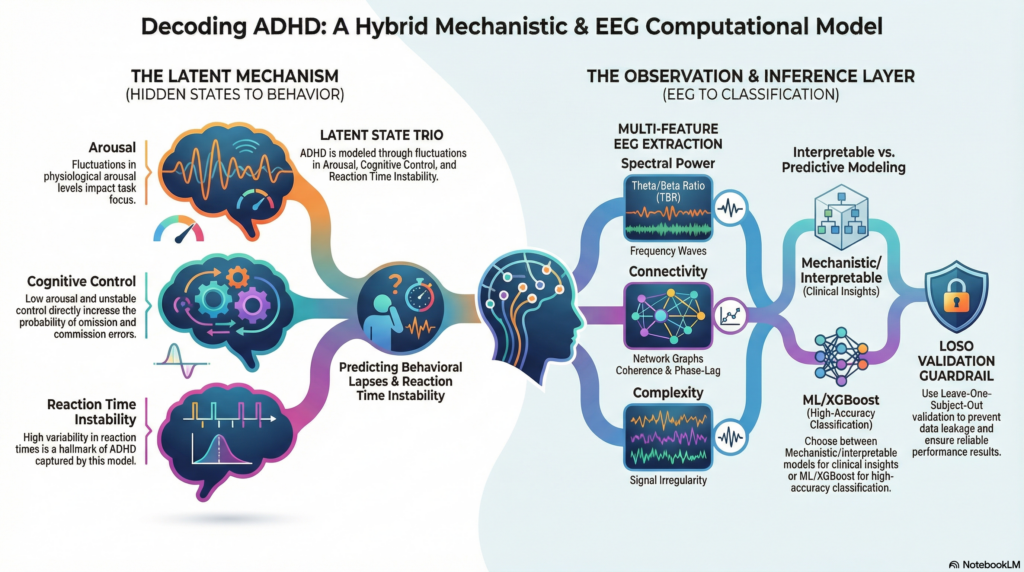 ADHD is often discussed as a checklist of symptoms. Clinically, however, it behaves more like a dynamic instability: attention fluctuates, control weakens under load, reaction times wobble, and performance varies from moment to moment.
What if we stopped asking only whether someone has ADHD, and instead asked what brain-state dynamics are producing the behaviour we see—and whether EEG can help us estimate those states?
Below is a computational, implementable model of ADHD that does exactly that. It combines three ideas that are increasingly converging in the literature:
-
Latent brain-state dynamics (from computational psychiatry)
-
EEG feature families that actually survive modern reviews
-
Machine-learning inference layers that can be validated rigorously
This is not a speculative toy model. Every component is grounded in methods already used in contemporary EEG-ADHD research.
1. Why ADHD looks the way it does: a latent-state view
At any moment, a person’s behaviour is shaped by internal brain states we don’t observe directly. In ADHD, three such states appear repeatedly across task, EEG, and behavioural studies:
-
Arousal / alertness – too low or unstable leads to lapses
-
Cognitive control – governs inhibition and top-down regulation
-
Variability / noise – drives reaction-time instability
We represent these as a latent state vector evolving over time:
z = [Arousal, Control, Variability]
This state drifts dynamically rather than remaining fixed, which already explains a key clinical observation: ADHD performance is often inconsistent, not uniformly poor.
From these latent states, task behaviour naturally emerges:
-
Omission errors rise when arousal and control drop
-
Commission errors rise when control is weak and variability is high
-
Reaction time slows and becomes noisier as stability degrades
In other words, impulsivity and inattention are not separate traits here—they are different expressions of the same unstable internal system.
2. How brain state becomes EEG: the observation model
Latent states are theoretical. EEG is measurable. The bridge between them is an observation model that maps internal dynamics to EEG features.
Importantly, this model avoids the trap of assuming there is one EEG signature of ADHD. Modern evidence suggests heterogeneity, so the model works with feature families, not single markers.
(a) Spectral power features
Relative or absolute power across canonical bands (delta to gamma).
The theta–beta ratio appears here—but only as one feature among many. Meta-analyses have shown it cannot stand alone as a diagnostic marker.
(b) Functional connectivity features
Connectivity matrices (coherence, phase-lag measures) transformed into graph metrics such as strength, clustering, or modularity.
These capture network-level differences, particularly in attention and control systems, and are increasingly used with graph neural networks.
(c) Complexity and entropy measures
Signal complexity (sample entropy, multiscale entropy) reflects neural stability and adaptability—properties that align well with ADHD-related variability.
Together, these features form a multivariate EEG observation that reflects—but does not rigidly define—the underlying brain state.
3. Inferring ADHD-relevant states: two complementary paths
Once EEG features are extracted, there are two legitimate and scientifically defensible ways forward.
Option A: Interpretable, computational-psychiatry style
Estimate latent states using state-space methods (Kalman or particle filters), then summarise individuals by:
-
Average arousal
-
Average control
-
Variability of instability
These parameters can be related to symptoms or task performance, offering mechanistic insight rather than black-box prediction.
Option B: Predictive, modern EEG-ML style
Skip explicit state estimation and train classifiers directly on EEG features using methods that currently perform best in the literature:
-
XGBoost with SHAP for interpretability
-
Graph neural networks on connectivity data
-
Attention-based CNNs that learn channel relevance dynamically
A crucial safeguard here is validation strategy. Leave-One-Subject-Out cross-validation is essential to avoid inflated performance from within-subject leakage.
4. A pipeline that can actually be implemented
This framework is not aspirational—it can be built with standard EEG datasets and open-source tools:
-
Acquire EEG (resting or task-based; ideally 19+ channels)
-
Preprocess (bandpass, notch, artefact handling)
-
Segment into windows
-
Extract features (power, connectivity, entropy)
-
Aggregate to subject level
-
Train and validate models with strict subject-wise separation
The result is not just a classification score, but a structured understanding of instability, control, and arousal dynamics.
5. What this model is—and what it is not
This model is:
-
A research-grade framework grounded in current EEG-ML practice
-
A bridge between mechanistic theory and predictive modelling
-
A platform that can evolve toward personalised interventions
This model is not:
-
A standalone diagnostic tool
-
A replacement for clinical assessment
-
A justification for single-marker shortcuts
High accuracy in papers does not guarantee generalisation across devices, populations, or clinics. Responsible use demands humility and validation.
Why this matters
ADHD is not a static deficit. It is a dynamic disorder of regulation. Models like this shift the conversation from labels to mechanisms, from averages to variability, and from speculation to testable structure.
That shift—slow, careful, and evidence-driven—is where the future of neuropsychiatry is heading.
About the Author
Dr. Srinivas Rajkumar T, MD (AIIMS, New Delhi), DNB, MBA (BITS Pilani)
Consultant Psychiatrist & Neurofeedback Specialist
Mind & Memory Clinic, Apollo Clinic Velachery (Opp. Phoenix Mall)
📞 +91-8595155808
✉️ srinivasaiims@gmail.com