A Simple Manual for Jacobson’s Progressive Muscle Relaxation (JPMR)
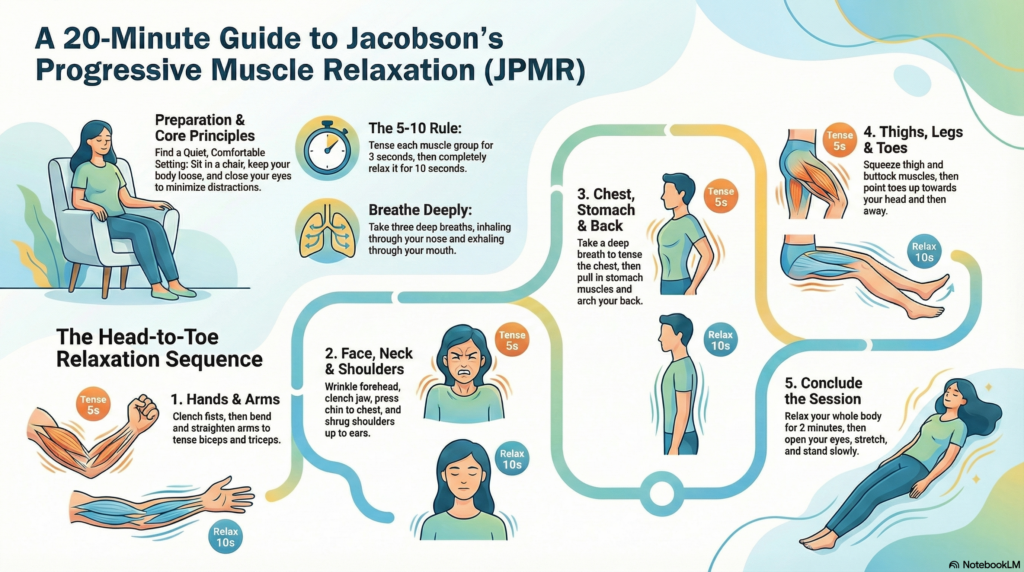 Introduction and Preparation
Jacobson’s Progressive Muscle Relaxation (JPMR) is a structured relaxation technique designed to produce deep physical and mental calm over approximately 20 minutes. It works by systematically tensing and relaxing different muscle groups, helping the body release stored tension and signal safety to the mind.
Before you begin, choose a quiet environment where you will not be disturbed.
-
Get settled
Sit comfortably in a chair, allowing your body to be fully supported. Keep your posture relaxed and loose. -
Focus your mind
Close your eyes. Allow your attention to remain on your body. Let go of unnecessary movements and distractions. -
The core cycle
For each muscle group:-
Tense the muscles firmly for 5 seconds
(silently count: 1001, 1002, 1003, 1004, 1005) -
Relax the muscles quickly and completely for 10 seconds
-
-
Breathing
After each step, take three slow, deep breaths:
inhale through your nose and exhale through your mouth.
Step-by-Step Muscle Sequence
Follow this head-to-toe sequence, paying attention to the contrast between tension and relaxation.
Hands
Clench each fist tightly, one at a time, noticing the tension in the fist and forearm.
Arms
Bend each arm at the elbow to tense the biceps, then straighten the arms and press them gently against the chair to tense the triceps.
Facial muscles
-
Wrinkle your forehead by raising your eyebrows
-
Screw your eyes shut tightly
-
Clench your teeth to tense the jaw
-
Press your tongue firmly against the roof of your mouth
Neck and shoulders
-
Push your head gently back against the chair, then bring your chin toward your chest
-
Shrug your shoulders upward toward your ears
Chest
Take a deep breath, filling your lungs completely. Hold briefly, then exhale slowly and passively.
Stomach and back
Pull your stomach muscles inward tightly, then gently arch your lower back away from the chair.
Thighs and buttocks
Squeeze the thigh and buttock muscles firmly together.
Lower legs and toes
Point your toes toward your head to tense the calves, then point them away to tense the feet and toes.
Post-Exercise Recovery
Once the full sequence is complete:
-
Relax your entire body for 2 minutes
-
Keep your eyes closed
-
Enjoy the sensation of looseness, warmth, and calm
When ready:
-
Gently stretch
-
Open your eyes
-
Stand up slowly, allowing your body to readjust
A Helpful Analogy
Think of your muscles like a wet sponge.
Tensing the muscle is like squeezing the sponge tightly, pushing out all the trapped water (stress and tension). When you release, the sponge naturally expands back to its soft, light state—drawing in fresh air (relaxation).
JPMR teaches your body to let go completely, rather than holding tension unconsciously.
In Summary
Jacobson’s Progressive Muscle Relaxation is not about forcing calm.
It is about training the body to recognise tension and release it deliberately.
With regular practice, relaxation becomes faster, deeper, and more automatic—supporting better sleep, reduced anxiety, improved emotional regulation, and overall wellbeing.
About the Author
Dr. Srinivas Rajkumar T, MD (AIIMS), DNB, MBA (BITS Pilani)
Consultant Psychiatrist & Neurofeedback Specialist
Mind & Memory Clinic, Apollo Clinic Velachery (Opp. Phoenix Mall)
Dr. Srinivas integrates CBT, relaxation therapies, neurofeedback, and neuroscience-based interventions for anxiety disorders, depression, OCD, ADHD, stress-related conditions, and sleep problems.
✉ srinivasaiims@gmail.com
📞 +91-8595155808