Autism How parents and caregivers can identify early signs
 Autism does not arrive with an announcement.
It does not suddenly appear one morning with a clear label attached.
More often, it reveals itself quietly—through small, gradual differences in how a child connects with people, communicates needs and feelings, plays, and responds to everyday experiences. In Indian families especially, these early signs are frequently explained away as “late bloomer,” “very shy,” “pampered,” “stubborn,” or “boys talk late.” Many parents sense something is different, yet hesitate to voice it.
Early detection of autism is not about labeling a child or predicting their future.
It is about understanding a developmental pattern early enough to offer support, at a time when the brain is still remarkably adaptable and responsive to intervention.
This article is written for parents, grandparents, and caregivers who may be noticing small concerns or quiet doubts. It explains autism in a calm, grounded, and practical way, rooted in science but sensitive to Indian social realities.
What is autism, simply explained
Autism—also called Autism Spectrum Disorder (ASD)—is a neurodevelopmental condition. This means it reflects differences in how the brain develops and processes information from early childhood onward.
Autistic children may show differences or difficulties in:
-
Social communication and interaction
-
Flexibility, predictability, and routine
-
Sensory processing
-
Interests and patterns of behaviour
These features are present from early childhood and typically persist across life, though their expression changes with age, support, and environment.
Autism is described as a spectrum because children vary widely:
-
Some need minimal support and attend mainstream schools
-
Some may be non-speaking or need significant daily assistance
-
Many fall somewhere in between
A formal diagnosis is made only when these differences cause meaningful challenges in daily life, beyond what would be expected for a child’s age and cultural context.
Why are autism diagnoses increasing?
Across the world—including India—autism diagnoses have risen over the past few decades. This does not mean autism is suddenly new or spreading.
The increase is largely due to:
-
Broader and clearer diagnostic criteria
-
Greater awareness among parents, teachers, and doctors
-
Improved access to assessments
-
Changing social and educational demands on children
The World Health Organization estimates that about 1 in 100 children worldwide meet criteria for autism. Many adults, especially in earlier generations, were never diagnosed despite having lifelong autistic traits.
Autism is highly heritable, involving many genes. Environmental factors appear to play a smaller role, mostly during prenatal development. Autism is not caused by parenting, screen use alone, vaccines, or emotional deprivation.
Boys are diagnosed more often than girls, partly because girls tend to mask or hide difficulties, especially in social settings.
Autism is a pattern across domains, not a single symptom
One of the most important points for parents to understand is this:
No single behaviour defines autism.
-
Poor eye contact alone is not autism
-
Speech delay alone is not autism
-
Repetitive play alone is not autism
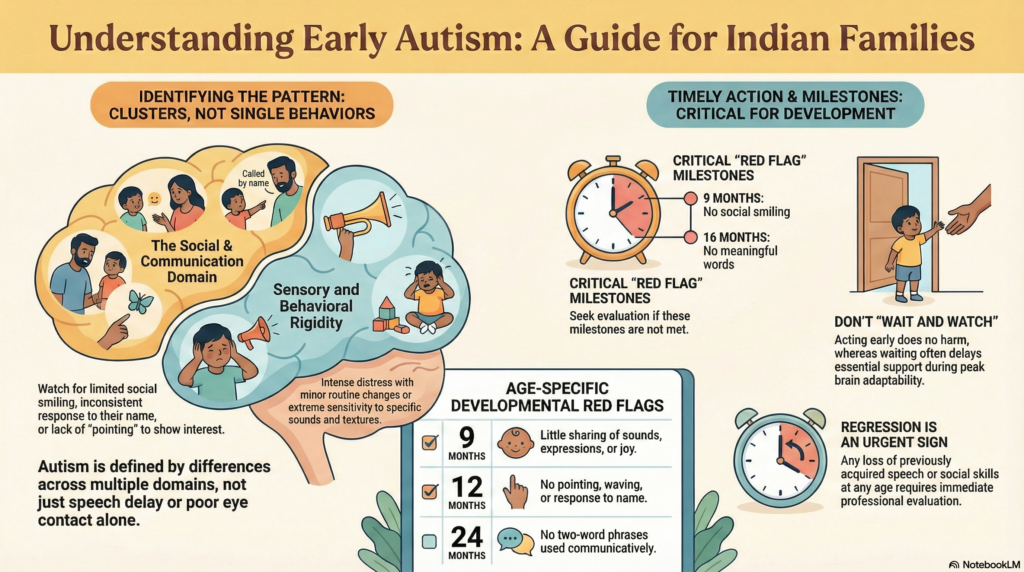
Autism is identified when differences cluster across multiple developmental domains, consistently over time and across settings.
What follows is a domain-wise way of understanding these patterns.
1. Social interaction and social attention
This domain often shows differences first.
Parents may notice:
-
Reduced or inconsistent eye contact
-
Limited social smiling
-
Rarely looking back and forth between a person and an object (poor joint attention)
-
Not pointing to show interest (“see that”)
-
Appearing content without actively seeking social engagement
A subtle but important sign:
Some children look at faces, but do not use eye contact to communicate emotion, intent, or shared experience.
In Indian households, where children are often surrounded by family members, these signs can be easily missed or compensated for by adults speaking for the child.
2. Communication and language (verbal and non-verbal)
Language delay is not always the earliest sign. Often, the issue lies in communication intent.
Early indicators include:
-
Delayed or reduced babbling
-
Limited gestures (waving, pointing, nodding)
-
Inconsistent response to name
-
Repetition of words or phrases without communicative purpose (echolalia)
-
Speech that exists but is not used for conversation or social exchange
Some children may speak fluently but struggle with back-and-forth conversation, turn-taking, or using language to share experiences rather than only to request or label.
3. Restricted and repetitive behaviours or interests
These behaviours are often the most visible.
Common examples include:
-
Hand flapping, rocking, spinning
-
Lining up toys rather than imaginative play
-
Strong insistence on routines
-
Distress with minor changes
-
Intense interest in specific objects or topics
-
Focus on parts of objects (wheels, switches, textures)
Repetition alone is not diagnostic.
What matters is rigidity, intensity, and interference with learning or social engagement.
4. Sensory processing differences
Sensory features are extremely common and often misunderstood.
Parents may observe:
-
Sensitivity to sounds, textures, lights, or smells
-
Avoidance of certain foods or clothing
-
High pain tolerance or extreme reaction to mild discomfort
-
Sensory-seeking behaviours such as spinning, crashing, or chewing objects
These differences reflect how the nervous system processes input—not behavioural stubbornness or “bad habits.”
5. Play and imagination
Play reflects social, emotional, and cognitive development.
Early concerns include:
-
Limited pretend or symbolic play
-
Repetitive play themes with little variation
-
Difficulty involving others in play
-
Preference for objects over people
A child may play with toys but struggle to play with people.
Early red flags by age (approximate guide)
-
By 6 months: limited eye contact, reduced social smile
-
By 9 months: little sharing of sounds, expressions, or joy
-
By 12 months: no pointing, waving, or response to name
-
By 16 months: no meaningful words
-
By 24 months: no two-word phrases used communicatively
Loss of previously acquired skills at any age requires urgent evaluation.
What parents and caregivers should know
-
Autism is not caused by parenting
-
Children may have clear strengths alongside difficulties
-
Intelligence and abilities vary widely
-
Autism commonly co-exists with ADHD, anxiety, epilepsy, or learning difficulties
-
Early support improves communication, adaptability, and independence
-
Parental observation is one of the most reliable early screening tools
Waiting for certainty often delays help.
Acting early does not cause harm—delay often does.
What to do if you are concerned
-
Do not rely only on “wait and watch”
-
Seek a structured developmental evaluation
-
Begin early intervention if recommended
-
Reassess periodically—development is dynamic, not fixed
Early identification does not define a child’s limits.
It defines the starting point for support.
A final thought
Autism is not a tragedy discovered early.
It is a developmental difference understood early—and that understanding changes outcomes.
About the Author
Dr. Srinivas Rajkumar T, MD (AIIMS), DNB, MBA (BITS Pilani)
Consultant Psychiatrist & Neurofeedback Specialist
Mind & Memory Clinic, Apollo Clinic Velachery (Opp. Phoenix Mall)
Dr. Srinivas works extensively with children, adolescents, and families, focusing on early identification of neurodevelopmental conditions, comprehensive developmental assessments, parent guidance, and evidence-based interventions—tailored to Indian families and real-world settings.
✉ srinivasaiims@gmail.com
📞 +91-8595155808
Early clarity empowers families. Early support shapes futures.