Brain Mapping and Neurofeedback for Autism: Understanding the Brain to Support the Child
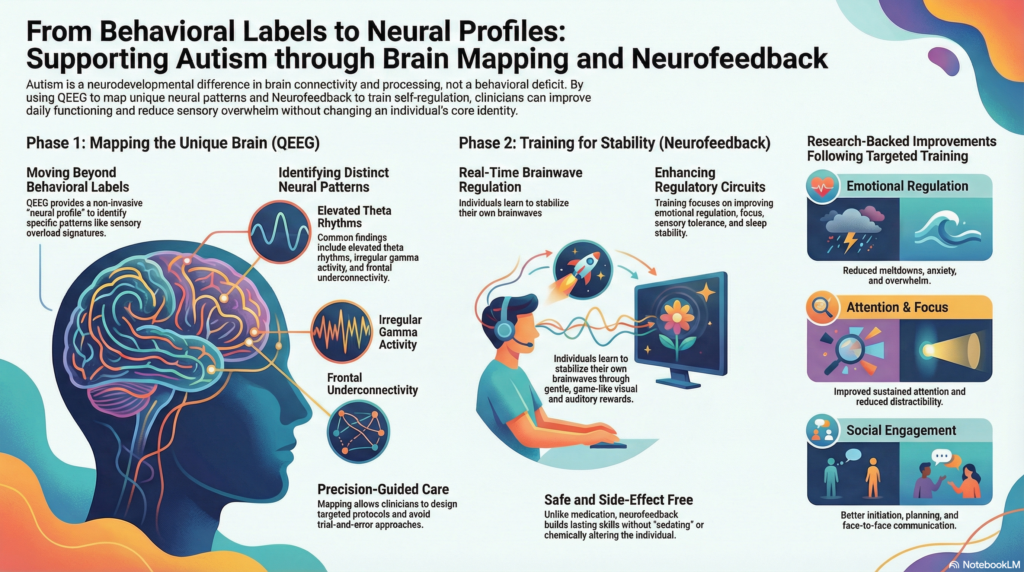 Autism is not a behavioural problem. It is not caused by parenting, personality, or a lack of motivation. Autism is a neurodevelopmental difference—a unique way the brain processes information, responds to the environment, and connects with the world.
As research advances, we now understand that autistic individuals show distinct patterns of brain connectivity, oscillations, and activation. These patterns do not reflect “damage,” but differences in:
• sensory processing
• attention networks
• emotional regulation circuits
• social communication pathways
This is where brain mapping (QEEG) and neurofeedback offer remarkable insight and support. They help us understand how the brain functions—not to “cure” autism, but to enhance strengths, reduce challenges, and improve daily functioning.
Autism is a spectrum; brain patterns are also a spectrum. Mapping them respectfully and scientifically opens new possibilities for personalised care.
What Is Brain Mapping (QEEG) in Autism?
QEEG (Quantitative EEG) is a non-invasive assessment that measures:
• brainwave activity
• connectivity patterns
• asymmetries between regions
• underactive or overactive networks
• sensory overload signatures
• attention and executive-function rhythms
In autistic children and adults, research often shows patterns such as:
• elevated theta rhythms
• irregular gamma activity (linked to sensory integration)
• frontal underconnectivity
• excessive fast-wave activity during stress
• disrupted coherence between hemispheres
• altered mirror-neuron network rhythms
QEEG does not diagnose autism—but it reveals how the autistic brain works, which is crucial for personalised intervention.
It moves us from a behavioural label to a neural profile.
Why QEEG Matters in Autism Care
Autism is wonderfully diverse. Some individuals struggle with sensory overload, others with attention, speech initiation, emotional flexibility, or anxiety. QEEG helps pinpoint which circuits need support.
This precision allows clinicians to:
• design targeted neurofeedback protocols
• understand strengths and bottlenecks
• optimise attention, regulation, and learning
• avoid trial-and-error approaches
• track progress objectively over time
It transforms autism care from generalized advice to brain-specific guidance.
Neurofeedback: Training the Brain Using Its Own Activity
Neurofeedback is a therapeutic technique where individuals learn to regulate their brainwaves using real-time EEG feedback. It is:
• gentle
• non-invasive
• safe
• game-like and engaging for children
• scientifically validated
The idea is simple:
when the brain produces healthier rhythms, the system rewards it.
Over time, the brain learns to stabilise itself.
In autism, neurofeedback is not about changing identity, personality, or core autistic traits.
It focuses on supporting:
1. Emotional Regulation
Helps reduce meltdowns, overwhelm, and anxiety by stabilising fast-wave overactivity.
2. Attention and Focus
Improves sustained attention and reduces distractibility, especially in autistic individuals with ADHD traits (very common).
3. Sensory Processing
Trains calmer, more organised neural rhythms to reduce sensory overload.
4. Language and Social Engagement
Supporting frontal connectivity improves initiation, planning, and face-to-face engagement.
5. Sleep and Behaviour Stability
Balancing alpha-theta patterns improves sleep, which dramatically improves daytime functioning.
6. Reduction in Rigidity and Stress Responses
Helps the prefrontal cortex manage transitions, unpredictability, and frustration.
Neurofeedback does not “treat autism.”
It treats the regulation challenges that often make life harder for autistic individuals.
What Research Shows
Studies over the last two decades demonstrate improvements in:
• attention
• cognitive flexibility
• emotional stability
• sensory tolerance
• social responsiveness
• learning speed
• behaviour management
Many families report better eye contact, improved communication attempts, and calmer daily routines—not because autism changed, but because the child’s regulatory circuits became more efficient.
Why Neurofeedback Fits the Autism Spectrum So Well
Autistic brains are highly plastic, especially in childhood and adolescence. When given precise and repeated training, they:
• adapt faster
• generalise skills naturally
• retain gains longer
• respond well to visual, gamified feedback
Unlike medication, neurofeedback has no side effects and respects neurodiversity. It builds skills, not dependency.
Parents appreciate that the child is not “sedated” or chemically altered; they are simply being guided to a more regulated neurological state.
How Brain Mapping + Neurofeedback Creates a Complete Approach
Brain mapping shows where the challenges are.
Neurofeedback shows how to train them.
Together, they create a personalised pathway for:
• better self-regulation
• improved learning
• reduced anxiety
• enhanced communication
• greater participation in school and therapy
• improved family harmony
This combined model is becoming a hallmark of modern interventional neuropsychiatry.
Final Thoughts
Autism is not a deficit—it is a different neural architecture.
Brain mapping and neurofeedback do not seek to normalise or erase this uniqueness.
They aim to make life easier, calmer, and more functional by supporting the brain’s natural ability to self-regulate.
When a child becomes less overwhelmed, more focused, and more emotionally steady, their strengths shine naturally.
Brain-based interventions are not replacements for behavioural therapy, speech therapy, or structured routines—they amplify their effectiveness.
Autism care works best when science respects neurodiversity.
About the Author
Dr. Srinivas Rajkumar T, MD (AIIMS), DNB, MBA (BITS Pilani)
Senior Consultant Interventional Neuropsychiatrist
Mind & Memory Clinic, Apollo Clinic Velachery (Opp. Phoenix Mall)
✉ srinivasaiims@gmail.com 📞 +91-8595155808