Dual Sex Therapy: When Healing Intimacy Requires Working With Both Partners
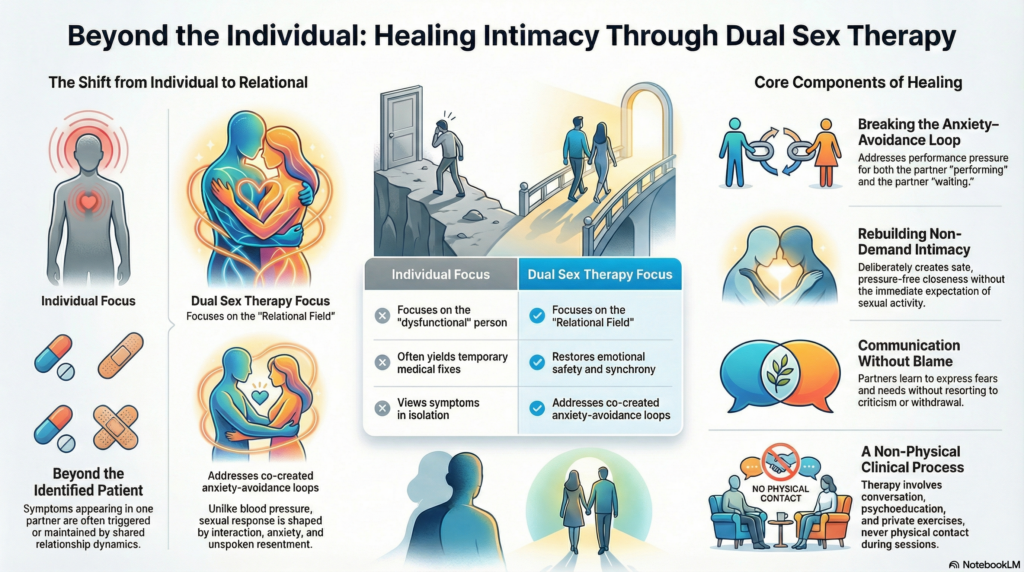 Sexual difficulties rarely belong to one person alone.
In clinical practice, complaints such as low desire, erectile difficulty, premature ejaculation, vaginismus, orgasmic difficulties, or loss of intimacy often arrive framed as “his problem” or “her issue.” But sexuality, unlike blood pressure or blood sugar, is inherently relational. This is where Dual Sex Therapy becomes not just useful, but necessary.
Dual sex therapy refers to a structured therapeutic approach where both partners are involved in the assessment and treatment of sexual concerns, even when symptoms appear to be located in one individual.
This is not couples counselling in disguise, nor is it therapy about sex alone. It is therapy through the sexual relationship.
Why Individual-Only Sexual Treatment Often Falls Short
Traditional models of sexual treatment focused heavily on the “identified patient.”
The man with erectile dysfunction.
The woman with low desire.
The partner with painful intercourse.
While this model works well for purely medical causes, many patients experience partial or temporary improvement because:
-
Sexual response is shaped by interaction, not isolation
-
Anxiety, expectation, and avoidance are often co-created within relationships
-
One partner’s symptoms frequently become the other partner’s triggers
-
Unspoken resentment, fear, or guilt quietly sabotages progress
In other words, the relationship becomes the treatment field, whether we acknowledge it or not.
Dual sex therapy makes this explicit and therapeutic.
What Exactly Is Dual Sex Therapy?
Dual sex therapy is a clinician-guided, ethically bound, non-physical therapeutic process involving both partners, aimed at restoring:
-
Sexual functioning
-
Emotional safety
-
Desire and arousal synchrony
-
Communication around intimacy
-
Pleasure without pressure
Sessions may include joint meetings, individual sessions, or alternating formats, depending on clinical need.
Importantly, there is no physical sexual activity in therapy. The work happens through conversation, psychoeducation, exercises prescribed for private practice, and gradual restructuring of intimacy.
Core Components of Dual Sex Therapy
1. Shared Sexual History Mapping
Both partners explore how sexuality developed individually and as a couple — early messages, cultural beliefs, past trauma, medical events, and relationship turning points.
2. De-pathologising Desire Differences
Mismatched libido is one of the most common issues. Therapy reframes this not as rejection or defect, but as a difference in sexual rhythm that can be negotiated.
3. Breaking the Anxiety–Avoidance Loop
Repeated failed attempts often create anticipatory anxiety. Dual therapy addresses performance pressure on both sides — the one “performing” and the one “waiting.”
4. Rebuilding Non-Demand Intimacy
Many couples forget how to touch, talk, or be close without expectation. Therapy deliberately rebuilds safe, pressure-free closeness.
5. Communication Without Blame
Partners learn to express needs, fears, and disappointments without criticism, sarcasm, or withdrawal — a crucial step often overlooked in medical treatment.
Who Benefits Most From Dual Sex Therapy?
Dual sex therapy is especially effective when:
-
Medical treatment alone has failed or plateaued
-
Sexual problems emerged after marriage, childbirth, illness, or conflict
-
One partner feels rejected while the other feels pressured
-
Desire has faded despite emotional attachment
-
Sexual difficulties coexist with anxiety, depression, or relationship stress
It is also valuable in long-term relationships where sex has become functional, absent, or emotionally disconnected rather than overtly “dysfunctional.”
What Dual Sex Therapy Is Not
To clear common misconceptions:
-
It is not erotic coaching
-
It is not voyeuristic or experimental
-
It does not involve physical contact in sessions
-
It is not about assigning blame
-
It is not a substitute for medical evaluation when required
It is a serious, evidence-informed clinical intervention rooted in psychology, psychiatry, and sexual medicine.
Cultural Sensitivity and the Indian Context
In Indian settings, sexuality is often burdened by:
-
Silence and shame
-
Gendered expectations
-
Performance myths
-
Limited sexual education
-
Fear of being “abnormal”
Dual sex therapy provides a safe, professional space to unlearn myths, correct misinformation, and develop a healthier, more compassionate sexual narrative — without judgment or embarrassment.
Many couples experience relief simply from discovering that their struggles are common and treatable.
Outcomes: What Couples Often Notice
With consistent engagement, couples commonly report:
-
Reduced anxiety around intimacy
-
Improved communication and emotional closeness
-
Greater sexual confidence
-
Renewed curiosity and playfulness
-
A sense of partnership rather than opposition
Sex improves not because techniques change first, but because safety returns.
A Final Thought
Sexual difficulties are not signs of failure.
They are signals — of stress, change, unmet needs, or disconnection.
Dual sex therapy listens to those signals together, not in fragments.
When both partners participate in healing intimacy, the outcome is rarely just better sex. It is often a stronger relationship and a kinder understanding of oneself and the other.
About the Author
Dr. Srinivas Rajkumar T
MD (AIIMS), DNB, MBA
Consultant Psychiatrist & Neurofeedback Specialist
Dr. Srinivas Rajkumar specialises in the assessment and treatment of sexual dysfunctions, relationship-linked mental health concerns, and anxiety-related intimacy issues, using evidence-based, ethical, and culturally sensitive approaches.
Mind & Memory Clinic
Apollo Clinic Velachery (Opp. Phoenix Mall), Chennai
📞 +91-8595155808
✉ srinivasaiims@gmail.com
🌐 https://srinivasaiims.com