Early Signs of Autism: A Practical Guide for Parents and Teachers
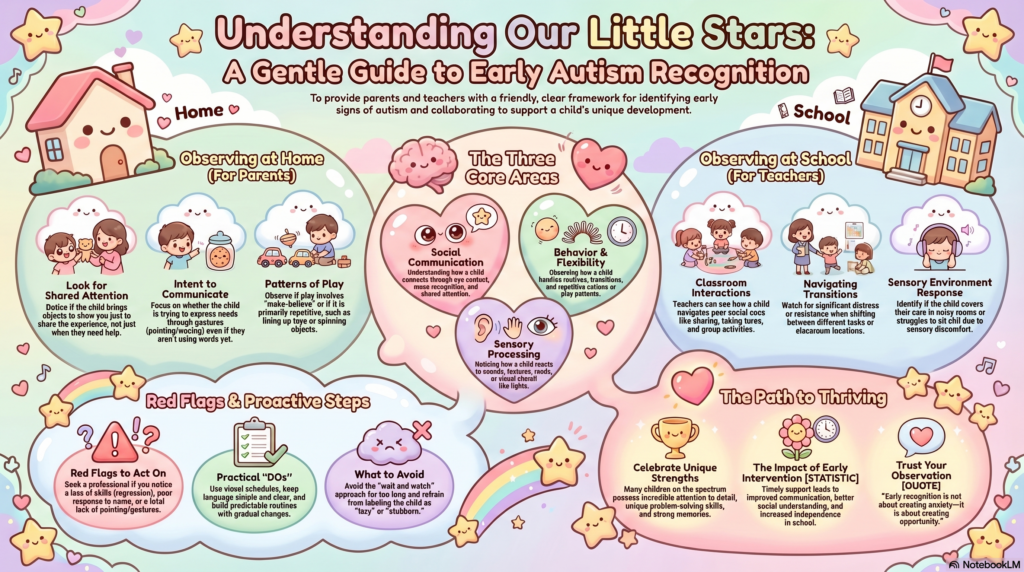 Recognizing autism early is not about labeling a child—it is about understanding their way of experiencing the world and responding in a way that supports growth.
This guide is designed to help parents and teachers work together, because early development unfolds across both home and school environments.
Understanding the Core Areas
Autism primarily affects:
- Social communication
- Behavior and flexibility
- Sensory processing
Early signs may be subtle—but patterns over time are what matter.
What Parents Should Look For at Home
1. Social Connection
- Does the child make eye contact when interacting?
- Do they respond when their name is called?
- Do they bring objects to show you (not just to get help)?
👉 A key marker is shared attention, not just interaction.
2. Communication
- Is the child using gestures (pointing, waving)?
- Are they speaking age-appropriate words or sentences?
- Do they try to communicate needs—even nonverbally?
👉 Watch for intent to communicate, not just speech.
3. Play Behavior
- Do they engage in pretend play (feeding a doll, driving a toy car)?
- Or do they prefer repetitive actions (spinning, lining up)?
👉 Play reflects cognitive and social development.
4. Behavior Patterns
- Do they insist on routines?
- Do they become distressed with small changes?
- Do they repeat certain movements?
5. Sensory Responses
- Do they avoid certain sounds, textures, or foods?
- Or seek unusual sensory input (spinning, watching lights)?
What Teachers Should Observe in School
Teachers are often the first to notice differences because they see peer comparison and structured behavior.
1. Classroom Interaction
- Does the child engage with peers?
- Do they understand social cues (turn-taking, sharing)?
2. Communication in Context
- Can the child follow instructions?
- Do they initiate conversation with peers or teachers?
3. Attention and Flexibility
- Difficulty shifting between tasks
- Strong preference for routines
- Resistance to transitions (e.g., changing activities)
4. Group Behavior
- Playing alone consistently
- Difficulty participating in group activities
- Appearing “withdrawn” or “overwhelmed”
5. Sensory Challenges in School
- Covering ears in noisy environments
- Difficulty sitting still due to sensory discomfort
- Overreaction or underreaction to stimuli
Red Flags That Need Attention (Home + School)
If both parents and teachers notice:
- Poor response to name
- Lack of pointing or gestures
- Delayed or unusual speech
- Limited social interaction
- Repetitive behaviors
- Regression (loss of skills)
👉 It is advisable to seek a professional evaluation early.
What NOT to Do
- ❌ “Wait and watch” for too long
- ❌ Compare excessively with other children
- ❌ Label the child as “stubborn,” “lazy,” or “introverted”
- ❌ Ignore parental or teacher concerns
What TO Do: Practical Strategies
For Parents
1. Increase Interaction Opportunities
- Sit face-to-face
- Follow the child’s interests
- Use simple, clear language
2. Encourage Communication
- Reward attempts to communicate (verbal or nonverbal)
- Use gestures along with speech
3. Build Predictable Routines
- Maintain structure—but introduce small changes gradually
4. Manage Sensory Needs
- Identify triggers (noise, textures)
- Modify environment accordingly
For Teachers
1. Use Structured Teaching
- Clear instructions
- Visual schedules
- Step-by-step guidance
2. Support Communication
- Allow extra time to respond
- Use visual aids and cues
3. Facilitate Social Interaction
- Pair with supportive peers
- Encourage guided group activities
4. Manage Transitions
- Give advance warnings (“5 minutes left”)
- Use consistent routines
Parent–Teacher Collaboration: The Most Powerful Tool
The best outcomes happen when:
- Observations are shared openly
- Patterns are tracked across settings
- Strategies are consistent
👉 A child may behave differently at home and school—both perspectives matter.
When to Seek Professional Help
Consult a specialist if:
- Concerns persist beyond a few months
- Developmental milestones are delayed
- There is regression
- The child struggles significantly in social or communication domains
Early Intervention Makes a Difference
With timely support, children can:
- Improve communication skills
- Develop social understanding
- Adapt better to school environments
- Build independence
A Balanced Perspective
Autism is not just about challenges—it is also about differences in thinking and perception.
Many children show:
- Strong memory
- Attention to detail
- Unique problem-solving approaches
The goal is not to “normalize” the child—but to help them function, connect, and thrive.
Final Takeaway
If something feels different, trust your observation.
Early recognition is not about creating anxiety—it is about creating opportunity.
About the Author
Dr. Srinivas Rajkumar T, MD (AIIMS, New Delhi), DNB, MBA (BITS Pilani)
Consultant Psychiatrist & Neurotechnology Specialist
Mind & Memory Clinic, Apollo Clinic Velachery (Opp. Phoenix Mall)
✉ srinivasaiims@gmail.com 📞 +91-8595155808