EMDR Therapy Explained: How Modern Trauma Treatment Is Transforming Mental Health Care
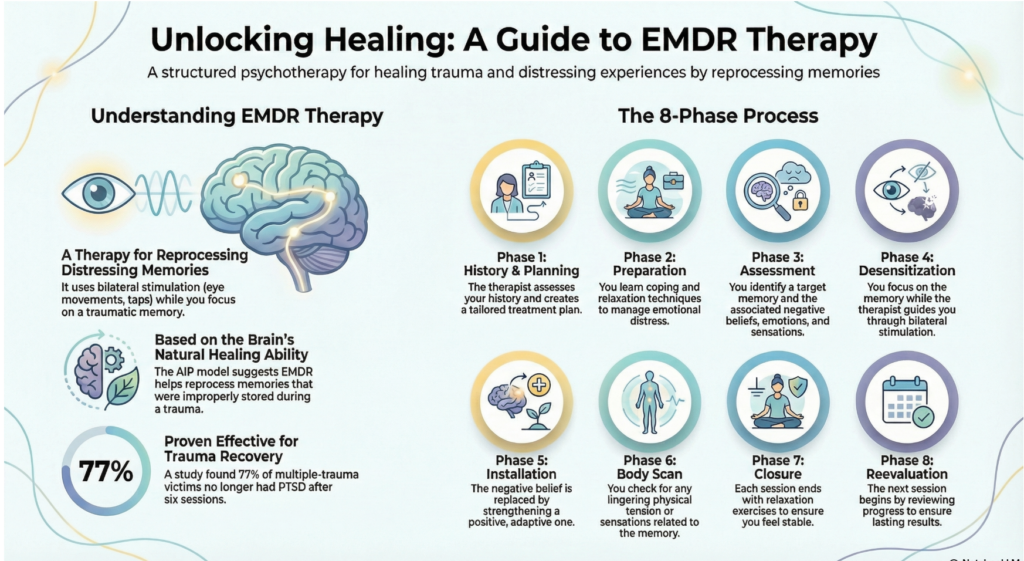 For many years, psychotherapy focused primarily on talking through emotional distress. While traditional talk therapy remains valuable, trauma often resides beyond words—in bodily sensations, emotional reflexes, and fragmented memories. This is where Eye Movement Desensitization and Reprocessing (EMDR) has fundamentally reshaped modern psychiatric and psychological treatment.
EMDR therapy, developed in the late 1980s, is now practiced by over 100,000 clinicians worldwide and is considered one of the most effective evidence-based treatments for trauma, PTSD, and emotional dysregulation.
EMDR does not replace talk therapy.
It expands how healing happens.
What Is EMDR Therapy?
Eye Movement Desensitization and Reprocessing (EMDR) is a structured, neuroscience-informed psychotherapy used to help individuals process traumatic or distressing life experiences.
Unlike conventional therapy, EMDR does not rely on detailed verbal recounting of events. Instead, it uses bilateral stimulation—such as guided eye movements, tapping, or auditory tones—to help the brain reprocess unintegrated memories.
EMDR is widely used for:
-
Post-traumatic stress disorder (PTSD)
-
Childhood trauma and complex trauma
-
Anxiety and panic disorders
-
Depression linked to adverse life experiences
-
Emotional dysregulation and personality patterns
-
Phobias and performance anxiety
-
Addiction and relapse prevention
The Science Behind EMDR: The Adaptive Information Processing (AIP) Model
At the core of EMDR is the Adaptive Information Processing (AIP) model.
The AIP model proposes that the human brain has a natural capacity to heal psychological wounds, much like the body heals physical injuries. Under normal circumstances, experiences are processed, integrated, and stored in a way that allows learning and emotional resolution.
Trauma disrupts this system.
When an experience is overwhelming, the brain fails to fully process it. The memory becomes “stuck”—stored with its original emotions, beliefs, and bodily sensations. As a result, the past intrudes into the present through flashbacks, emotional flooding, hypervigilance, or avoidance.
EMDR helps the brain resume its natural processing, allowing traumatic memories to shift:
-
from emotional reactivity to emotional distance
-
from sensory fragments to coherent narrative
-
from present threat to past experience
This is not forgetting.
It is integration.
The Eight Phases of EMDR Therapy
EMDR follows a clearly defined eight-phase protocol, ensuring both safety and effectiveness:
1. History Taking
Identifying significant life events, current symptoms, and treatment goals.
2. Preparation
Teaching grounding and emotional regulation skills, such as relaxation and imagery techniques.
3. Assessment
Identifying the target memory, negative core belief, and associated emotions and body sensations.
4. Desensitization
Using bilateral stimulation to reduce emotional intensity linked to the memory.
5. Installation
Strengthening adaptive and positive beliefs related to the experience.
6. Body Scan
Identifying and resolving residual physical tension or discomfort.
7. Closure
Ensuring emotional stability before ending the session.
8. Reevaluation
Reviewing progress and planning future targets in subsequent sessions.
This structure allows EMDR to access deep material without overwhelming the patient.
Advanced and Specialized EMDR Protocols
As clinical research expanded, EMDR evolved to address specific psychological challenges more efficiently.
The Flash Technique
A gentle, minimally intrusive EMDR approach where clients do not need to consciously engage with traumatic memories for extended periods. Particularly helpful for highly sensitive or dissociative individuals.
EMDR 2.0
An enhanced version of EMDR that increases working-memory load through dual tasks such as mental calculations or spelling backward. This appears to weaken traumatic imagery faster than standard EMDR.
DeTUR (Desensitization of Triggers and Urge Reprocessing)
A structured protocol used in addiction treatment. DeTUR focuses on present-day triggers and urges rather than exclusively on past trauma.
CravEx
An EMDR-based approach for addiction that reprocesses craving-related memories and strengthens future-oriented coping templates to reduce relapse risk.
These developments position EMDR as a memory reconsolidation-based therapy, not merely a trauma technique.
Modern Innovations in EMDR Delivery
EMDR Intensives
Instead of weekly sessions, EMDR intensives involve extended sessions (3–5 hours per day) over a short period. Research suggests that a single intensive week may achieve outcomes comparable to many months of weekly therapy, with lower dropout rates.
Online and Tele-EMDR
Remote EMDR has proven effective and safe, allowing access to trauma-focused therapy for individuals unable to attend in-person sessions.
EMDR Combined with Neuromodulation and VR
Emerging research explores combining EMDR principles with virtual reality exposure and non-invasive brain stimulation techniques to enhance emotional regulation and fear extinction.
These innovations reflect the future of precision psychiatry.
Why EMDR Therapy Is Highly Effective
EMDR is recognised globally as a first-line treatment for PTSD and trauma-related disorders. Its key advantages include:
-
Faster symptom reduction compared to many traditional therapies
-
Minimal need for detailed verbal descriptions
-
Strong body-based processing
-
No homework between sessions
-
Suitable for individuals who struggle to talk about trauma
A useful analogy:
Traditional therapy often repairs emotional injuries gradually.
EMDR accelerates healing by addressing the core memory networks directly.
Final Thoughts: Healing Beyond Words
Trauma is not stored only in stories—it is stored in the nervous system.
EMDR works because it allows the brain to complete unfinished emotional processing. Instead of repeatedly reliving the past, individuals learn to remember without re-experiencing.
Healing, in this sense, is not about erasing pain.
It is about freeing the present from the past.
About the Author
Dr. Srinivas Rajkumar T, MD (AIIMS, New Delhi)
Consultant Psychiatrist & Neurofeedback Specialist
Mind & Memory Clinic, Apollo Clinic Velachery (Opp. Phoenix Mall)
Dr. Srinivas specializes in trauma-informed psychiatry, EMDR therapy, neurofeedback, and neuromodulation approaches for PTSD, emotional dysregulation, and complex psychiatric conditions.
📞 +91-8595155808
✉️ srinivasaiims@gmail.com