Global Screen Time Guidelines for Children: A Science-Based International Perspective
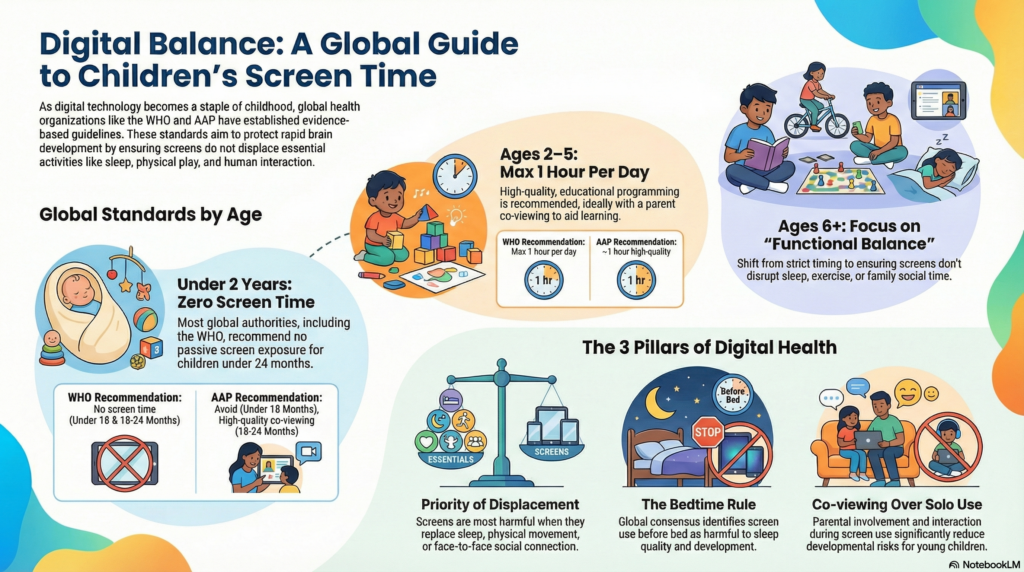 Screens have become inseparable from childhood. Smartphones, tablets, televisions, laptops, online classrooms, and gaming consoles now shape how children learn, relax, and socialize. While digital technology offers undeniable benefits, excessive or poorly regulated screen use has emerged as a global public health concern.
In response, international health organizations have issued screen time guidelines for children, based on developmental neuroscience, behavioral research, and long-term outcome studies. Interestingly, while exact limits vary across countries, the core principles are strikingly similar worldwide.
This article presents a global, evidence-based overview of screen usage guidelines for children, explains the scientific rationale behind them, and offers a practical, clinician-friendly interpretation for parents and caregivers.
Why Screen Time Guidelines Matter in Childhood
Early childhood is a period of rapid brain development. Neural circuits governing attention, emotional regulation, language, executive function, and social cognition are shaped by real-world interaction, play, movement, and caregiver engagement.
Excessive or unstructured screen exposure during sensitive developmental windows has been associated with:
-
Delayed language development
-
Reduced attention span
-
Sleep disturbances
-
Behavioral dysregulation
-
Increased risk of problematic digital use in adolescence
Importantly, screens are not inherently harmful. The risk lies in displacement—when screens replace sleep, physical activity, unstructured play, or human connection.
World Health Organization (WHO) Screen Time Guidelines
The WHO focuses on children under five years and integrates screen exposure into broader recommendations on physical activity and sleep.
WHO Recommendations:
-
Under 1 year: No screen time
-
1–2 years: Screen time not recommended
-
2–4 years: Maximum 1 hour per day (less is better)
Scientific Basis:
The WHO emphasizes that young children learn best through sensorimotor experiences and responsive human interaction, not passive digital consumption.
American Academy of Pediatrics (AAP) Guidelines
The AAP adopts a pragmatic, family-centered approach that recognizes the inevitability of screens.
AAP Screen Time Recommendations:
-
Below 18 months: Avoid screens (except video calls)
-
18–24 months: High-quality content with adult co-viewing
-
2–5 years: Around 1 hour/day of high-quality programming
-
6 years and older: Consistent limits tailored to family routines
Key Concept:
The AAP emphasizes content quality, co-viewing, and balance, rather than rigid time policing.
United Kingdom (NHS & RCPCH): Context Over Counting
Unlike other countries, the UK avoids specifying exact time limits for older children.
Instead, the Royal College of Paediatrics and Child Health (RCPCH) recommends asking:
-
Is screen use compulsive?
-
Does it interfere with sleep?
-
Does it disrupt family life or mood?
This approach reflects an understanding that functional impairment matters more than raw screen hours.
European Approaches: France Takes a Firm Stand
France has one of the strictest screen policies globally:
-
No screens before age 3
-
No personal screens before age 6
-
Gradual, supervised digital exposure after foundational literacy
French guidelines explicitly state that screens should not replace early cognitive and emotional development processes.
Canada and Australia: Movement-Centric Models
Canada (24-Hour Movement Guidelines):
-
Under 2 years: No screen time
-
2–4 years: Less than 1 hour/day
-
Emphasizes the balance between sleep, physical activity, and sedentary behavior
Australia:
-
Under 2 years: No screens
-
2–5 years: Less than 1 hour/day
-
Strong focus on outdoor play and parental role modeling
Both countries frame screen time as part of a child’s daily rhythm, not an isolated variable.
Asia: High Digital Exposure, Emerging Regulation
In countries like South Korea, Japan, China, and Singapore, screen exposure is high due to academic pressure and digital infrastructure.
-
South Korea: Digital overuse recognized as a public health issue
-
Japan: Advises screen reduction, especially before bedtime
-
China: Enforces strict gaming limits for minors
Asian policies focus heavily on gaming addiction, academic displacement, and sleep disruption.
What Global Screen Time Guidelines Agree On
Despite cultural differences, international guidelines converge on five principles:
-
Early childhood screen exposure should be minimal
-
Screens should never replace sleep, play, or relationships
-
Bedtime screen use is harmful
-
Parental involvement significantly reduces risk
-
Children with neurodevelopmental vulnerabilities are more susceptible
No major health authority considers unrestricted screen exposure safe for young children.
Screen Time and Mental Health: A Clinical Perspective
From a psychiatric standpoint, screens rarely cause disorders directly. Problems arise when screens become:
-
Primary emotional regulators
-
Tools for avoiding distress or boredom
-
Replacements for interpersonal connection
-
Sources of constant dopaminergic stimulation
Children with ADHD, autism spectrum disorder, anxiety, or emotional dysregulation are particularly vulnerable to problematic screen use patterns.
Practical Guidance for Parents: Beyond Minutes and Timers
Rather than focusing only on time limits, parents can assess screen use by asking:
-
Is my child sleeping adequately?
-
Can my child tolerate boredom?
-
Does screen use escalate emotional outbursts?
-
Is physical play happening daily?
-
Are screens used intentionally or automatically?
When these domains remain intact, screen use is likely within healthy limits.
The Future: From Screen Time to Screen Literacy
The global conversation is shifting from “How much screen time?” to:
-
What kind of content?
-
At what developmental stage?
-
With what guidance?
-
For what purpose?
The goal is not digital abstinence—but digital self-regulation.
Children must learn to coexist with technology, not be consumed by it.
Final Takeaway
Global screen time guidelines are not about fear or prohibition. They are about protecting the developing brain, preserving childhood experiences, and fostering emotional resilience in a digital world.
Screens are powerful tools.
Children need powerful guidance.
Dr. Srinivas Rajkumar T, MD (AIIMS, New Delhi), DNB, MBA (BITS Pilani)
Consultant Psychiatrist & Neurofeedback Specialist
Mind & Memory Clinic, Apollo Clinic Velachery (Opp. Phoenix Mall)
✉ srinivasaiims@gmail.com 📞 +91-8595155808