How Misinformation Wins Elections: Lessons from How to Win an Indian Election
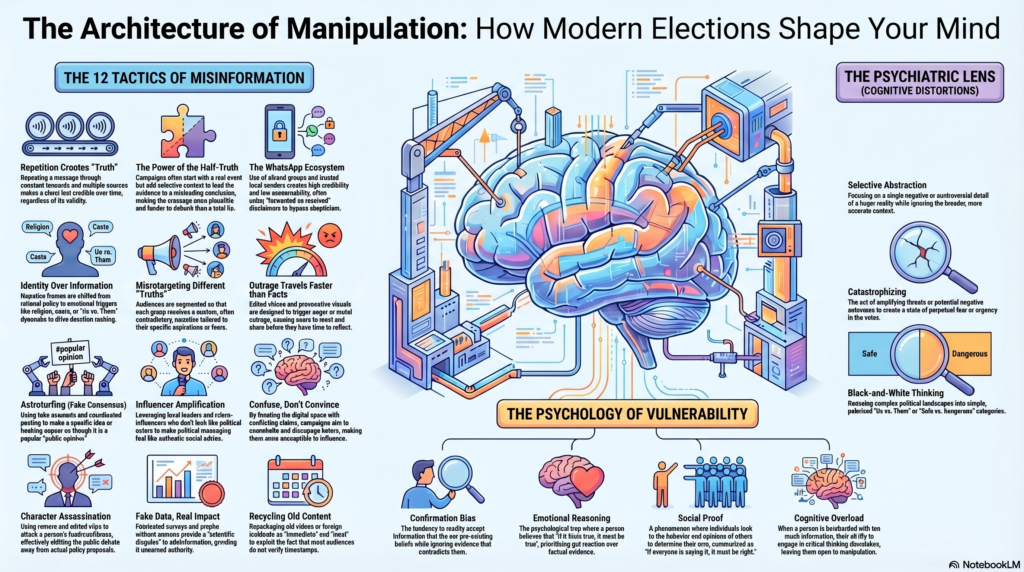 In the age of smartphones and social media, elections are no longer fought only on the ground—they are fought in the mind.
In How to Win an Indian Election, political strategist Shivam Shankar Singh offers a rare insider view into how modern campaigns shape voter perception. One of the most striking takeaways from the book is this:
Elections today are less about changing minds—and more about controlling the information ecosystem in which minds operate.
This article unpacks the misinformation strategies described in the book, while also examining the psychology that makes them so effective.
🧠 The New Battlefield: Your Attention
Earlier, campaigns focused on:
- Rallies
- Manifestos
- Media debates
Today, the real battleground is:
- WhatsApp groups
- Short videos
- Hyperlocal narratives
Information is no longer scarce—it is engineered, targeted, and repeated.
🔁 1. Repetition Creates “Truth”
One of the most powerful tools is simple:
👉 Repeat a message enough times, and it starts feeling true.
This is known as the illusory truth effect. A claim—no matter how weak—gains credibility through:
- Constant forwards
- Multiple sources
- Familiar phrasing
Over time, familiarity replaces verification.
🧩 2. Half-Truths Work Better Than Lies
Blatant lies can be exposed.
Half-truths cannot.
A typical misinformation structure:
- Start with a real event ✔
- Add selective context ❌
- Lead the audience to a misleading conclusion
This makes the message:
- Plausible
- Shareable
- Defensible
📲 3. The WhatsApp Ecosystem
In India, WhatsApp has become the primary carrier of political messaging.
Why it works:
- Closed groups → low accountability
- Trusted senders → high credibility
- Regional language → emotional resonance
Common patterns:
- “Forwarded as received” disclaimers
- Fake quotes attributed to leaders
- Emotional narratives around religion, nationalism, or fear
🎭 4. Identity Over Information
Facts rarely change minds.
Identity does.
Campaigns often trigger:
- Religion
- Caste
- Regional belonging
By framing narratives as:
- “Us vs Them”
- “Threat vs Protection”
They shift decision-making from rational to emotional.
🧪 5. Microtargeting: Different Truths for Different People
Not every voter sees the same message.
Campaigns segment audiences:
- Youth → jobs, pride, aspiration
- Rural voters → welfare, subsidies
- Urban middle class → taxes, development
Each group receives a custom narrative, often contradictory to others.
🧨 6. Outrage Travels Faster Than Facts
Emotionally charged content spreads faster than neutral information.
Especially:
- Anger
- Fear
- Moral outrage
Edited videos, misleading headlines, and provocative visuals are used to:
👉 Trigger reaction before reflection
🧵 7. Fake Consensus (Astroturfing)
Ever seen:
- Thousands of similar comments?
- A hashtag suddenly trending?
This is often engineered.
Through:
- Fake accounts
- Coordinated posting
- Paid amplification
The goal:
👉 Make an idea look like “public opinion”
🧑🤝🧑 8. Influencer Amplification
People trust people more than institutions.
So campaigns use:
- Local leaders
- Community figures
- Micro-influencers
These individuals:
- Don’t look like political actors
- Carry social credibility
👉 Making misinformation feel authentic
🪤 9. Confuse, Don’t Convince
Sometimes the goal isn’t persuasion.
It’s confusion.
By flooding the space with:
- Multiple narratives
- Conflicting claims
People become:
- Overwhelmed
- Disengaged
👉 And disengaged voters are easier to influence.
📉 10. Attack the Person, Not the Policy
Character assassination is a key tactic:
- Rumors
- Edited clips
- Personal allegations
This shifts focus from:
👉 “What is being proposed?”
to
👉 “Can this person be trusted?”
🧾 11. Fake Data, Real Impact
Numbers create authority.
Even when false.
Common tactics:
- Fabricated surveys
- Misrepresented statistics
- Graphs without sources
👉 Data gives misinformation a scientific disguise
🔄 12. Recycling Old Content
Old videos, unrelated incidents, and foreign clips are:
- Repackaged
- Reframed
- Redistributed
Most audiences:
- Don’t verify timestamps
- Assume immediacy
🧠 Why Do These Tactics Work?
From a psychological perspective, these strategies exploit:
1. Confirmation Bias
We accept information that fits our beliefs.
2. Emotional Reasoning
“If it feels true, it must be true.”
3. Social Proof
“If everyone is saying it, it must be right.”
4. Cognitive Overload
Too much information → less critical thinking
🧭 A Psychiatric Lens
Interestingly, many of these patterns resemble clinical cognitive distortions:
- Selective abstraction → focusing on one part of reality
- Catastrophizing → amplifying threats
- Black-and-white thinking → us vs them
At a societal level, misinformation can function like:
👉 A collective cognitive bias loop
⚖️ What This Means for Voters
The book makes one thing clear:
👉 Elections are not just fought on policies—they are fought on perception.
And perception is:
- Built
- Reinforced
- Manipulated
🧩 Final Thought
Misinformation doesn’t win because people are unintelligent.
It wins because it is:
- Emotionally intelligent
- Psychologically precise
- Technologically amplified
The real challenge is not just detecting misinformation.
👉 It is developing the mental discipline to pause, question, and verify—especially when something feels immediately convincing.
📢 About the Author
Dr. Srinivas Rajkumar T, MD (AIIMS, New Delhi), DNB, MBA (BITS Pilani)
Consultant Psychiatrist & Neurotechnology Specialist
Mind & Memory Clinic, Apollo Clinic Velachery (Opp. Phoenix Mall)
✉ srinivasaiims@gmail.com 📞 +91-8595155808
If you’re interested in understanding how cognition, emotion, and behavior shape decision-making—whether in mental health or everyday life—reach out for a consultation or follow the ongoing blog series at srinivasaiims.com.