How Parents Can Handle Screen Addiction in Children
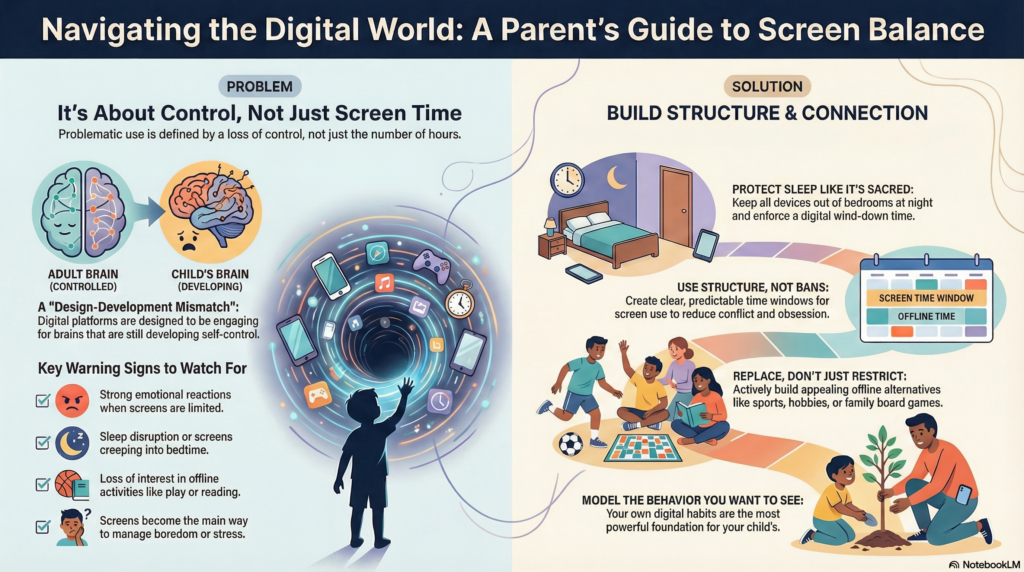 A practical, calm, and evidence-informed guide
Screen use in children is no longer a side issue—it is part of daily life. Phones, tablets, online classes, games, and social media now sit alongside school, play, and family time. Many parents sense something is off long before anyone uses the word addiction: irritability when devices are removed, loss of interest in offline activities, bedtime battles, slipping academics, or a child who seems constantly “mentally elsewhere.”
The goal of this article is not to demonize screens or promote unrealistic bans. It is to help parents regain influence—gently, consistently, and effectively—over how screens shape their child’s brain, habits, and emotions.
First, let’s clarify: what does “screen addiction” really mean?
In children, screen addiction rarely looks like substance addiction. It shows up as loss of control rather than sheer quantity.
Common warning signs include:
-
Strong emotional reactions when screens are limited
-
Difficulty stopping despite clear rules
-
Progressive increase in screen use over time
-
Sleep disruption
-
Reduced interest in reading, play, or family interaction
-
Screens becoming the primary way to regulate boredom, stress, or low mood
The problem is not screens themselves. The problem is when screens become the main regulator of emotion, attention, and reward.
Why children are especially vulnerable
Children’s brains are still under construction. Three systems are particularly relevant:
-
The reward system – highly sensitive to novelty and instant feedback
-
The attention system – still learning sustained focus
-
The self-control system – the last to mature
Most digital platforms are designed to:
-
Deliver rapid rewards
-
Encourage constant checking
-
Reduce natural stopping points
This is not a moral failure of parenting. It is a design–development mismatch.
The most important shift: stop counting hours, start watching patterns
Parents often ask, “How many hours is too much?”
A better question is: Is screen use escalating and crowding out other parts of life?
Red flags include:
-
Screen time rising month by month
-
Screens creeping into bedtime
-
Screens replacing reading, play, or outdoor activity
-
Increasing conflict around devices
Patterns matter more than absolute numbers.
Core principles for managing screen addiction (that actually work)
1. Lead with regulation, not confrontation
When a child is dysregulated, logic will not work. Angry lectures strengthen resistance.
What helps instead:
-
Calm tone
-
Predictable rules
-
Consistent follow-through
Children borrow regulation from adults before they can generate it themselves.
2. Protect sleep like it is sacred
Sleep is the single most powerful protective factor against screen addiction.
Practical rules:
-
No screens in bedrooms at night
-
Devices charge outside the room
-
A fixed digital “wind-down” time (30–60 minutes before bed)
-
Notifications off at night
Many screen-related problems dramatically improve once sleep stabilizes.
3. Use structure, not bans
Total bans usually fail unless there is severe impairment.
Instead:
-
Create clear time windows for screen use
-
Keep screens out of meal times
-
Avoid background screen use
-
No screens during homework unless required
Predictable access reduces obsession. Unpredictable access increases craving.
4. Change the environment before changing the child
Behavior follows design.
Small environmental tweaks:
-
Remove social media and gaming apps from the home screen
-
Turn off autoplay and infinite scroll
-
Disable non-essential notifications
-
Use grayscale mode on phones if needed
These changes reduce compulsive use without confrontation.
5. Replace, don’t just restrict
Removing screens without adding alternatives creates a vacuum.
Actively build offline rewards:
-
Sports or physical play
-
Music, art, or building activities
-
Family rituals (walks, board games, shared reading)
-
Age-appropriate responsibilities
A child needs something to move towards, not just something taken away.
6. Delay personal smartphones when possible
For younger children:
-
Shared devices are better than personal ones
-
Phones without social media or games are often sufficient
-
Smartwatches with calling can meet safety needs without full access
Later introduction = better self-regulation.
7. Model the behavior you want to see
Children watch far more than they listen.
Ask yourself:
-
Is my phone present at meals?
-
Do I scroll when bored or stressed?
-
Do I respond to notifications instantly?
Parental digital hygiene is not optional—it is the foundation.
8. Talk about screens as tools, not temptations
Avoid framing screens as forbidden fruit.
Better conversations include:
-
“What do you enjoy about this game?”
-
“How do you feel after long screen time?”
-
“What helps you stop more easily?”
Curiosity reduces secrecy. Secrecy fuels addiction.
Age-specific strategies
Young children (under 7 years)
-
Prioritize physical play and sensory experiences
-
Avoid fast-paced, overstimulating content
-
Co-view whenever possible
-
Keep screens out of daily routines (eating, sleeping)
School-age children (7–12 years)
-
Clear rules with visual schedules
-
Screen time only after homework and physical activity
-
Encourage hobbies that build skill and patience
-
Begin conversations about self-control
Adolescents
-
Focus on sleep, autonomy, and trust
-
Negotiate boundaries rather than impose them
-
Watch for escalation rather than absolute time
-
Address underlying stress, anxiety, or academic pressure
When to seek professional help
Consider consulting a mental health professional if:
-
Screen use causes severe conflict or distress
-
There is academic collapse
-
Sleep is persistently disrupted
-
The child shows anxiety, depression, or aggression
-
Attempts at structure consistently fail
Screen addiction is often a symptom, not the root problem.
The long view: what really helps children thrive
Children do not need perfect screen rules.
They need:
-
Sleep
-
Structure
-
Emotional connection
-
Meaningful offline experiences
-
Adults who are calm, consistent, and present
Screens will remain part of childhood. Our job is not to eliminate them—but to ensure they do not replace development itself.
Small, steady changes beat dramatic interventions.
Design the environment well, and behavior will follow.
References
-
Nagata JM, Wong JH, Kim KE, et al. Social media use trajectories and cognitive performance in adolescents. JAMA. 2025;334(21):1948–1950.
-
Madigan S, Yeates KO, Fearon P. Developmental costs of youth social media require policy action. JAMA. 2025;334(21):1891–1892.
-
Office of the Surgeon General. Social media and youth mental health: advisory. U.S. Department of Health and Human Services; 2023.
-
Boer M, Stevens GWJM, Finkenauer C, van den Eijnden RJJM. The course of problematic social media use in young adolescents. Child Dev. 2022;93(2):e168–e187.
-
Stiglic N, Viner RM. Effects of screentime on the health and well-being of children and adolescents: a systematic review. BMJ Open. 2019;9:e023191.
About the author
Dr. Srinivas Rajkumar T, MD (AIIMS, New Delhi)
Consultant Psychiatrist
Apollo Clinic Velachery (Opp. Phoenix Mall), Chennai
Dr. Srinivas works with children, adolescents, and families on attention, sleep, emotional regulation, and digital behavior concerns, combining clinical psychiatry with neuroscience-informed, practical strategies.
✉ srinivasaiims@gmail.com
📞 +91-8595155808