How to Predict Divorce: What Science Says About Relationship Breakdown
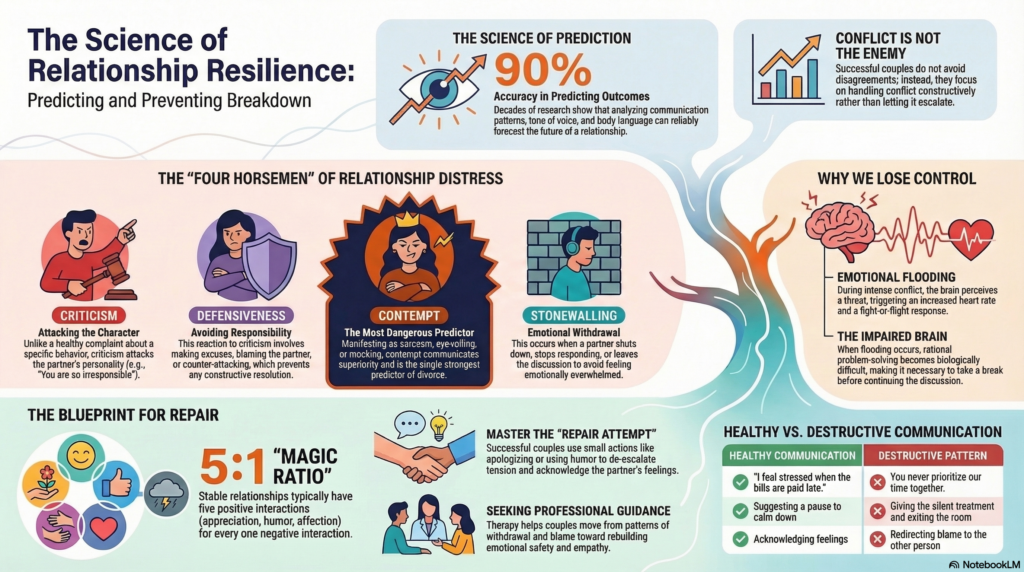 Marriage rarely collapses suddenly. In most cases, the breakdown begins long before separation or divorce is even discussed. Small patterns of communication, repeated over months or years, gradually erode emotional connection.
Modern relationship science has shown something remarkable: certain behavioral patterns can predict divorce with surprising accuracy. Understanding these patterns can help couples recognize early warning signs and potentially repair their relationship before it reaches a breaking point.
This article explores the psychological science behind predicting divorce, and what couples can do to protect their relationships.
Can Divorce Really Be Predicted?
Yes—at least statistically.
Relationship researcher John Gottman conducted decades of studies observing couples interact in laboratory settings. His research demonstrated that by analyzing communication patterns, relationship outcomes could be predicted with up to 90% accuracy.
In these studies, couples were asked to discuss a conflict while researchers recorded:
-
facial expressions
-
tone of voice
-
body language
-
emotional responses
-
physiological stress markers
What emerged was a consistent pattern: certain communication styles reliably predicted relationship breakdown.
Why Communication Matters More Than Conflict
One of the most important findings in marital research is this:
Successful couples are not those who avoid conflict.
Instead, they are couples who handle conflict constructively.
Every long-term relationship involves disagreements about finances, parenting, responsibilities, or lifestyle. Conflict itself is not dangerous. What damages relationships is the emotional tone of the interaction.
Some communication patterns escalate tension and damage trust. Others allow couples to resolve problems while maintaining emotional safety.
The Four Behaviors That Predict Divorce
Researchers identified four communication patterns that strongly predict relationship breakdown. These behaviors are famously called “The Four Horsemen.”
1. Criticism
Criticism occurs when one partner attacks the other’s character rather than discussing a specific problem.
Example:
Healthy complaint:
“I feel stressed when the bills are paid late.”
Criticism:
“You are so irresponsible.”
Repeated criticism makes the partner feel constantly judged and inadequate, creating emotional distance.
2. Defensiveness
Defensiveness is a natural reaction to criticism, but it prevents constructive problem solving.
Common defensive responses include:
-
making excuses
-
denying responsibility
-
blaming the partner
-
counter-attacking
When both partners become defensive, conversations turn into cycles of blame rather than attempts to solve the issue.
3. Contempt (The Most Dangerous Predictor)
Contempt is the strongest predictor of divorce.
It includes behaviors such as:
-
sarcasm
-
mocking
-
eye-rolling
-
insults
-
hostile humor
Contempt communicates superiority and disrespect. Over time, it destroys emotional intimacy and mutual respect within the relationship.
Interestingly, research also suggests that contempt in relationships may contribute to increased stress and poorer physical health.
4. Stonewalling
Stonewalling occurs when one partner emotionally withdraws from the conversation.
Signs include:
-
silence
-
avoiding eye contact
-
short responses
-
leaving the discussion
Stonewalling usually occurs when a person becomes emotionally overwhelmed. At that stage, productive conversation becomes extremely difficult.
Emotional Flooding: When Conflict Overwhelms the Brain
During intense arguments, many people experience emotional flooding.
This state includes:
-
increased heart rate
-
difficulty thinking clearly
-
strong urge to escape the discussion
When the brain perceives threat, the body activates the fight-or-flight response. In this state, rational problem-solving becomes impaired.
Healthy couples often manage this by taking short breaks during heated discussions, allowing emotional regulation before continuing the conversation.
The “Magic Ratio” That Protects Relationships
Research has shown that stable relationships maintain approximately:
5 positive interactions for every 1 negative interaction
Positive interactions include:
-
appreciation
-
humor
-
affection
-
emotional support
-
expressions of interest
This balance creates an emotional buffer. Even when disagreements occur, the relationship remains fundamentally supportive.
When the ratio drops toward equal negative and positive interactions, the risk of relationship dissatisfaction increases significantly.
The Role of Repair Attempts
Healthy couples frequently use repair attempts during conflict.
Repair attempts are small actions that reduce tension, such as:
-
apologizing
-
acknowledging the partner’s feelings
-
using humor
-
suggesting a pause in the discussion
The success of repair attempts is a major predictor of relationship stability.
Couples who accept these attempts and de-escalate conflict are far less likely to divorce.
Patient Education: Signs Your Relationship May Need Attention
While every relationship experiences conflict, certain patterns may signal growing distress.
Couples may benefit from counseling if they notice:
-
frequent criticism or blame
-
sarcastic or disrespectful communication
-
emotional withdrawal during discussions
-
inability to resolve recurring conflicts
-
growing emotional distance between partners
Seeking professional help early can prevent these patterns from becoming entrenched.
Couples therapy focuses on:
-
improving communication
-
rebuilding emotional safety
-
understanding each partner’s emotional needs
-
learning constructive conflict resolution strategies
The Good News: Relationships Can Improve
One of the most hopeful findings in relationship science is that communication patterns can change.
Couples who learn healthier communication strategies often experience significant improvements in relationship satisfaction.
Healthy relationships are built on:
-
respect
-
emotional responsiveness
-
empathy
-
constructive dialogue
-
appreciation of each other
Small changes in everyday interactions can significantly strengthen emotional bonds.
Final Thoughts
Divorce rarely results from a single dramatic event. More often, it reflects a gradual pattern of communication breakdown and emotional disconnection.
The science of relationships shows that by recognizing destructive patterns early—criticism, defensiveness, contempt, and withdrawal—couples can take steps to repair their connection.
Awareness is the first step toward change. When couples learn healthier ways of communicating and responding to conflict, relationships often become stronger and more resilient.
Dr. Srinivas Rajkumar T, MD (AIIMS), DNB, MBA (BITS Pilani)
Consultant Psychiatrist & Neurofeedback Specialist
Mind & Memory Clinic, Apollo Clinic Velachery (Opp. Phoenix Mall)
✉ srinivasaiims@gmail.com 📞 +91-8595155808