Machine Learning and Artificial Intelligence in Psychiatry
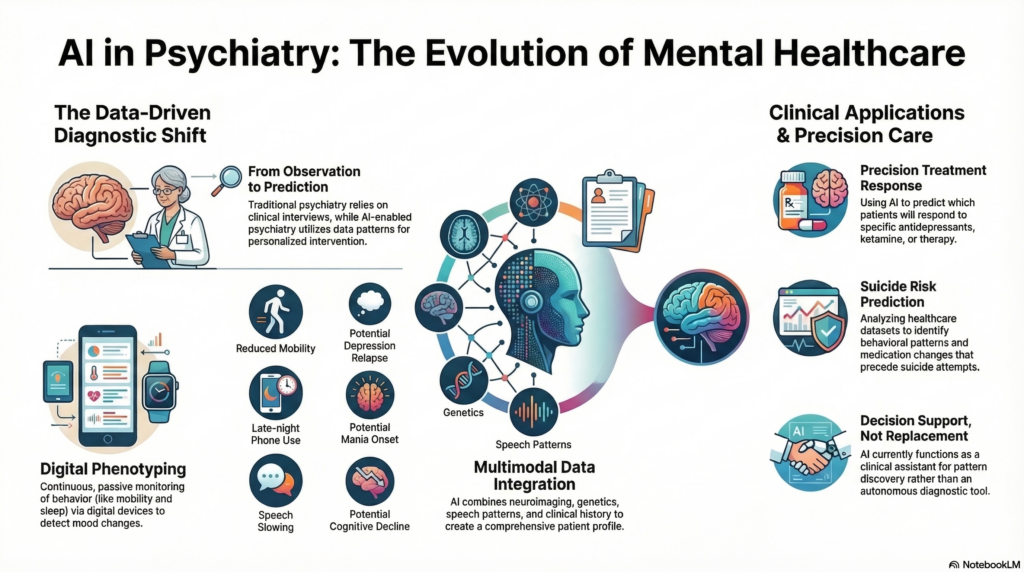 Psychiatry is increasingly intersecting with machine learning (ML), artificial intelligence (AI), computational neuroscience, and digital health technologies. While psychiatry traditionally relied on phenomenology, clinical interviews, and symptom clusters, modern research is moving toward data-driven models of mental illness.
AI in psychiatry currently functions mainly as decision-support, pattern discovery, and predictive analytics, rather than autonomous clinical diagnosis.
Key Terminology in AI and Machine Learning for Psychiatry
| Term | Definition | Psychiatric Relevance |
|---|---|---|
| Artificial Intelligence (AI) | Broad field of systems performing tasks requiring human-like intelligence | Automated analysis of behavioral and clinical data |
| Machine Learning (ML) | Algorithms that learn patterns from data | Predicting diagnosis, relapse risk, treatment response |
| Deep Learning | Neural networks with multiple layers | Image and speech analysis in psychiatry |
| Supervised Learning | Models trained using labeled data | Diagnosing depression from speech samples |
| Unsupervised Learning | Identifying patterns without labeled outcomes | Discovering subtypes of schizophrenia |
| Reinforcement Learning | Models learning through feedback rewards | Adaptive therapy interventions |
| Natural Language Processing (NLP) | AI analysis of human language | Detecting depression from speech or text |
| Explainable AI (XAI) | Methods that reveal how models make decisions | Ensuring clinical transparency |
| Digital Phenotyping | Continuous behavioral monitoring using digital devices | Passive detection of mood changes |
| Precision Psychiatry | Personalized treatment using biological and behavioral data | Targeted interventions |
Types of Data Used in AI Psychiatry
AI models integrate multimodal psychiatric datasets.
| Data Type | Example Signals | Clinical Use |
|---|---|---|
| Clinical Data | Symptoms, diagnoses, medications | Predict treatment response |
| Neuroimaging | fMRI, structural MRI, EEG | Biomarker discovery |
| Behavioral Data | Activity, sleep, mobility | Monitoring relapse |
| Speech Data | Prosody, semantic structure | Depression and psychosis detection |
| Genetic Data | SNP variants, polygenic risk scores | Risk prediction |
| Digital Data | Smartphone usage, typing patterns | Digital phenotyping |
| Physiological Data | HRV, galvanic skin response | Anxiety and stress detection |
Major Applications of AI in Psychiatry
1. Diagnostic Prediction
Machine learning models analyze clinical and biological data to identify patterns associated with psychiatric disorders.
| Disorder | AI Approach | Data Source |
|---|---|---|
| Depression | NLP + EEG models | Speech, EEG |
| Schizophrenia | MRI-based classifiers | Brain imaging |
| ADHD | Behavioral ML models | Cognitive tests |
| Autism | Deep learning | Eye-tracking and behavior |
However, AI diagnosis is not yet clinically validated for routine practice.
2. Treatment Response Prediction
Psychiatry often relies on trial-and-error pharmacotherapy. AI models attempt to predict which patients respond to which treatment.
| Treatment | AI Biomarker |
|---|---|
| Antidepressants | EEG connectivity patterns |
| Ketamine therapy | Functional brain network markers |
| CBT response | Linguistic markers in therapy transcripts |
| Antipsychotics | Genetic and imaging predictors |
This area represents the core of precision psychiatry.
3. Digital Phenotyping
Digital phenotyping refers to continuous monitoring of behavior using personal devices.
| Signal | Psychiatric Meaning |
|---|---|
| Reduced mobility | Depression relapse |
| Increased late-night phone use | Mania onset |
| Decreased social interaction | Social withdrawal |
| Speech slowing | Cognitive decline |
AI analyzes these patterns to detect subclinical deterioration.
4. Suicide Risk Prediction
Large healthcare datasets allow AI models to detect patterns preceding suicide attempts.
Predictive variables may include:
| Predictor | Example |
|---|---|
| Prior hospitalizations | Psychiatric admissions |
| Medication changes | Rapid antidepressant switching |
| Social stressors | Divorce or job loss |
| Behavioral patterns | Isolation, sleep disruption |
These models aim to support early intervention.
Machine Learning Models Commonly Used in Psychiatry
| Algorithm | Function | Example Use |
|---|---|---|
| Logistic Regression | Probability classification | Depression prediction |
| Decision Trees | Rule-based classification | Symptom clustering |
| Random Forest | Ensemble decision trees | Treatment response models |
| Support Vector Machines | High-dimensional classification | Neuroimaging analysis |
| K-Means Clustering | Unsupervised grouping | Identifying patient subtypes |
| Neural Networks | Deep learning pattern detection | Imaging analysis |
| Bayesian Models | Probabilistic inference | Risk prediction |
Model Evaluation Metrics
To evaluate performance, ML models use several statistical metrics.
| Metric | Meaning |
|---|---|
| Accuracy | Overall correct predictions |
| Precision | Correct positive predictions |
| Recall (Sensitivity) | Ability to detect true cases |
| F1 Score | Balance of precision and recall |
| AUC-ROC | Model discrimination ability |
| Confusion Matrix | Classification performance per class |
High accuracy alone can be misleading due to class imbalance or overfitting.
Explainable AI in Psychiatry
Clinical adoption requires interpretability.
Common explainable AI tools include:
| Method | Purpose |
|---|---|
| SHAP values | Feature contribution analysis |
| LIME | Local explanation of predictions |
| Feature importance | Ranking predictive variables |
| Decision trees | Transparent rule-based models |
Explainability allows clinicians to understand why a prediction was made.
Limitations of AI in Psychiatry
Despite progress, major challenges remain.
| Challenge | Explanation |
|---|---|
| Small datasets | Many studies have limited samples |
| Overfitting | Models fail in new populations |
| Cultural variability | Emotional expression differs globally |
| Ethical concerns | Privacy and data misuse |
| Lack of biomarkers | Psychiatric constructs remain heterogeneous |
AI models often perform well in research datasets but poorly in real-world settings.
Current Clinical Reality
AI is not replacing psychiatrists.
Present-day applications are mostly supportive:
| Practical Use | Example |
|---|---|
| Clinical documentation | AI-assisted notes |
| Research analysis | Neuroimaging ML studies |
| Psychoeducation | AI-generated educational material |
| Monitoring tools | Wearable mental health trackers |
Clinical diagnosis still relies on human expertise and patient narratives.
Future Directions
Several developments are expected in the next decade:
| Direction | Impact |
|---|---|
| Multimodal datasets | Integration of brain, behavior, and genetics |
| Precision psychiatry | Personalized treatment algorithms |
| Continuous monitoring | AI-based relapse detection |
| AI-assisted psychotherapy | Digital CBT and coaching tools |
However, ethical governance and clinical oversight will remain essential.
Conceptual Summary
AI in psychiatry represents a shift from symptom-based classification toward computational models of mental illness.
Traditional psychiatry focuses on:
Clinical observation → Diagnosis → Treatment
AI-enabled psychiatry adds:
Data patterns → Prediction → Personalized intervention
The future will likely involve collaboration between clinicians, neuroscientists, and data scientists, combining computational insight with human understanding.
Dr. Srinivas Rajkumar T, MD (AIIMS), DNB, MBA (BITS Pilani)
Consultant Psychiatrist & Neurofeedback Specialist
Mind & Memory Clinic, Apollo Clinic Velachery (Opp. Phoenix Mall)
✉ srinivasaiims@gmail.com 📞 +91-8595155808