Mobile Addiction in Teenagers What Parents and Teachers Should Do
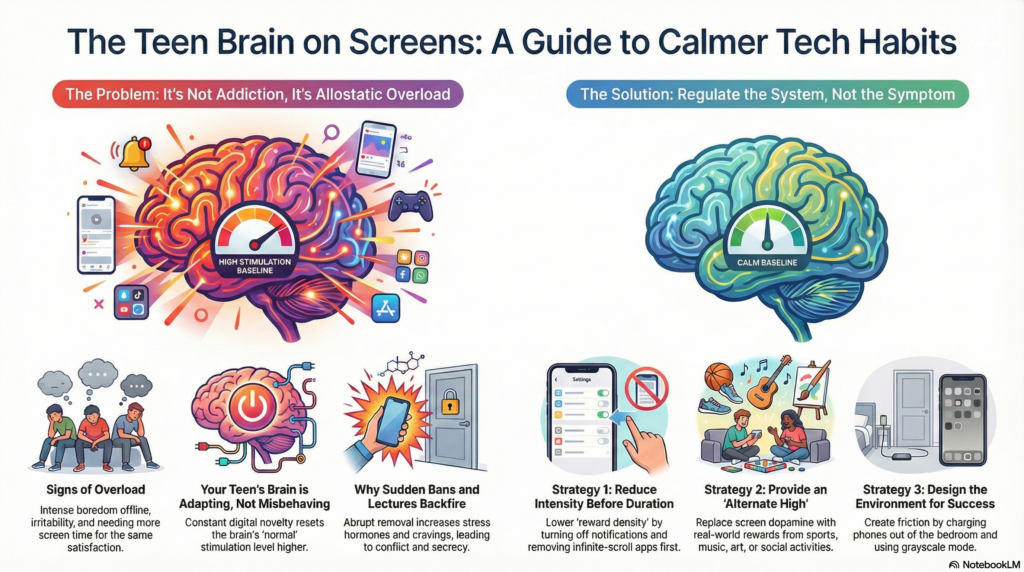 Mobile addiction in teenagers is best understood not as misbehavior, but as a predictable outcome of how adolescent brains adapt to chronic digital stimulation. When we frame the problem correctly, solutions become calmer, smarter, and far more effective.
This article integrates three key ideas:
-
Allostasis (how the brain adapts to repeated stress and stimulation)
-
Behavioral addiction (habit loops without substances)
-
Specific behavior-change techniques such as alternate high and reverse shaping
1. Reframing the problem: from “addiction” to allostatic overload
Teenagers are not weak-willed. Their brains are adapting.
Allostasis, explained simply
Allostasis means stability through change.
The brain constantly adjusts its baseline to match the environment.
When a teenager is exposed to:
-
Constant novelty
-
Social evaluation (likes, views, messages)
-
Rapid rewards
-
Endless scrolling
…the brain resets its “normal” level of stimulation upward.
This is called allostatic load.
What allostatic overload looks like in daily life
-
Boredom feels unbearable without a phone
-
Offline activities feel “flat” or “slow”
-
Irritability when stimulation drops
-
Difficulty sustaining attention
-
Needing more screen time for the same satisfaction
This is not addiction in a moral sense.
It is adaptive brain recalibration—but in the wrong direction.
2. Mobile addiction as a behavioral addiction (not a habit)
Mobile overuse fits the model of behavioral addiction, similar to gaming or gambling.
Key features:
-
Compulsive use
-
Loss of control
-
Escalation over time
-
Withdrawal-like irritability
-
Use for mood regulation
Importantly, there is no chemical dependence—but the dopamine learning loops are real.
This distinction matters because:
-
Punishment doesn’t work
-
Willpower-based strategies fail
-
Environment and reinforcement must change
3. Why bans and lectures backfire (neurobiology explains why)
When phones are suddenly removed:
-
The brain experiences a reward drop
-
Stress hormones rise
-
Emotional regulation worsens
This triggers:
-
Anger
-
Secrecy
-
Rebound overuse
-
Power struggles
From a brain perspective, sudden deprivation increases craving.
That’s why effective strategies focus on reshaping reward, not removing it abruptly.
4. Core principle: regulate the system, not the symptom
The goal is not “less phone use.”
The goal is to lower the brain’s stimulation baseline safely.
This is where named techniques matter.
5. Technique 1: Reverse Shaping (reduce without triggering withdrawal)
Reverse shaping means reducing intensity before reducing duration.
Instead of:
❌ “Cut phone time from 4 hours to 1 hour”
Do this:
-
Turn off autoplay
-
Disable notifications
-
Remove short-form video apps first
-
Keep messaging, remove infinite scroll
Why it works:
-
The brain still gets access
-
But reward density drops
-
Craving reduces naturally
This gently lowers allostatic load.
6. Technique 2: Alternate High (replace dopamine, don’t remove it)
Teenagers need high-reward alternatives.
Low-stimulation advice (like “read a book”) often fails early.
Alternate high means offering:
-
Physical intensity (sports, gym, cycling)
-
Skill-based flow (music, coding, art)
-
Social reward (team activities, real-world peers)
-
Novel challenge (projects, competitions)
Rule of thumb:
You cannot remove a high-dopamine behavior without offering another high-dopamine pathway.
Over time, these alternatives retrain reward circuits.
7. Technique 3: Environmental Friction (design beats discipline)
Behavioral addiction responds better to friction than rules.
Effective friction strategies:
-
Apps off the home screen
-
Phone kept in another room during study
-
Notifications off by default
-
Charging station outside bedrooms
-
Grayscale mode on phones
These reduce automatic use without confrontation.
8. Technique 4: Sleep Anchoring (resetting the system overnight)
Sleep is the fastest way to reduce allostatic load.
Non-negotiable anchors:
-
No phone in bed
-
Fixed digital sunset
-
Devices charging outside bedrooms
-
Consistent sleep–wake times
Sleep restoration improves:
-
Attention
-
Mood
-
Impulse control
-
Motivation for offline activities
Often, screen “addiction” weakens dramatically once sleep stabilizes.
9. What teachers should do (from a neurobehavioral lens)
Shift from punishment to predictability
-
Clear, consistent phone rules
-
Same expectations across teachers
-
Phones physically out of reach, not just silent
Predictability reduces stress-driven defiance.
Teach attention as a trainable skill
-
Explain attention fatigue
-
Normalize focus breaks
-
Encourage phone-free reading and note-taking
When teens understand the why, compliance improves.
Coordinate with parents
Mixed messages collapse progress.
Unified rules across home and school reduce friction.
10. What parents should stop doing
❌ Sudden bans
❌ Moral panic
❌ Constant monitoring
❌ Power struggles
❌ Treating phone use as the “main problem”
Remember: mobile overuse is often self-soothing for stress, anxiety, or academic pressure.
11. When to seek professional help
Consult a mental health professional if:
-
Phone use causes major conflict
-
Academic functioning collapses
-
Sleep disruption persists
-
Emotional symptoms (anxiety, depression, anger) dominate
-
Behavioral strategies repeatedly fail
Often, treating the underlying distress reduces screen dependence naturally.
The long view
Teenagers are not addicted to phones.
They are adapting to an environment that evolved faster than their brains.
Your job as a parent or teacher is not to fight technology—but to reshape the ecosystem so development can resume.
Lower stimulation gently.
Replace reward wisely.
Design the environment well.
Behavior will follow.
About the author
Dr. Srinivas Rajkumar T, MD (AIIMS, New Delhi)
Consultant Psychiatrist
Apollo Clinic Velachery (Opp. Phoenix Mall), Chennai
Dr. Srinivas works at the intersection of adolescent psychiatry, neurocognition, and behavioral addictions, helping families and schools manage attention, sleep, emotional regulation, and digital behavior using neuroscience-informed, practical strategies.
✉ srinivasaiims@gmail.com
📞 +91-8595155808