Moodiness in Teenagers: A Practical Management Guide
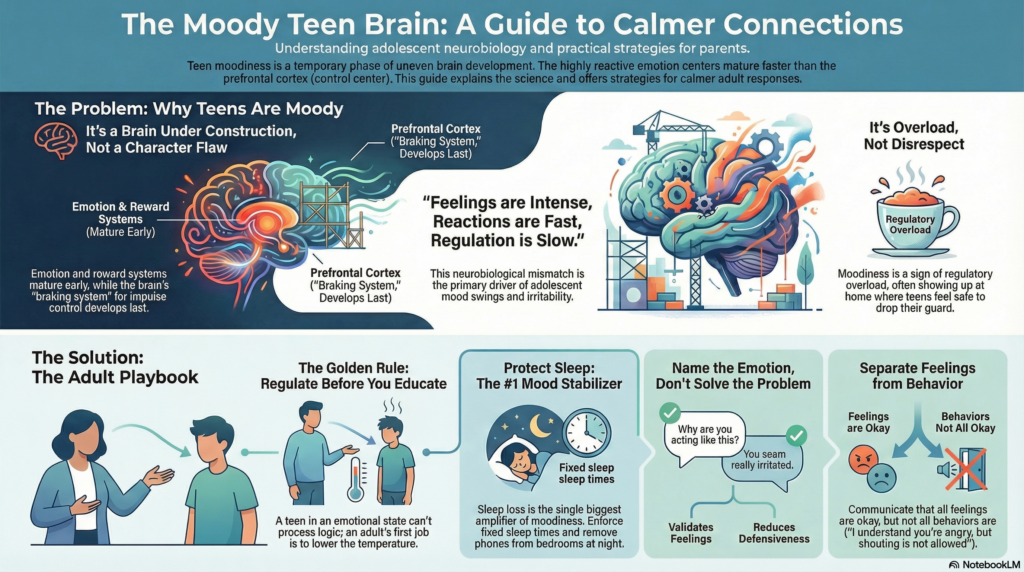 A neuroscience-informed, calm, and realistic approach for parents and teachers
Moodiness in teenagers is one of the most common—and most misunderstood—features of adolescence. Sudden irritability, emotional withdrawal, dramatic reactions to small triggers, or oscillations between closeness and distance often leave adults asking:
Is this normal… or is something wrong?
The short answer is: moodiness is developmentally expected, but persistent dysregulation is not inevitable. Understanding why it happens allows adults to respond in ways that reduce conflict rather than amplify it.
1. Why teenagers are moody (the brain-based explanation)
Adolescence is a period of neurobiological imbalance, not emotional weakness.
Three systems mature at different speeds:
-
Emotion & reward systems (amygdala, limbic circuitry): mature early and are highly reactive
-
Social sensitivity systems: peak during adolescence (peer approval matters intensely)
-
Prefrontal control systems (planning, impulse control, emotional braking): mature last
This mismatch means:
-
Feelings are intense
-
Reactions are fast
-
Regulation is slow
Moodiness is often the visible expression of this imbalance.
2. Allostasis: why moodiness clusters in the evening
Teenagers don’t just feel emotions—they adapt to stress.
Through allostasis, the brain recalibrates its baseline in response to repeated demands: academic pressure, social comparison, sleep loss, screens, family conflict.
High allostatic load looks like:
-
Irritability over small issues
-
“Nothing feels good” boredom
-
Emotional shutdown after school
-
Explosive reactions at home
This explains a common pattern:
“My child is fine at school and impossible at home.”
Home is where the nervous system finally drops its guard.
3. What moodiness is NOT
Before managing moodiness, avoid these traps:
-
❌ It is not intentional disrespect
-
❌ It is not poor character
-
❌ It is not something to be “argued away”
-
❌ It is not fixed or permanent
Moodiness reflects regulatory overload, not moral failure.
4. The single most important rule: regulate before you educate
A dysregulated teenager cannot process logic.
In emotionally charged moments:
-
Lectures fail
-
Questions provoke defensiveness
-
Reasoning escalates conflict
The adult task is first to lower emotional temperature.
This means:
-
Lower your voice
-
Fewer words
-
Neutral tone
-
Physical space if needed
Calm adults lend calm brains.
5. Practical strategies that actually help
A. Protect sleep (non-negotiable)
Sleep loss is the strongest amplifier of teenage moodiness.
Action steps:
-
Fixed sleep–wake times
-
No phones in bed
-
Devices out of bedrooms
-
30–60 minute digital wind-down before sleep
Mood regulation improves dramatically once sleep stabilizes.
B. Reduce evening overload
After school, teenagers are cognitively and emotionally depleted.
Helpful adjustments:
-
Avoid confrontations immediately after school
-
Offer food and quiet time first
-
Schedule discussions later in the evening
-
Keep expectations low during decompression hours
C. Use emotion labeling, not problem-solving
Instead of:
❌ “Why are you behaving like this?”
Try:
-
“You seem really irritated today.”
-
“Looks like it was a heavy day.”
Naming emotions activates regulation circuits and reduces escalation.
D. Separate feelings from behavior
All feelings are allowed.
Not all behaviors are.
Clear message:
“I understand you’re angry. I won’t allow shouting / insults / aggression.”
This preserves dignity while maintaining boundaries.
E. Don’t personalize withdrawal
Teenagers often need solitude to reset.
Withdrawal does not automatically mean:
-
Disrespect
-
Loss of attachment
-
Depression
Offer availability without intrusion:
-
“I’m around if you want to talk.”
-
“I’ll check back later.”
Safety comes from presence, not pressure.
6. Screens, moodiness, and emotional regulation
For many teens, phones become emotional regulators.
Warning signs:
-
Increased irritability when devices are removed
-
Late-night scrolling
-
Mood improves only with screen access
-
Offline activities feel “boring”
Management principles:
-
Phones out of bedrooms
-
Clear time windows
-
Reduced notifications
-
No screens during emotional meltdowns
Screens should not be the primary coping strategy.
7. What parents should stop doing
❌ Arguing during emotional peaks
❌ Interpreting mood as attitude
❌ Forcing conversations
❌ Using sarcasm or comparisons
❌ Over-monitoring every mood shift
Moodiness needs containment, not confrontation.
8. When moodiness may signal a problem
Seek professional evaluation if moodiness is:
-
Persistent (weeks to months)
-
Associated with sleep or appetite change
-
Causing academic decline
-
Accompanied by withdrawal from all activities
-
Marked by hopelessness, self-harm thoughts, or aggression
Normal moodiness fluctuates.
Pathological mood disturbance narrows life.
9. The adult mindset that helps most
Helpful internal scripts for parents and teachers:
-
“This is development, not defiance.”
-
“My calm matters more than my words.”
-
“I’m shaping skills, not controlling emotions.”
-
“Connection now, correction later.”
Teenagers remember how adults made them feel, long after they forget what was said.
The long view
Moodiness is not something to eliminate.
It is something to guide through.
With:
-
Sleep
-
Structure
-
Emotional safety
-
Predictable boundaries
-
Calm adult presence
Most teenagers emerge from this phase with stronger self-awareness and emotional depth.
The goal is not a cheerful teenager.
The goal is a regulated adult in the making.
About the author
Dr. Srinivas Rajkumar T, MD (AIIMS, New Delhi)
Consultant Psychiatrist
Apollo Clinic Velachery (Opp. Phoenix Mall), Chennai
Dr. Srinivas works with adolescents and families on mood regulation, behavioral challenges, sleep, attention, and digital habits using neuroscience-informed, practical approaches.
✉ srinivasaiims@gmail.com
📞 +91-8595155808