Regression After Trauma: Understanding Immature Behaviour as a Survival Response
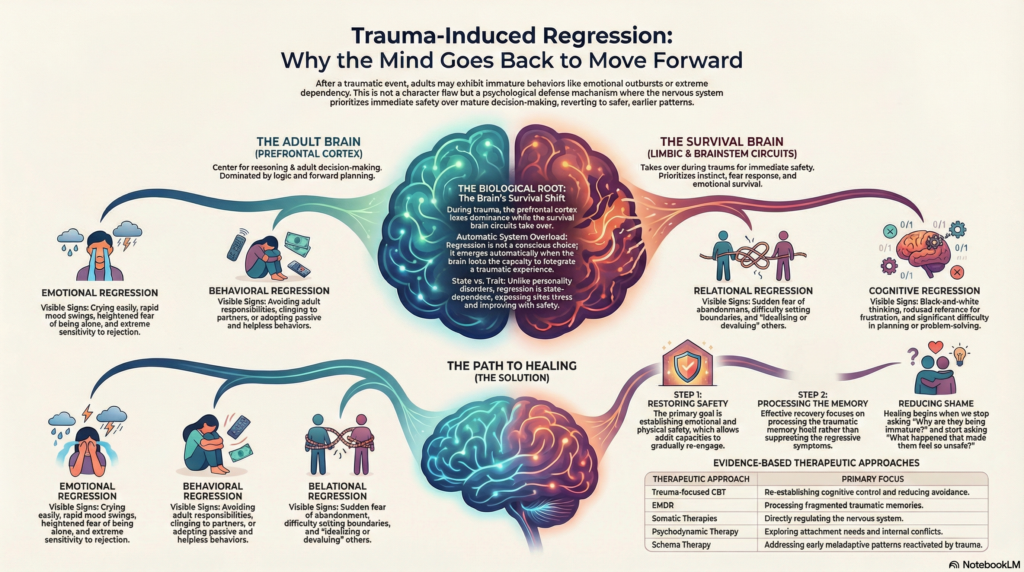 After a traumatic event, people sometimes behave in ways that seem out of character or immature. An adult may become clingy, dependent, irritable, avoid responsibility, or seek excessive reassurance. Others may withdraw, sulk, throw emotional tantrums, or rely on others to make even simple decisions.
To observers, this can look like immaturity or “going backwards.”
From a psychological perspective, it is often something else entirely: regression.
Regression after trauma is not weakness. It is the mind’s attempt to survive when overwhelmed.
What Is Regression?
In psychology, regression is a defense mechanism in which an individual temporarily reverts to earlier patterns of thinking, feeling, or behaving when faced with stress or threat.
Sigmund Freud first described regression as a return to an earlier developmental stage. Modern trauma psychology reframes it more compassionately:
Regression is a protective fallback to a time when the person felt safer, cared for, or less burdened.
After trauma, the nervous system prioritizes safety over maturity.
Why Trauma Triggers Regression
Traumatic events overwhelm the brain’s capacity to integrate experience. This is especially true for:
-
Interpersonal trauma (abuse, betrayal, abandonment)
-
Sudden losses
-
Medical trauma
-
Accidents or disasters
-
Childhood trauma reactivated in adulthood
When trauma occurs, the prefrontal cortex (responsible for reasoning, impulse control, and adult decision-making) becomes less dominant, while limbic and brainstem circuits take over.
The result:
-
Reduced emotional regulation
-
Heightened threat sensitivity
-
Increased reliance on primitive coping strategies
Regression is not chosen. It emerges automatically when the system is overloaded.
Common Forms of Regressive or “Immature” Behaviour After Trauma
Regression can look different across individuals. Common patterns include:
Emotional regression
-
Crying easily
-
Mood swings
-
Heightened sensitivity to rejection
-
Fear of being alone
Behavioural regression
-
Avoiding responsibilities
-
Clinging to caregivers or partners
-
Seeking constant reassurance
-
Passive or helpless behaviour
Relational regression
-
Dependency in relationships
-
Fear of abandonment
-
Difficulty tolerating boundaries
-
Idealising or devaluing others
Cognitive regression
-
Black-and-white thinking
-
Difficulty planning or problem-solving
-
Reduced frustration tolerance
In adults, these behaviours are often mislabeled as “attention-seeking” or “immature,” which adds shame and worsens symptoms.
Regression vs Personality Disorder: An Important Distinction
One of the most common clinical mistakes is confusing trauma-related regression with a fixed personality pathology.
Key differences:
-
Regression is state-dependent: It appears after stress or trauma and improves with safety and support.
-
Personality traits are trait-like: They are long-standing, pervasive, and present across contexts.
A previously well-functioning adult who becomes emotionally dependent after trauma is showing a stress response, not a personality flaw.
Regression as a Signal, Not a Failure
Regression tells us something important:
-
The person feels unsafe
-
Their internal resources are overwhelmed
-
They are trying to reduce threat, not create problems
Seen this way, regression is not a breakdown of character.
It is a communication from the nervous system.
How Recovery Happens
Recovery does not mean forcing someone to “grow up” again.
It involves:
-
Restoring safety (emotional, relational, physical)
-
Gradual re-engagement of adult capacities
-
Processing the traumatic memory, not suppressing it
-
Reducing shame around the regressive behaviour
As safety increases, regression naturally recedes. The person does not lose maturity permanently; it becomes temporarily inaccessible.
Therapeutic Approaches That Help
Several evidence-based therapies address regression after trauma:
-
Trauma-focused CBT: Helps re-establish cognitive control and reduce avoidance
-
EMDR: Processes traumatic memories stored in fragmented form
-
Psychodynamic therapy: Explores regression, attachment needs, and internal conflicts
-
Somatic therapies: Regulate the nervous system directly
-
Schema therapy: Useful when trauma reactivates early maladaptive patterns
Medication may be helpful when trauma is accompanied by severe anxiety, depression, or sleep disturbance, but it is rarely sufficient on its own.
A Compassionate Reframe
Instead of asking:
“Why is this person behaving so immaturely?”
A more accurate question is:
“What happened that made their system feel this unsafe?”
Regression is not the opposite of strength.
It is what happens before healing begins, when the psyche pauses to protect itself.
With the right understanding and support, most people move forward again — often with deeper resilience than before.
Dr. Srinivas Rajkumar T, MD (AIIMS), DNB, MBA (BITS Pilani)
Consultant Psychiatrist & Neurofeedback Specialist
Mind & Memory Clinic, Apollo Clinic Velachery (Opp. Phoenix Mall)
✉ srinivasaiims@gmail.com 📞 +91-8595155808