Sleep Series: Irregular Sleep: The Silent Disruptor of Health and Longevity
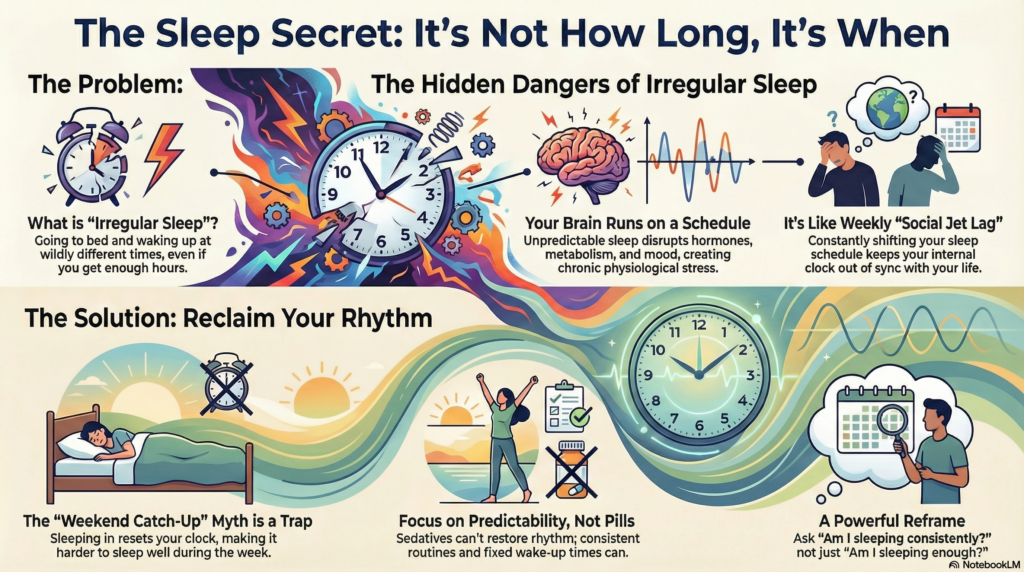 If long sleep is a misunderstood signal, irregular sleep is the sleeper agent of modern life.
It rarely feels dramatic.
It doesn’t always cause immediate insomnia.
And because people still “get their hours,” it often goes unnoticed.
Yet irregular sleep timing may be one of the most biologically disruptive patterns we routinely tolerate—and even normalise.
What Does “Irregular Sleep” Actually Mean?
Irregular sleep is not about a bad night here or there.
It refers to inconsistent sleep–wake timing, such as:
-
Going to bed at 10 pm on some nights and 1–2 am on others
-
Sleeping in several hours on weekends
-
Shifting wake-up times based on workload, screens, or mood
-
“Catching up” on sleep after poor nights
Importantly, a person can sleep seven or eight hours and still have irregular sleep.
The issue is not how long you sleep, but when your brain expects sleep.
Your Brain Runs on Prediction
The human brain is a prediction machine.
It anticipates:
-
Light and darkness
-
Activity and rest
-
Meals, hormones, and sleep
The circadian system relies on regular timing cues to coordinate:
-
Cortisol release in the morning
-
Melatonin secretion at night
-
Blood pressure rhythms
-
Glucose metabolism
-
Immune regulation
When sleep timing becomes unpredictable, the brain loses its ability to prepare.
The result is not immediate collapse—but chronic, low-grade physiological stress.
Why Irregular Sleep Is So Harmful
Research consistently shows that irregular sleep is associated with:
-
Higher all-cause mortality
-
Increased cardiovascular risk
-
Metabolic dysfunction
-
Mood instability
-
Cognitive inefficiency
And crucially, these risks persist even when total sleep duration is adequate.
Irregular sleep creates a state similar to repeated jet lag—sometimes called social jet lag—where the internal clock is constantly out of sync with external demands.
The body never quite catches up.
The Weekend Sleep Myth
One of the most common—and damaging—sleep habits is weekend compensation.
The pattern is familiar:
-
Short, late nights during the week
-
Sleeping in on weekends
-
Feeling briefly better
-
Starting Monday already misaligned
This repeated shift resets the circadian clock just enough to make weekday sleep harder, reinforcing the cycle.
In effect, the person gives themselves mild jet lag every week—and wonders why sleep never stabilises.
Why Irregular Sleep Often Feels “Normal”
Irregular sleep is culturally rewarded.
Late nights signal productivity.
Sleeping in signals recovery.
Flexibility is mistaken for resilience.
But biologically, regularity is safety.
Children sleep well not because they are disciplined, but because their rhythms are protected. Adults often lose sleep quality not because of stress alone, but because they sacrifice predictability.
Irregular Sleep and the Mind
From a psychiatric perspective, irregular sleep timing:
-
Worsens anxiety by destabilising arousal systems
-
Increases emotional reactivity
-
Impairs attention and impulse control
-
Exacerbates depression and bipolar vulnerability
This is why sleep regularity is often the first intervention in mood disorders—even before medications are adjusted.
Rhythm stabilisation stabilises emotion.
Why Medications Can’t Fix Irregular Sleep
Sedatives can induce sleep.
They cannot restore rhythm.
A pill may help you sleep now, but it does not teach the brain when to sleep. In fact, irregular medication use can further fragment sleep timing.
This is why durable sleep improvement almost always begins with:
-
Fixed wake-up times
-
Daylight exposure
-
Consistent routines
-
Reducing time-in-bed variability
These are not lifestyle tips. They are biological interventions.
A Simple but Powerful Reframe
If sleep feels unreliable, the question is rarely:
“Am I sleeping enough?”
It is more often:
“Am I sleeping consistently?”
Sleep improves when the brain knows what to expect.
Predictability reduces arousal.
Rhythm restores trust between the brain and the body.
The Takeaway
Irregular sleep does not announce itself as a problem.
It whispers—through fatigue, mood changes, and subtle health decline.
By the time sleep feels “broken,” irregularity has often been present for years.
Restoring sleep rhythm is not restrictive.
It is liberating.
In the next article, we’ll explore how sleep risk patterns differ between men and women, and why gender-neutral sleep advice misses the mark.
Reference
Park SJ, Park J, Kim BS, Park J-K. The impact of sleep health on cardiovascular and all-cause mortality in the general population. Scientific Reports. 2025;15:30034.
About the Author
Dr. Srinivas Rajkumar T, MD (AIIMS), DNB, MBA
Consultant Psychiatrist & Neurofeedback Specialist
Dr. Srinivas focuses on evidence-based, rhythm-informed approaches to insomnia, anxiety, depression, ADHD, and stress-related sleep disturbance. His work emphasises CBT-I, circadian stabilisation, and long-term sleep health over symptom suppression.
📍 Mind & Memory Clinic, Apollo Clinic Velachery (Opp. Phoenix Mall), Chennai
✉ srinivasaiims@gmail.com
📞 +91-8595155808