Stabilising Rhythms, Stabilising Mood: A Practical Guide to IPSRT in Bipolar Disorder
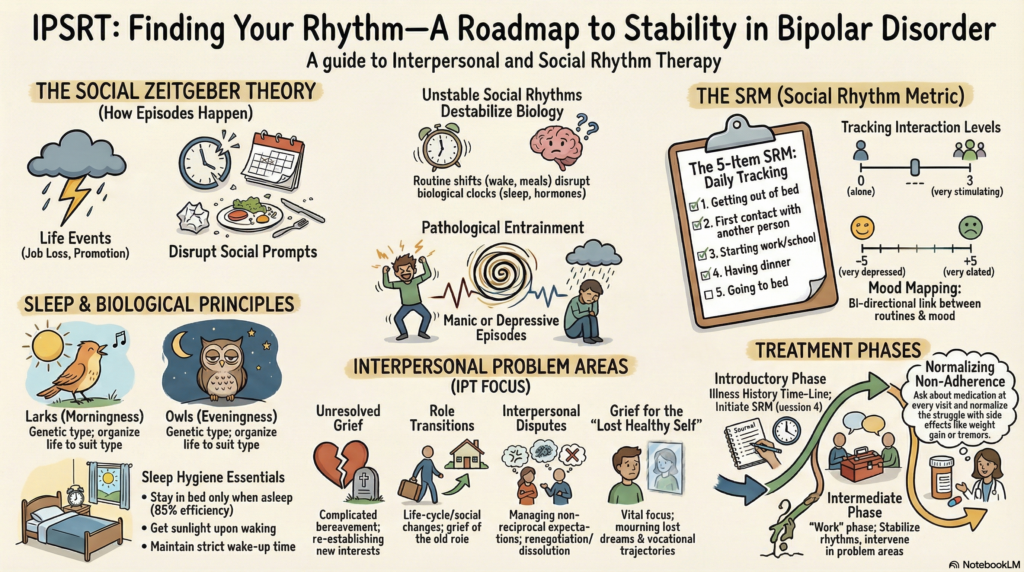 Bipolar disorder is often misunderstood as a condition of “mood swings.”
In reality, it is fundamentally a disorder of rhythm—of sleep, activity, social interaction, and biological timing.
One of the most powerful, evidence-based psychotherapies addressing this core disturbance is Interpersonal and Social Rhythm Therapy (IPSRT)—a structured, clinically elegant approach that integrates circadian science with interpersonal psychology.
Why Rhythms Matter in Bipolar Disorder
At the heart of IPSRT lies a simple but profound idea:
Mood episodes are often triggered by disruptions in biological and social rhythms.
The social zeitgeber theory explains this clearly—life events disrupt daily routines → routines destabilise biological rhythms → mood episodes emerge .
Common Triggers
- Loss (death, breakup)
- Role changes (promotion, job loss)
- Travel or shift work
- Irregular sleep schedules
These are not just “stressors”—they are rhythm disruptors.
What is IPSRT?
IPSRT combines three key components:
1. Social Rhythm Therapy (SRT)
- Focus: Regularising daily routines
- Tracks:
- Wake time
- First social contact
- Work start
- Meals
- Bedtime
2. Interpersonal Psychotherapy (IPT)
- Focus: Life events and relationships
- Targets:
- Grief
- Role transitions
- Role disputes
- Interpersonal deficits
3. Psychoeducation
- Focus: Insight + adherence + early warning signs
Core Goals of IPSRT
- Stabilise sleep–wake cycles
- Understand the link between mood and life events
- Improve interpersonal functioning
- Reduce recurrence of episodes
The Social Rhythm Metric (SRM): A Powerful Clinical Tool
IPSRT operationalises rhythm through the Social Rhythm Metric (SRM).
Patients track:
- Wake-up time
- First interaction
- Work/activity start
- Dinner time
- Bedtime
- Daily mood (-5 to +5 scale)
👉 This converts abstract instability into measurable behavioural data.
The Often-Ignored Link: Sleep and Mood
Sleep is not just a symptom—it is a driver of bipolar illness.
IPSRT places sleep at the center of treatment:
- Fixed wake-up time (non-negotiable)
- Sleep efficiency optimisation (~85%)
- Avoid naps
- Morning sunlight exposure
- Bed only for sleep
You cannot force sleep—but you can stabilise the rhythm that enables it .
Interpersonal Focus: Where Psychology Meets Biology
IPSRT recognises that relationships regulate rhythms.
Four Core Problem Areas:
1. Grief
- Loss of a person
- Or loss of the “healthy self”
2. Role Transitions
- Marriage, job change, parenthood
- Often underestimated triggers
3. Role Disputes
- Conflicts in expectations (partner, workplace)
4. Interpersonal Deficits
- Social isolation
- Chronic relational difficulties
Each of these affects daily structure → biological rhythm → mood stability.
Phases of IPSRT (Clinical Flow)
1. Initial Phase
- Psychoeducation
- Illness timeline mapping
- Identify interpersonal focus
- Introduce SRM
2. Intermediate Phase
- Stabilise routines
- Work on interpersonal problem areas
3. Maintenance Phase
- Prevent relapse
- Adapt rhythms to life changes
A Clinical Insight: “Grief for the Lost Healthy Self”
One of the most powerful constructs in IPSRT:
Patients often grieve:
- Lost ambitions
- Interrupted careers
- Changed identity
Therapy involves:
- Validating this grief
- Rebuilding realistic goals
- Integrating illness into identity
This is where IPSRT becomes more than behavioural—it becomes deeply human.
What Makes IPSRT Unique?
Unlike generic psychotherapy:
- It is biologically informed
- It is structured yet flexible
- It directly targets relapse prevention
- It bridges chronobiology + psychotherapy
Clinical Takeaway
Bipolar disorder is not just about mood—it is about timing.
Stabilise the rhythm, and you stabilise the mood.
IPSRT offers a clear, evidence-based pathway to do exactly that—by aligning daily life with the brain’s internal clock.
About the Author
Dr. Srinivas Rajkumar T, MD (AIIMS, New Delhi), DNB, MBA (BITS Pilani)
Consultant Psychiatrist & Neurofeedback Specialist
Mind & Memory Clinic, Apollo Clinic Velachery (Opp. Phoenix Mall)
With a clinical approach that integrates structured psychotherapy, neurobiological insights, and technology-assisted assessments (including QEEG and cognitive profiling), Dr. Srinivas focuses on personalised care in mood disorders, ADHD, and neurodevelopmental conditions.
📞 +91-8595155808
✉ srinivasaiims@gmail.com