The Digital Sleeping Pill: How Muse Is Redefining Sleep Without Medication
 Sleep medicine has traditionally leaned on tablets, prescriptions, and trial-and-error patience. Yet for a large group of people, the real problem is not lack of sleep hygiene knowledge—it is a busy, hyper-aroused brain that refuses to disengage at night. This is where the idea of a Digital Sleeping Pill (DSP), developed by Muse, quietly challenges the old paradigm.
This is not a metaphor dressed up as marketing. It is a neurotechnology-based attempt to do what sedatives often struggle with: guide the brain into sleep instead of chemically forcing it.
Sleep Is a Transition, Not an On–Off Switch
Falling asleep resembles landing an aircraft, not switching off a light. Speed must reduce, systems must power down, and attention must narrow. Many individuals with insomnia, anxiety, ADHD traits, or high cognitive load fail at sleep because the brain remains in problem-solving mode long after the body is ready for rest.
Conventional sleeping pills blunt neural activity globally. Digital Sleeping Pills take a different route—they work with the brain’s natural sleep transitions rather than overriding them.
What Is a Digital Sleeping Pill?
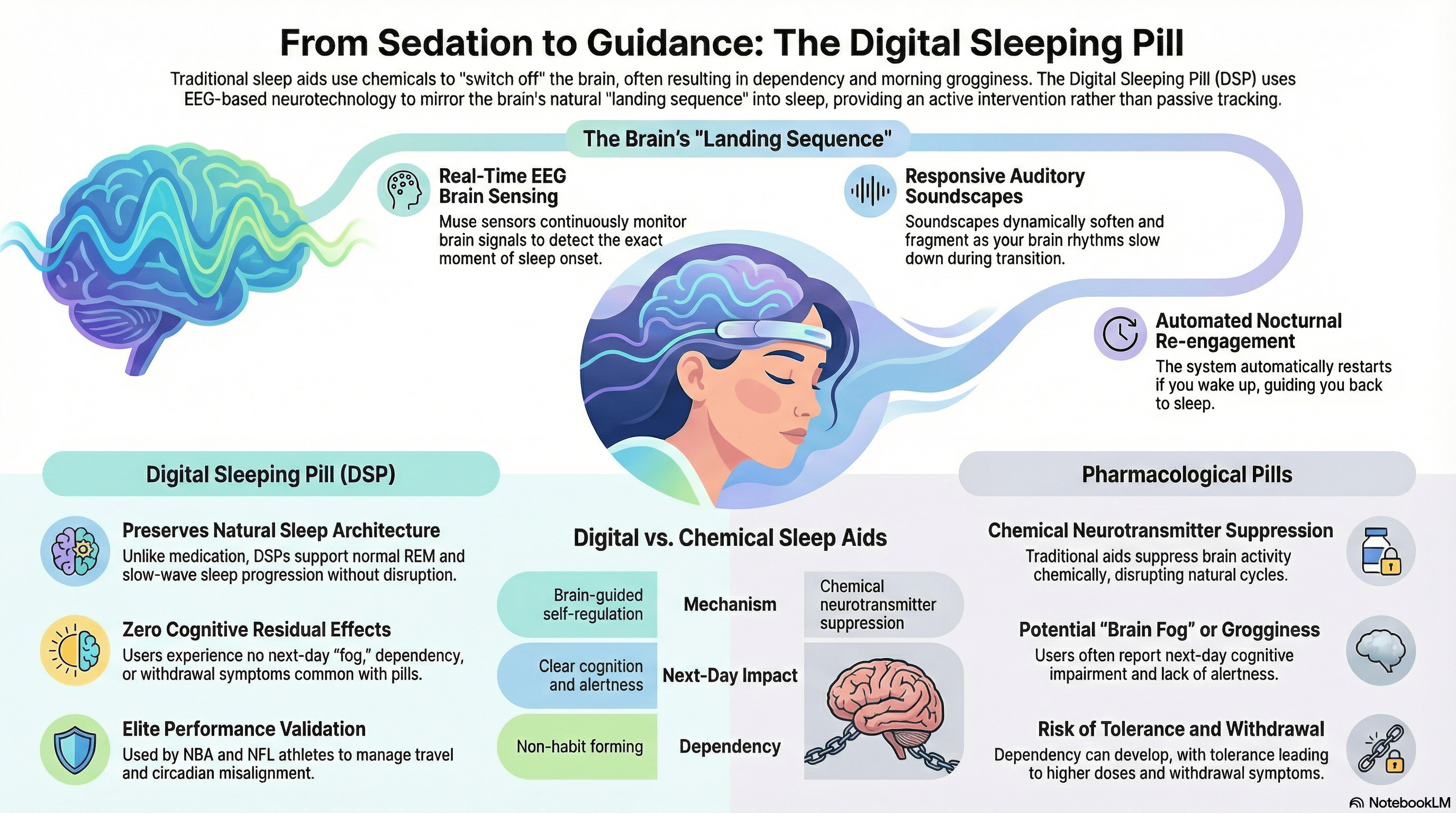
A Muse Digital Sleeping Pill (DSP) is a responsive, brain-sensing sleep experience available to Muse S users. Using EEG signals, Muse continuously detects changes in brain activity as a person drifts toward sleep. Based on this real-time data, it dynamically modulates soundscapes—stories, ambient audio, or nature sounds—to gently cue the brain toward sleep onset.
If the user wakes during the night, the same system automatically re-engages, guiding the brain back toward sleep without conscious effort.
No drugs. No sedation. No next-day cognitive fog.
Why DSPs Are Different From Sleep Tracking
Most sleep technologies are passive observers. They tell you what happened after the night is over.
Digital Sleeping Pills are active interventions. They operate at the most fragile moments of sleep—sleep onset and nocturnal awakenings—providing immediate support when it is actually needed.
From a clinical perspective, this distinction matters. Insight alone does not treat insomnia. State-dependent intervention does.
The Neuroscience Behind Muse DSPs
As sleep begins, the brain transitions from fast, desynchronized activity to slower, more rhythmic patterns. Muse detects these shifts and adapts the auditory environment in response. As the brain moves closer to sleep, the sounds soften, fragment, and fade—mirroring the fading of conscious awareness itself.
Many users describe it as a story that gently dissolves rather than abruptly ends, allowing the mind to disengage naturally.
Importantly, this approach respects sleep architecture. Rather than suppressing REM or deep sleep, DSPs aim to support normal progression across sleep stages, which is reflected in Muse’s sleep metrics: REM duration, slow-wave intensity, heart rate, stillness, and body position.
Clinical and Performance Perspectives
Sleep clinicians and neuroscientists have taken note.
Dr. W. Christopher Winter, board-certified sleep neurologist, has described the Digital Sleeping Pill as a fascinating and innovative tool, highlighting how sound drifts in and out of awareness as sleep deepens.
Neuroscientist Louisa Nicola reports its use among elite athletes—including NBA and NFL players—particularly as a travel and jet-lag mitigation protocol, where pharmacological sleep aids often worsen circadian misalignment.
This is a key point: DSPs are not only about falling asleep faster, but about preserving sleep quality and circadian integrity.
Rethinking “Sleep Aids”
Calling this a “digital sleeping pill” is deliberately provocative. It invites comparison with medication—and scrutiny.
Unlike pharmacological agents, DSPs:
-
Do not act on neurotransmitter receptors
-
Do not cause dependence or tolerance
-
Do not impair next-day cognition
-
Can be discontinued instantly without withdrawal
Conceptually, they function closer to sleep-specific neurofeedback, gently training the brain to recognize and enter sleep-compatible states.
This reflects a broader shift in psychiatry and neuroscience: from chemical control toward brain-guided self-regulation.
The Bigger Picture: Brain-Powered Sleep
Muse integrates Digital Sleeping Pills into a wider ecosystem of brain-based sleep and meditation tools, including sleep scores, REM and deep sleep insights, slow-wave intensity, heart rate trends, stillness, and body position tracking. The emphasis is not merely measurement, but actionable brain training.
The underlying promise is simple yet ambitious: better nights that lead to better mornings.
Final Reflections
Digital Sleeping Pills represent a meaningful evolution in how we think about insomnia and disturbed sleep. They frame sleep difficulties not as failures of discipline or chemistry, but as misaligned brain states that can be gently guided back into rhythm.
For individuals reluctant to rely on long-term medication, for clinicians seeking non-pharmacological tools, and for anyone whose mind refuses to slow down at night, this approach feels less like sedation—and more like guidance.
Sleep is not something we should be knocked into.
It is something the brain must be invited into.
About the Author
Dr. Srinivas Rajkumar T, MD (AIIMS), DNB, MBA (BITS Pilani)
Consultant Psychiatrist & Neurofeedback Specialist
Mind & Memory Clinic, Apollo Clinic Velachery (Opp. Phoenix Mall), Chennai
Dr. Srinivas specializes in integrating neuroscience-based tools—such as neurofeedback, EEG-guided interventions, and digital therapeutics—into ethical, patient-centred psychiatric care. His clinical work focuses on sleep disorders, anxiety, ADHD, emotional regulation, and technology-assisted mental health interventions.
📞 +91-8595155808
✉ srinivasaiims@gmail.com
🌐 www.srinivasaiims.com
Because better sleep begins in the brain.