Life After Psychosis: A Patient’s Journey Back to Reality
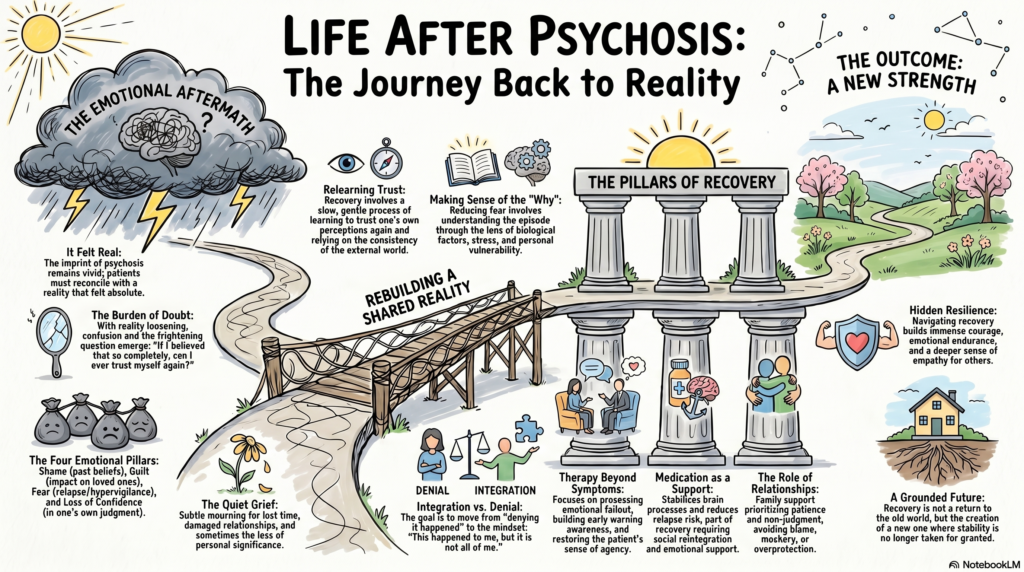
Introduction: When the Storm Passes
Psychosis is often described in clinical terms—delusions, hallucinations, disorganized thought.
But for the person who lives through it, it is something else entirely:
- A world that once felt absolutely real
- A certainty that could not be questioned
- A reality that slowly… painfully… begins to loosen
And then comes a phase we speak far less about:
Life after psychosis
“It Felt Real…”
One of the most consistent things patients say is:
- “I know it wasn’t real… but it felt real.”
This is not confusion.
It is not denial.
It is an attempt to describe something difficult to put into words:
During psychosis, reality is not imagined—it is experienced differently.
Even after recovery:
- The memory remains vivid
- The emotional imprint persists
Like a dream that refuses to fade completely.
The First Realization: Doubt Enters
Recovery rarely happens in a dramatic moment.
It begins quietly:
- “Maybe… I was mistaken.”
- “I’m not as sure anymore.”
This is the beginning of distance from the experience.
But it is not always comforting.
For many, it brings:
- Confusion
- Embarrassment
- Fear
Because the question arises:
If I could believe that so completely… can I trust myself again?
The Emotional Aftermath
After psychosis resolves, patients often experience:
1. Shame
- “How could I believe that?”
- “What must others think of me?”
2. Guilt
- Over actions taken during the episode
- Over distress caused to loved ones
3. Fear of Relapse
- “What if it happens again?”
- Hypervigilance to thoughts and sensations
4. Loss of Confidence
- In one’s own mind
- In one’s judgment
The Quiet Grief No One Talks About
There is also a subtler experience:
Grief.
Grief for:
- Lost time
- Damaged relationships
- A sense of “normalcy”
Sometimes even:
- A strange loss of the intensity or meaning that psychosis once gave
Because, in its own way, psychosis can feel:
- Powerful
- Significant
- Personal
Letting go of it can feel like losing a part of oneself.
Rebuilding Reality: Slowly, Gently
Recovery is not just about removing symptoms.
It is about reconstructing a shared reality.
This involves:
1. Relearning Trust
- Trust in one’s perceptions
- Trust in others
- Trust in consistency
2. Making Sense of the Experience
Patients often ask:
- “Why did this happen to me?”
The answer is not always simple.
But meaning can be built around:
- Stress
- Vulnerability
- Biological factors
👉 Understanding reduces fear.
3. Integrating the Experience
Instead of:
- Denying the episode
The goal becomes:
- “This happened to me… but it is not all of me.”
The Role of Therapy in This Phase
Therapy after psychosis is not about correcting delusions anymore.
It is about:
1. Processing the Experience
- What did it feel like?
- What did it mean?
2. Addressing Emotional Fallout
- Shame
- Fear
- Identity confusion
3. Building Early Warning Awareness
- Recognizing subtle changes
- Acting early
4. Restoring Agency
- Helping the patient feel:
- “I can understand my mind again”
Medication: A Support, Not the Whole Story
Medication often helps:
- Reduce relapse risk
- Stabilize brain processes
But recovery requires more than symptom control.
It requires:
- Understanding
- Support
- Reintegration
Relationships: Healing or Hurting
Family and friends play a crucial role.
Helpful responses:
- Patience
- Non-judgment
- Avoiding constant reminders
Unhelpful responses:
- Blame
- Mockery
- Overprotection
The patient needs:
To be seen as a person—not as “someone who had psychosis.”
The Strength Hidden in Recovery
Patients often do not recognize this immediately, but:
Recovering from psychosis requires:
- Courage
- Adaptation
- Emotional endurance
Over time, many develop:
- Greater self-awareness
- Deeper empathy
- Increased resilience
A New Relationship with the Mind
After psychosis, the relationship with one’s own mind changes.
There is:
- More caution
- More reflection
Sometimes even:
- A deeper appreciation for stability
The mind is no longer taken for granted.
A Message to Patients
If you have experienced psychosis:
- You are not alone
- You are not “broken”
- Your experience, however intense, can be understood and integrated
Recovery is not about becoming who you were before.
It is about becoming:
Someone who has gone through this—and found a way forward
A Message to Families
- Be patient
- Avoid blame
- Support without controlling
Recovery takes time—but it does happen.
Final Reflection
Life after psychosis is not a return to the old world.
It is the creation of a new, more aware, more grounded one.
And in that world, slowly but surely:
Reality becomes something not just experienced—but trusted again.
About the Author
Dr. Srinivas Rajkumar T, MD (AIIMS), DNB, MBA (BITS Pilani)
Consultant Psychiatrist & Neurofeedback Specialist
Mind & Memory Clinic, Apollo Clinic Velachery (Opp. Phoenix Mall)
✉ srinivasaiims@gmail.com 📞 +91-8595155808