Overvalued Ideas in Psychiatry: A Historical, Phenomenological, and Clinical Synthesis
 Introduction
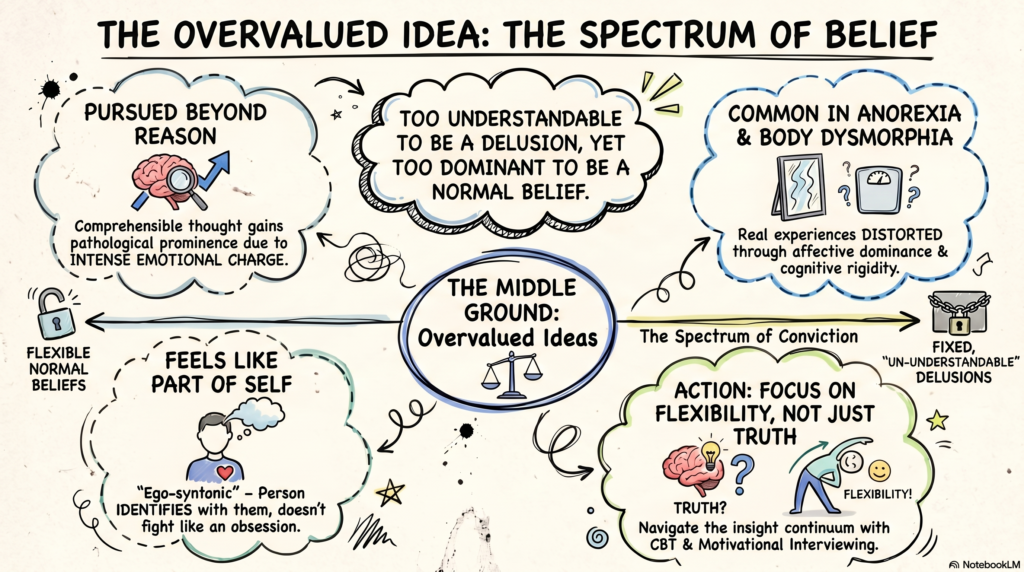
The concept of the overvalued idea occupies a critical yet often underemphasized position in descriptive psychopathology. It represents a transitional construct, bridging normal belief systems and pathological delusions.
The term was first formalized by Carl Wernicke, who described a category of ideas that are:
“emotionally charged… dominating the personality”
This early formulation remains strikingly relevant even in contemporary psychiatry.
Classical Definitions and Conceptual Foundations
1. Wernicke’s Original Formulation
Carl Wernicke conceptualized overvalued ideas as:
“Ideas which, because of their affective tone, come to dominate consciousness and behavior.”
Key implications:
- Not inherently false
- Derived from real experiences
- Gain pathological prominence through affect
2. Jaspers’ Phenomenological Clarification
Karl Jaspers, in General Psychopathology, emphasized understandability (Verstehen):
“We understand how these ideas arise from the personality and situation…”
He distinguished:
- Primary delusions → un-understandable
- Secondary beliefs → psychologically understandable
Overvalued ideas clearly fall into the latter category.
3. Fish’s Clinical Psychopathology
Frank Fish defined overvalued ideas as:
“A comprehensible idea pursued beyond the bounds of reason.”
This definition captures the core tension:
- The idea is comprehensible
- The degree of conviction is disproportionate
4. Sims’ Modern Clinical Description
Andrew Sims, in Symptoms in the Mind, describes:
“An acceptable idea that is pursued to an unreasonable extent… dominating the sufferer’s life.”
This adds a key clinical dimension:
- Functional impairment
Phenomenological Positioning: A Spectrum of Belief
Overvalued ideas are best understood within a continuum model of belief formation:
| Construct | Insight | Conviction | Emotional Investment |
|---|---|---|---|
| Normal belief | Preserved | Flexible | Moderate |
| Obsession | Preserved | Low | High (distress) |
| Overvalued idea | Partial | High | Very high |
| Delusion | Absent | Absolute | Variable |
Key Phenomenological Insight
Overvalued ideas are ego-syntonic but not psychotically fixed.
Core Psychopathological Features
1. Affective Dominance
- Emotional salience drives persistence
- Often linked to:
- Shame
- Fear
- Identity concerns
2. Cognitive Rigidity
- Reduced flexibility
- Selective attention and confirmation bias
3. Behavioral Enactment
- Ideas are acted upon, not merely thought
4. Partial Insight
- Patients may acknowledge:
- “Maybe I am overthinking”
- But cannot disengage
Clinical Illustrations
1. Anorexia Nervosa
- Belief: “I am overweight”
- Not entirely delusional
- Strong affective reinforcement
2. Body Dysmorphic Disorder
- Fluctuates between:
- Overvalued idea
- Delusional conviction
3. Hypochondriasis (Illness Anxiety Disorder)
- Persistent health fears
- Temporary reassurance possible
4. Paranoid Personality Structure
- Suspicious interpretations
- Not bizarre, but rigid
Differentiation from Related Constructs
Overvalued Idea vs Delusion
| Feature | Overvalued Idea | Delusion |
|---|---|---|
| Reality testing | Partially intact | Absent |
| Correctability | Possible | Impossible |
| Origin | Understandable | Often not |
Karl Jaspers emphasized:
“Delusions are un-understandable in their origin”
Overvalued Idea vs Obsession
| Feature | Overvalued Idea | Obsession |
|---|---|---|
| Ego-syntonic | Yes | No |
| Resistance | Low | High |
| Insight | Variable | Usually preserved |
Psychodynamic Interpretations
From a psychodynamic perspective, overvalued ideas often serve as:
1. Defensive Structures
- Protect against:
- Narcissistic injury
- Internal conflict
2. Identity Anchors
- Provide coherence to self-concept
Example:
- Anorexia → control, autonomy
- Hypochondriasis → fear of abandonment or loss
They function as:
Compromise formations between unconscious conflict and conscious belief
Cognitive-Behavioral Framework
CBT conceptualizes overvalued ideas as:
- Core dysfunctional beliefs
- Maintained by:
- Selective attention
- Safety behaviors
- Cognitive distortions
Example loop:
- Belief → Anxiety → Checking → Temporary relief → Reinforcement
Neurobiological Perspectives
Though less studied than delusions:
Likely mechanisms:
- Aberrant salience attribution (dopaminergic pathways)
- Prefrontal dysfunction → reduced cognitive flexibility
- Default mode network hyperactivity → excessive self-focus
These overlap with:
- OCD spectrum
- Psychotic disorders
Relevance in Contemporary Psychiatry
1. DSM-5 Insight Specifiers
DSM-5-TR includes:
- Good insight
- Poor insight
- Absent insight/delusional beliefs
This effectively captures:
A continuum from overvalued idea → delusion
2. Transdiagnostic Importance
Overvalued ideas are central in:
- Eating disorders
- OCD spectrum
- Personality disorders
- Health anxiety
3. Forensic and Social Relevance
Increasingly applied to:
- Radicalization
- Extremist ideologies
Where beliefs:
- Are culturally contextual
- Yet rigid and identity-defining
Therapeutic Implications
1. Pharmacological
- SSRIs → OCD spectrum
- Antipsychotics → when nearing delusional intensity
2. Psychotherapeutic
CBT:
- Cognitive restructuring
- Behavioral experiments
Psychodynamic:
- Meaning exploration
- Conflict resolution
Motivational Interviewing:
- Especially useful due to ego-syntonicity
Critical Conceptual Insight
Overvalued ideas challenge binary thinking in psychiatry.
They remind us:
Beliefs are not simply “true vs false”
but exist along dimensions of:
- Conviction
- Flexibility
- Emotional investment
Conclusion
The enduring relevance of overvalued ideas lies in their clinical subtlety.
They are:
“Too understandable to be delusions, yet too dominant to be normal beliefs.”
Ignoring them risks:
- Misdiagnosis
- Inadequate treatment planning
Recognizing them allows:
- Precision in formulation
- Nuanced therapeutic engagement
About the author
Dr. Srinivas Rajkumar T, MD (AIIMS, New Delhi), DNB, MBA (BITS Pilani)
Senior Consultant Psychiatrist
Apollo Clinic Velachery (Opp. Phoenix Mall)
✉ srinivasaiims@gmail.com 📞 +91-8595155808