Nicotine Addiction & Smoking Cessation in Chennai
 Why Quitting Feels Hard—and How to Make It Easier
Smoking is often described as a “habit.”
From a medical perspective, it is more accurate to call it a nicotine dependence syndrome—a condition where the brain has been trained, at a chemical level, to expect and respond to nicotine.
Understanding how this works is the first step toward quitting successfully.
How Nicotine Affects the Brain
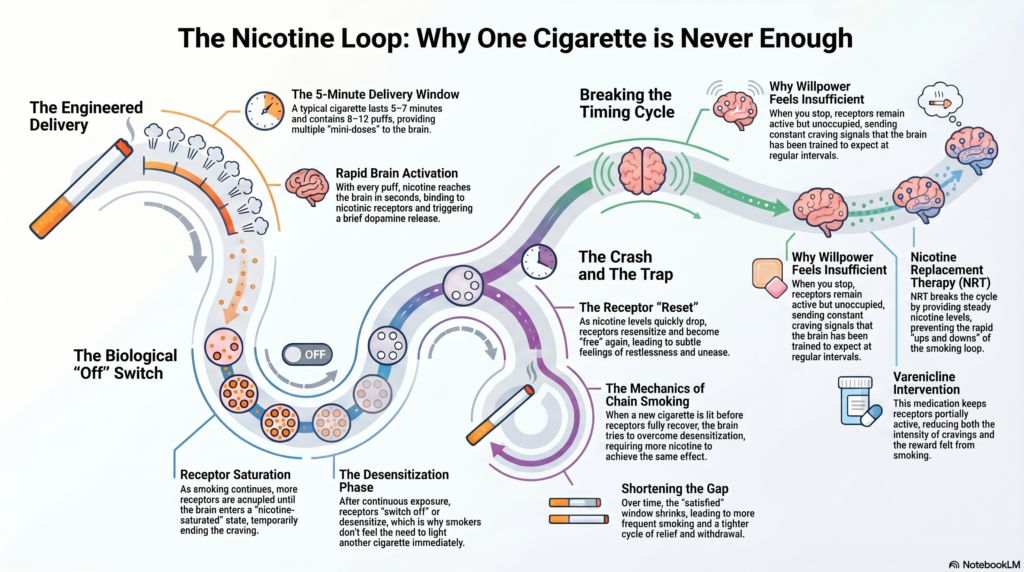
When you inhale cigarette smoke, nicotine reaches the brain within seconds. It binds to nicotinic acetylcholine receptors and triggers the release of dopamine—the brain’s reward chemical.
This produces:
- A brief sense of calm
- Improved focus
- Relief from tension
Over time, the brain learns a powerful association:
Nicotine = relief
This learning is rapid, repeated, and reinforced multiple times a day, making nicotine one of the most dependence-forming substances.
Why One Cigarette Feels “Enough”
A typical cigarette lasts about 5–7 minutes and delivers nicotine in multiple small doses with each puff.
During this period:
- Nicotine repeatedly stimulates brain receptors
- Dopamine is released in bursts
- Receptors gradually become desensitized
By the end of a cigarette:
- The brain enters a temporarily “satisfied” state
- Craving reduces
This is why many smokers feel that a single cigarette is enough—at least for a short time.
Why Cravings Return
Nicotine is cleared from the brain relatively quickly.
As levels fall:
- Receptors become active again (resensitization)
- Dopamine levels drop
- Early withdrawal symptoms begin
This may be experienced as:
- Restlessness
- Irritability
- Difficulty concentrating
At this stage, the brain signals the need for another cigarette.
An important clinical insight is this:
Smoking does not relieve stress—it relieves nicotine withdrawal.
The Cycle of Dependence
Nicotine addiction follows a repeating cycle:
- Nicotine intake
- Temporary relief
- Falling nicotine levels
- Withdrawal symptoms
- Craving
- Reuse
This cycle continues throughout the day, often unconsciously.
Why Chain Smoking Happens
When cigarettes are smoked in quick succession:
- Receptors do not fully recover between doses
- The effect of nicotine becomes less noticeable
- The smoker consumes more nicotine to achieve the same effect
This leads to:
- Increased frequency of smoking
- Reduced satisfaction
- Greater dependence
This is a biological process, not a failure of willpower.
Why Quitting Suddenly (“Cold Turkey”) Is Difficult
When nicotine use stops abruptly:
- Brain receptors remain active but unoccupied
- Dopamine levels drop significantly
- Withdrawal symptoms intensify
This can result in:
- Anxiety
- Irritability
- Strong cravings
- Reduced concentration
Many people relapse not because they lack motivation, but because the brain is in a state of neurochemical imbalance.
A Smarter Approach to Smoking Cessation
Modern treatment focuses on gradual disengagement from nicotine, rather than abrupt cessation.
1. Nicotine Replacement Therapy (NRT)
Nicotine replacement therapy provides controlled doses of nicotine without harmful smoke.
Forms include:
- Patches
- Gums
- Lozenges
Benefits:
- Reduces withdrawal symptoms
- Stabilizes brain chemistry
- Allows gradual reduction of dependence
2. Varenicline
Varenicline is a partial agonist at nicotine receptors.
It works by:
- Partially stimulating receptors (reducing cravings)
- Blocking the rewarding effects of cigarettes
This helps:
- Decrease the urge to smoke
- Reduce satisfaction from smoking
- Break the addiction cycle
Psychological Aspects of Smoking
Nicotine dependence is not only biological. It is also linked to:
- Daily routines (after meals, tea breaks, driving)
- Emotional triggers (stress, boredom, loneliness)
- Learned behaviors
Effective treatment includes:
- Identifying triggers
- Developing alternative coping strategies
- Building new routines
Structured approaches such as cognitive behavioral therapy improve long-term success.
What Recovery Looks Like
Smoking cessation is not a single event. It is a process.
With the right support:
- Cravings reduce gradually
- Withdrawal becomes manageable
- The brain adapts to lower nicotine levels
- Smoking loses its reinforcing effect
The goal is not just stopping cigarettes, but achieving:
- Better physical health
- Improved mental clarity
- Long-term stability
Key Takeaway
Cigarettes are designed to:
- Deliver nicotine rapidly
- Reinforce behavior repeatedly
- Create a cycle of dependence
Quitting is difficult because of how the brain has adapted—not because of a lack of willpower.
The good news is that the same brain can be retrained.
With a structured, medically supported approach, smoking cessation becomes:
- Safer
- More comfortable
- More successful
Smoking Cessation Services in Chennai
If you are trying to quit smoking and finding it difficult, professional support can significantly improve your chances of success.
Comprehensive smoking cessation services include:
- Assessment of nicotine dependence
- Individualized quit plans
- Medication-assisted treatment (nicotine replacement therapy, varenicline)
- Psychological support and relapse prevention strategies
About the Author
Dr. Srinivas Rajkumar T, MD (AIIMS, New Delhi), DNB, MBA (BITS Pilani)
Consultant Psychiatrist & Neurofeedback Specialist
Mind & Memory Clinic, Apollo Clinic Velachery (Opp. Phoenix Mall)
✉ srinivasaiims@gmail.com 📞 +91-8595155808