Comprehensive ADHD Assessment: Why a Detailed Evaluation Matters
 ADHD is often misunderstood as a simple problem of “poor concentration.” In reality, ADHD is a neurodevelopmental condition that can affect attention, impulse control, planning, emotional regulation, academic performance, work efficiency, relationships, sleep, driving, finances, and daily organisation.
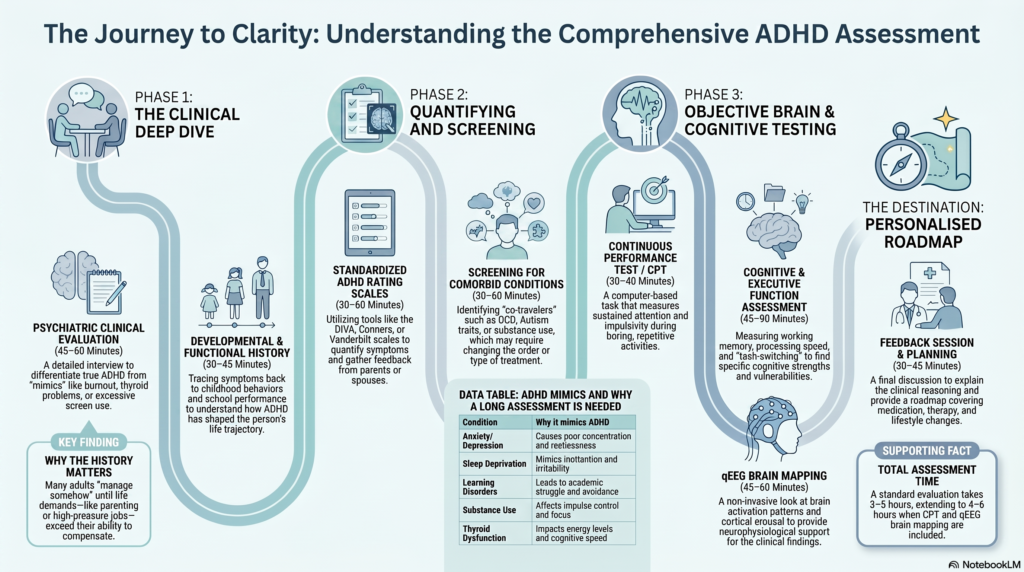
A good ADHD assessment should therefore not be a 10-minute conversation or a quick checklist. It should be a structured, multi-step evaluation that looks at symptoms, childhood history, current impairment, comorbid conditions, and objective measures of attention and brain functioning.
International guidelines emphasise that ADHD diagnosis should be based on a comprehensive clinical assessment, not on one test alone. NICE guidelines recommend specialist assessment that includes symptom review, impairment, developmental history, mental health assessment, and consideration of coexisting conditions. The CDC also clearly notes that there is no single test to diagnose ADHD, because sleep disorders, anxiety, depression, learning problems, and other conditions can mimic ADHD symptoms.
Total Duration of a Comprehensive ADHD Assessment
A detailed ADHD evaluation usually takes:
Approximately 3 to 5 hours
When CPT and qEEG brain mapping are included, the total time may extend to:
Approximately 4 to 6 hours
This may be completed in one long session or divided across two sessions, depending on the patient’s age, fatigue, availability, and complexity of symptoms.
What Does a Comprehensive ADHD Assessment Include?
1. Psychiatric Clinical Evaluation
Duration: 45 to 60 minutes
The first step is a detailed psychiatric interview. This is essential because ADHD symptoms often overlap with many other conditions.
The evaluation explores:
- Inattention
- Hyperactivity
- Impulsivity
- Forgetfulness
- Procrastination
- Poor planning
- Time blindness
- Emotional dysregulation
- Anger outbursts
- Restlessness
- Low frustration tolerance
- Academic or work-related impairment
- Relationship difficulties
- Sleep problems
- Substance use
- Anxiety, depression, bipolar disorder, OCD, trauma, and personality-related patterns
This stage helps answer an important question:
Is this truly ADHD, or is something else producing ADHD-like symptoms?
For example, poor concentration may occur in depression, anxiety, sleep deprivation, cannabis use, burnout, thyroid problems, seizure disorders, or excessive screen use. A proper psychiatric assessment helps avoid both underdiagnosis and overdiagnosis.
2. Developmental and Functional History
Duration: 30 to 45 minutes
ADHD is usually developmental in origin. This means that symptoms often begin in childhood, even if they become more visible only later in life.
The assessment includes:
- Childhood behaviour
- School performance
- Teacher remarks
- Homework habits
- Exam preparation style
- Disciplinary issues
- Daydreaming or restlessness in class
- Family history of ADHD or psychiatric disorders
- Current work or college functioning
- Daily organisation
- Driving behaviour
- Financial impulsivity
- Relationship patterns
- Addiction vulnerability
- Emotional regulation
In adults, many people say, “I was managing somehow earlier, but now I cannot cope.” This often happens when life becomes more demanding — college, professional courses, marriage, parenting, night shifts, business responsibilities, or high-pressure jobs.
The aim is not just to label a person as having ADHD. The aim is to understand how ADHD has shaped the person’s life trajectory.
3. Standardised ADHD Rating Scales
Duration: 30 to 60 minutes
Rating scales help quantify symptoms and compare them with expected patterns.
Depending on age and clinical requirement, ADHD assessment may include:
- Adult ADHD Self-Report Scale
- Conners ADHD rating scales
- Vanderbilt scales
- Barkley Adult ADHD Rating Scale
- Executive function scales
- Emotional dysregulation scales
- Parent or spouse informant forms
- Teacher feedback, when relevant
For children and adolescents, information from parents and teachers is especially important. The American Academy of Pediatrics recommends using DSM-based criteria and collecting information across settings, including from parents and school sources, while also assessing for comorbid conditions.
Rating scales are useful, but they are not enough by themselves. A person may score high because of anxiety, depression, trauma, excessive stress, sleep loss, or substance use. Similarly, high-functioning adults may underreport symptoms because they have spent years compensating.
4. Screening for Comorbid Conditions
Duration: 30 to 60 minutes
ADHD rarely exists in isolation. Many patients have associated emotional, behavioural, sleep, or substance-related difficulties.
A comprehensive assessment screens for:
- Depression
- Anxiety disorders
- Bipolar disorder
- OCD
- Substance use, including cannabis, nicotine, alcohol, or stimulants
- Sleep disorders
- Learning disorders
- Autism spectrum traits
- Personality vulnerabilities
- Emotional dysregulation
- Internet, gaming, or pornography addiction
- Self-esteem and rejection sensitivity
This step is crucial because treatment changes depending on the full picture.
For example:
- ADHD with anxiety may need slower medication titration and anxiety management.
- ADHD with bipolar disorder requires mood stabilisation first.
- ADHD with cannabis use needs substance-use intervention.
- ADHD with sleep deprivation may improve significantly once sleep is corrected.
- ADHD with emotional dysregulation may benefit from DBT-based skills in addition to medication.
A good ADHD assessment therefore does not ask only, “Do you have ADHD?”
It asks, “What is the complete clinical formulation?”
5. Continuous Performance Test / CPT
Duration: 20 to 40 minutes
The Continuous Performance Test, or CPT, is a computer-based test used to assess attention and response control.
It usually measures:
- Sustained attention
- Reaction time
- Response variability
- Errors of omission
- Errors of commission
- Impulsivity
- Vigilance
- Attention consistency over time
In simple terms, CPT helps us understand how the brain performs during a boring, repetitive, attention-demanding task.
This is useful because many people with ADHD can focus well on exciting tasks but struggle with repetitive, low-reward tasks. CPT gives an objective snapshot of attention performance under structured conditions.
However, CPT is not a stand-alone diagnostic test. It supports the clinical assessment. A normal CPT does not completely rule out ADHD, and an abnormal CPT does not automatically confirm ADHD. Continuous performance tests measure specific aspects of attention, especially sustained attention, but they do not capture the entire lived experience of ADHD.
CPT is particularly helpful when:
- The diagnosis is unclear
- There is a need for objective documentation
- Academic or occupational impairment needs to be better understood
- Medication response needs to be monitored
- Parents, teachers, employers, or the patient themselves need clearer evidence
- There is a mismatch between reported symptoms and observed functioning
6. qEEG Brain Mapping
Duration: 45 to 60 minutes
qEEG, or quantitative electroencephalography, is a non-invasive brain mapping technique that analyses EEG activity using computer-based methods.
In ADHD assessment, qEEG may help evaluate patterns related to:
- Cortical arousal
- Attention regulation
- Theta and beta activity
- Cognitive efficiency
- Brain activation patterns
- Neurophysiological markers associated with attention difficulties
The FDA-cleared NEBA system, for example, uses the theta/beta EEG ratio in children and adolescents aged 6 to 17 years as an aid to clinical evaluation, not as a replacement for it. The FDA documentation states that it should be used with a clinician’s evaluation as confirmatory support or to guide further testing.
This distinction is very important.
qEEG should not be presented as “the ADHD test.”
It is better understood as an additional neurophysiological assessment that may provide useful supportive information when interpreted by a trained clinician in the context of full clinical history, psychological testing, CPT, rating scales, and functional impairment.
qEEG can be especially useful when:
- The diagnosis is complex
- There are overlapping symptoms
- There is poor response to previous treatment
- Neurofeedback planning is being considered
- Objective brain-based information may add value
- Parents or adult patients want a more detailed evaluation beyond symptom checklists
But qEEG should never replace clinical judgement.
7. Cognitive and Executive Function Assessment
Duration: 45 to 90 minutes
Many patients with ADHD have difficulties not just with attention, but with executive functions.
Executive functions include:
- Planning
- Prioritising
- Starting tasks
- Completing tasks
- Working memory
- Cognitive flexibility
- Emotional control
- Inhibition
- Time management
- Organisation
- Goal-directed behaviour
A person with ADHD may know what to do but struggle to do it at the right time, in the right sequence, and consistently.
This is why many intelligent patients with ADHD say:
“I know I am capable, but I am not consistent.”
The assessment may include tests of:
- Working memory
- Processing speed
- Cognitive flexibility
- Response inhibition
- Verbal and visual learning
- Planning ability
- Attention span
- Error monitoring
This gives a more nuanced understanding of the person’s strengths and vulnerabilities.
8. Feedback Session and Treatment Planning
Duration: 30 to 45 minutes
The final stage is one of the most important parts of the assessment.
The patient should receive a clear explanation of:
- Whether ADHD is present
- Which ADHD presentation is most likely
- What comorbidities are present
- What else may be contributing to symptoms
- Whether medication is indicated
- Whether psychotherapy or coaching is needed
- Whether sleep, substance use, anxiety, or mood needs priority treatment
- What lifestyle modifications are realistic
- What follow-up plan is recommended
A proper ADHD report should not merely say “ADHD positive” or “ADHD negative.” It should explain the clinical reasoning and provide a treatment roadmap.
Why a Detailed ADHD Assessment Is Better Than a Quick Diagnosis
A quick diagnosis may miss important issues.
A person may appear inattentive because of:
- Anxiety
- Depression
- Sleep deprivation
- Excessive mobile phone use
- Cannabis use
- Bipolar disorder
- Trauma
- Learning disorder
- Burnout
- Thyroid dysfunction
- Medication side effects
- Personality-related emotional dysregulation
Similarly, ADHD may be missed in people who are intelligent, quiet, academically successful, or highly compensated. Many adults with ADHD are not obviously hyperactive. Instead, they may present with chronic procrastination, internal restlessness, emotional reactivity, poor consistency, unfinished projects, impulsive decisions, and low self-esteem.
A comprehensive assessment helps avoid both errors:
calling everything ADHD and missing ADHD when it is genuinely present.
Suggested Clinic Format
Comprehensive ADHD Assessment
Total Duration: 3 to 5 hours
With CPT and qEEG: approximately 4 to 6 hours
Includes:
- Psychiatric evaluation
- Developmental and functional history
- Standardised ADHD rating scales
- Screening for anxiety, depression, sleep problems, substance use, and learning issues
- CPT-based attention testing
- Cognitive and executive function assessment
- qEEG brain mapping, where clinically indicated
- Feedback session and personalised treatment plan
Dr. Srinivas Rajkumar T, MD (AIIMS, New Delhi), DNB, MBA (BITS Pilani)
Senior Consultant Psychiatrist
Mind & Memory Clinic, Apollo Clinic Velachery
Opp. Phoenix Mall, Chennai
✉ srinivasaiims@gmail.com
📞 +91-8595155808
Related posts:
- ✅ Autism Screening in Children – When, How & Why Early Diagnosis Matters
- Detailed Examination of Masters and Johnson’s Specific Techniques and Contributions
- Exploring Freud’s “On Narcissism”: A Detailed Breakdown
- Detailed Psychiatry Medications List with Legal Status for Online Prescription in India