Psychiatrist or Psychologist: Whom Should You Consult First?
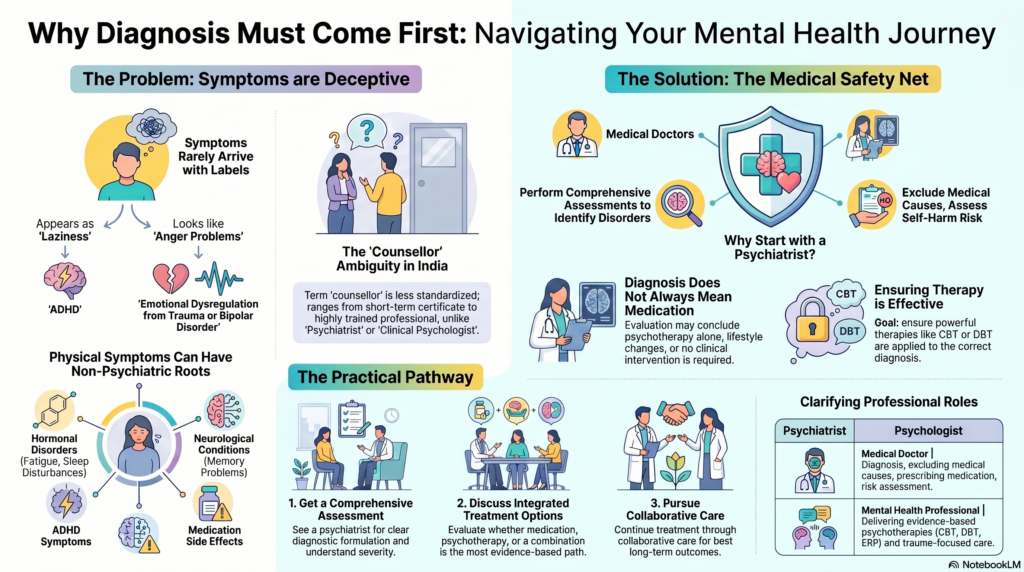 One of the most common questions people ask when seeking help for emotional or mental health difficulties is:
“Should I see a psychiatrist or a psychologist?”
The answer is not always straightforward.
Both psychiatrists and psychologists play essential roles in mental healthcare. Both help people who are struggling with anxiety, depression, stress, relationship difficulties, emotional dysregulation, trauma, ADHD, and many other concerns. In an ideal healthcare system, these professionals work together to provide comprehensive care.
However, before deciding who should provide treatment, it is often more important to answer a different question:
“What exactly is causing my symptoms?”
The Challenge: Symptoms Can Be Misleading
Mental health symptoms rarely arrive with labels.
A person may think they have stress when they are actually experiencing depression.
Someone may believe they are lazy when they have ADHD.
What appears to be anxiety may be OCD.
What looks like anger problems may be emotional dysregulation associated with ADHD, personality difficulties, trauma, or bipolar disorder.
Even physical symptoms such as fatigue, poor concentration, sleep disturbance, irritability, or memory problems can arise from medical illnesses, medication side effects, hormonal disorders, neurological conditions, or psychiatric disorders.
The problem is that treatment is only as good as the diagnosis.
The Indian Reality
In countries with highly regulated mental health systems, patients often have clear pathways to access appropriately trained professionals.
India is more complicated.
The titles psychiatrist and clinical psychologist require substantial formal training and professional registration.
The term counsellor, however, is far less standardized. Depending on where you seek help, a counsellor may be:
- An experienced mental health professional
- A psychologist with psychotherapy training
- A social worker
- A life coach
- Someone who has completed a short-term certification course
- Someone with limited exposure to psychiatric diagnosis
For the average patient, distinguishing between these backgrounds can be difficult.
As a result, some individuals spend months—or even years—receiving supportive counselling without ever undergoing a comprehensive diagnostic evaluation.
Why Diagnosis Matters
Consider a few examples.
The Adult with “Motivation Problems”
A professional seeks counselling for procrastination, poor organization, forgetfulness, and underachievement.
The real diagnosis may be ADHD.
Without recognizing ADHD, years of therapy may help with coping but fail to address the core neurodevelopmental condition.
The Student with “Anxiety”
A teenager presents with concentration difficulties, academic decline, and social withdrawal.
The underlying problem could be depression, ADHD, autism spectrum disorder, a learning disability, or even an emerging psychotic disorder.
The Elderly Person with “Stress”
A family may attribute forgetfulness and behavioral changes to aging.
A detailed psychiatric assessment may instead reveal dementia, depression, medication effects, or another neurological condition.
In each case, the critical step is not choosing therapy versus medication.
The critical step is obtaining the correct diagnosis.
Why Many Experts Recommend Seeing a Psychiatrist First
A psychiatrist is first and foremost a medical doctor.
This allows them to:
- Perform comprehensive psychiatric assessments
- Identify psychiatric disorders
- Exclude medical causes of symptoms
- Assess risk of self-harm or suicide
- Recommend investigations when necessary
- Prescribe medication when appropriate
- Refer for psychotherapy when indicated
Importantly, seeing a psychiatrist does not automatically mean receiving medication.
A good psychiatrist may conclude that:
- No psychiatric illness is present
- Psychotherapy alone is sufficient
- Lifestyle interventions are enough
- Medication is required
- A combination of medication and psychotherapy would be most effective
In other words, a psychiatrist can help determine the most appropriate pathway forward.
Therapy Remains Essential
This is not an argument against psychotherapy.
For many conditions, psychotherapy is among the most powerful treatments available.
Cognitive Behaviour Therapy (CBT), Dialectical Behaviour Therapy (DBT), Exposure and Response Prevention (ERP), family interventions, trauma-focused therapies, and other evidence-based approaches can be transformative.
The issue is not whether therapy works.
The issue is ensuring that therapy is being delivered for the correct diagnosis and by an appropriately trained professional.
A Practical Approach for Patients
If you are unsure where to begin:
- Start with a comprehensive psychiatric assessment.
- Obtain a clear diagnosis or diagnostic formulation.
- Understand the severity and contributing factors.
- Discuss treatment options.
- Pursue psychotherapy when recommended.
- Continue collaborative care between psychiatrist and psychologist when needed.
This approach reduces the likelihood of missed diagnoses and helps patients reach effective treatment sooner.
The Bottom Line
The debate should not be framed as psychiatrist versus psychologist.
Both are important.
However, in the Indian healthcare environment, where training backgrounds can vary significantly and psychiatric disorders are frequently under-recognized, starting with a qualified psychiatrist often provides the safest and most comprehensive entry point into mental healthcare.
A thorough assessment can clarify what is happening, identify whether therapy, medication, or both are needed, and ensure that treatment is based on an accurate understanding of the problem rather than assumptions.
About the Author
Dr. Srinivas Rajkumar T, MD (AIIMS, New Delhi), DNB, MBA (BITS Pilani)
Senior Consultant Psychiatrist
Mind & Memory Clinic, Apollo Clinic Velachery (Opp. Phoenix Mall), Chennai
Dr. Srinivas provides comprehensive psychiatric assessments for adults, adolescents, and older adults, with special interests in ADHD, autism, mood disorders, anxiety disorders, cognitive disorders, and neuropsychiatry. His approach integrates diagnostic precision, psychotherapy-informed care, psychoeducation, and evidence-based treatment planning.
📞 Appointments: +91-8595155808
✉ Email: srinivasaiims@gmail.com
🌐 Website: srinivasaiims.com
“The first step in treatment is not medication or therapy—it is understanding what is really going on.”