Long-Acting Olanzapine in Schizophrenia: Improving Adherence, Preventing Relapse, and Supporting Recovery
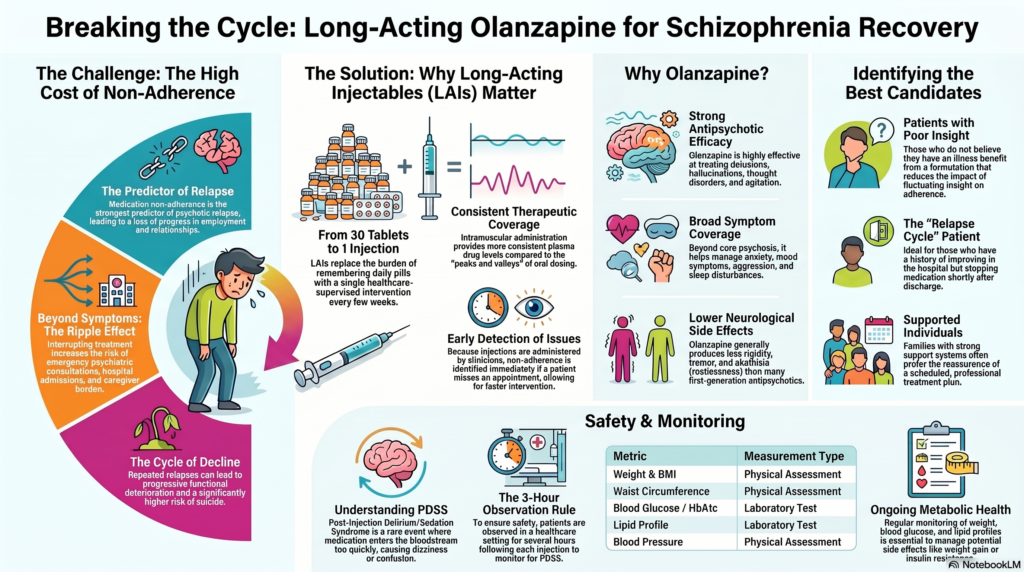 Introduction
Few developments in psychiatry have transformed the prognosis of schizophrenia as dramatically as antipsychotic medications. Before their introduction, repeated hospitalizations, persistent psychosis, and progressive social decline were often considered inevitable. Today, many individuals with schizophrenia can achieve meaningful recovery, maintain relationships, pursue education, and remain employed.
However, one major challenge continues to limit treatment success: medication adherence.
Even the most effective antipsychotic cannot work if it is not taken consistently. Unfortunately, difficulties with adherence are common in schizophrenia due to poor insight, cognitive deficits, medication side effects, stigma, forgetfulness, and the mistaken belief that treatment is no longer necessary once symptoms improve.
Long-acting injectable (LAI) antipsychotics were developed to address this problem. By providing sustained medication delivery over weeks or months, they reduce the burden of daily tablet-taking and help maintain continuous therapeutic coverage.
Among these agents, long-acting olanzapine occupies a unique position because it combines the proven efficacy of olanzapine with the benefits of depot treatment.
The Cost of Non-Adherence
Medication non-adherence remains one of the strongest predictors of relapse in schizophrenia.
Research consistently demonstrates that interruptions in treatment are associated with:
- Increased risk of psychotic relapse
- Emergency psychiatric consultations
- Hospital admissions
- Increased caregiver burden
- Occupational and educational disruption
- Higher suicide risk
- Progressive functional deterioration
For many patients, relapse is not merely a temporary return of symptoms. It can result in loss of employment, damaged relationships, financial hardship, and prolonged periods of recovery.
Every relapse prevented is therefore clinically significant.
Why Long-Acting Injectable Antipsychotics Matter
Long-acting injectable antipsychotics are designed to release medication gradually after intramuscular administration.
Advantages include:
- Reduced reliance on daily medication-taking
- More consistent plasma drug levels
- Earlier identification of non-adherence
- Reduced relapse rates
- Lower hospitalization rates
- Improved treatment continuity
Rather than asking a patient to remember 30 tablets every month, treatment can often be delivered once every few weeks under clinical supervision.
This transforms adherence from a daily challenge into a scheduled healthcare intervention.
Olanzapine: One of Psychiatry’s Most Effective Antipsychotics
Olanzapine has been used worldwide for more than two decades and remains one of the most effective antipsychotic medications available.
Its clinical benefits include:
Strong Antipsychotic Efficacy
Olanzapine is highly effective for:
- Delusions
- Hallucinations
- Thought disorder
- Agitation
- Behavioral disturbances
Numerous studies have demonstrated efficacy comparable to or exceeding many other antipsychotic agents.
Broad Symptom Coverage
In addition to positive symptoms, olanzapine may improve:
- Anxiety
- Mood symptoms
- Aggression
- Sleep disturbances
Lower Risk of Extrapyramidal Symptoms
Compared with many first-generation antipsychotics, olanzapine generally produces:
- Less rigidity
- Less tremor
- Less dystonia
- Less akathisia
This often contributes to better treatment acceptance.
What is Long-Acting Olanzapine?
Long-acting olanzapine contains olanzapine pamoate, a depot formulation designed for deep intramuscular injection.
After administration, the medication is gradually released over several weeks, producing sustained therapeutic plasma concentrations.
Depending on the prescribed regimen, injections are administered every two to four weeks.
This allows clinicians to maintain symptom control while reducing dependence on daily oral treatment.
Which Patients May Benefit Most?
Long-acting olanzapine is particularly useful in patients who:
Have Repeatedly Stopped Oral Medication
Many psychiatric admissions follow a familiar pattern:
- Symptoms improve
- Medication is discontinued
- Relapse occurs
- Hospitalization follows
Depot treatment can help break this cycle.
Have Poor Insight
Some patients do not believe they have an illness and therefore do not perceive the need for treatment.
Long-acting formulations reduce the impact of fluctuating insight on adherence.
Have Frequent Relapses
Patients with multiple relapses often benefit from more reliable medication delivery.
Have Strong Family Support
Families frequently appreciate the reassurance provided by scheduled treatment and regular follow-up.
Dosing Considerations
Long-acting olanzapine is available in multiple strengths, allowing flexibility in treatment planning.
Patients stabilized on oral olanzapine can generally be transitioned to depot treatment using established conversion schedules.
The exact dosing regimen should always be individualized based on:
- Previous oral dose
- Clinical response
- Tolerability
- Relapse history
- Metabolic profile
The Unique Safety Consideration: Post-Injection Delirium/Sedation Syndrome
A distinctive feature of long-acting olanzapine is the rare but important phenomenon known as Post-Injection Delirium/Sedation Syndrome (PDSS).
What is PDSS?
PDSS occurs when a portion of the injected medication inadvertently enters the bloodstream, leading to unexpectedly high serum olanzapine concentrations.
Symptoms may include:
- Excessive sedation
- Dizziness
- Confusion
- Slurred speech
- Altered consciousness
- Delirium
Although uncommon, the possibility of PDSS has led to specific monitoring recommendations.
Observation Requirements
Patients are typically observed in a healthcare setting for several hours after each injection.
This precaution has contributed significantly to the overall safety of depot olanzapine treatment.
Metabolic Monitoring Remains Essential
Like oral olanzapine, long-acting formulations may contribute to:
- Weight gain
- Increased appetite
- Insulin resistance
- Diabetes mellitus
- Dyslipidemia
Routine monitoring should include:
- Weight
- Body mass index
- Waist circumference
- Blood glucose
- HbA1c
- Lipid profile
- Blood pressure
Successful treatment involves managing both psychiatric symptoms and physical health.
Comparing Long-Acting Olanzapine with Other Depot Antipsychotics
Available long-acting injectable antipsychotics include formulations of:
- Haloperidol
- Fluphenazine
- Risperidone
- Paliperidone
- Aripiprazole
- Olanzapine
Each has unique advantages and limitations.
Olanzapine’s primary strengths include:
- High efficacy
- Broad symptom control
- Good tolerability regarding extrapyramidal symptoms
Its principal limitation is the requirement for post-injection monitoring because of PDSS risk.
Therefore, treatment selection should be individualized rather than based on a one-size-fits-all approach.
Recent Developments in India
The availability of indigenous long-acting olanzapine formulations, including Tolaz LA, represents an important milestone for psychiatric care in India.
Historically, access to depot antipsychotics has often been limited by availability and cost considerations. Increased local manufacturing may improve access and allow more patients to benefit from evidence-based relapse prevention strategies.
For psychiatrists working in busy outpatient settings, long-acting olanzapine provides another valuable option for patients who respond well to oral olanzapine but struggle with long-term adherence.
Looking Beyond Symptom Control
Modern schizophrenia care is no longer focused solely on reducing hallucinations and delusions.
The goals now include:
- Functional recovery
- Social reintegration
- Educational achievement
- Occupational success
- Independent living
- Improved quality of life
Long-acting injectable antipsychotics can play a crucial role in achieving these outcomes by providing a stable biological foundation upon which psychosocial recovery can occur.
Medication alone does not produce recovery, but recovery becomes much more difficult when effective medication is interrupted repeatedly.
Conclusion
Long-acting olanzapine represents an important therapeutic option for patients with schizophrenia who respond well to olanzapine but face challenges with medication adherence.
By reducing missed doses, lowering relapse risk, and promoting treatment continuity, depot formulations can improve both clinical outcomes and quality of life.
Although careful monitoring remains necessary—particularly because of the rare risk of Post-Injection Delirium/Sedation Syndrome—the benefits can be substantial for appropriately selected patients.
As access to long-acting injectable antipsychotics continues to expand in India, clinicians have greater opportunities than ever before to move beyond crisis management and toward sustained recovery-oriented care.
About the Author
Dr. Srinivas Rajkumar T, MD (AIIMS, New Delhi), DNB, MBA (BITS Pilani)
Senior Consultant Psychiatrist
I believe that effective psychiatric care extends beyond prescribing medication. Successful long-term outcomes require a comprehensive understanding of biological, psychological, social, cognitive, and family factors that influence recovery.
My clinical interests include schizophrenia, bipolar disorder, adult ADHD, autism, geriatric psychiatry, neuropsychiatry, cognitive assessment, neuromodulation, and recovery-focused psychiatric care.
Consultations are available both in-person and online.
Mind & Memory Clinic
Apollo Clinic Velachery (Opp. Phoenix Mall), Chennai
📞 +91-8595155808
✉ srinivasaiims@gmail.com