Tofisopam: The “Non-Sedating Benzodiazepine” That Most Psychiatrists Rarely Discuss
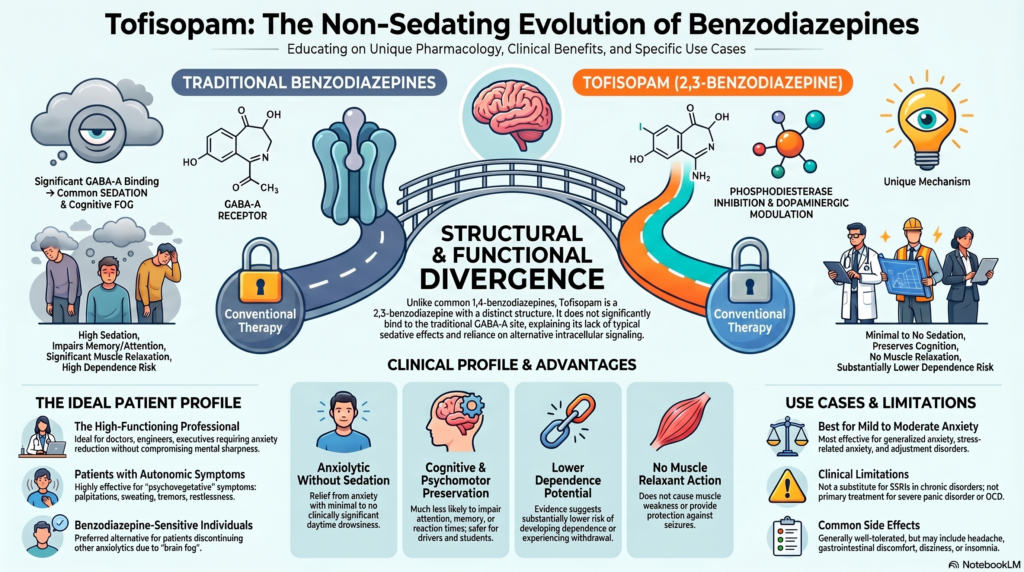 When clinicians think of benzodiazepines, they usually think of sedation, cognitive slowing, dependence, tolerance, falls, and withdrawal.
Yet there exists an unusual member of the benzodiazepine family that challenges many of these assumptions: Tofisopam.
Marketed in several countries for decades and increasingly prescribed in India, tofisopam occupies a unique position between classical benzodiazepines and modern anxiolytics.
What Makes Tofisopam Different?
Most benzodiazepines belong to the 1,4-benzodiazepine class, including diazepam, lorazepam, clonazepam, and alprazolam.
Tofisopam is structurally different. It belongs to the 2,3-benzodiazepine group and exhibits pharmacological properties distinct from conventional benzodiazepines. Unlike classical benzodiazepines, it does not significantly bind to the traditional benzodiazepine site on the GABA-A receptor.
This difference explains many of its unusual clinical effects.
The Clinical Profile
Tofisopam is often described as an anxiolytic without many of the disadvantages commonly associated with benzodiazepines.
Studies suggest that it possesses:
- Anxiolytic effects
- Minimal sedation
- No significant muscle relaxant effect
- No anticonvulsant action
- Little psychomotor impairment
- Minimal cognitive slowing
- Lower dependence potential than traditional benzodiazepines
For many patients, especially working professionals, this profile is highly attractive.
A Different Mechanism of Action
The exact mechanism remains incompletely understood.
Research suggests that tofisopam may influence intracellular signaling pathways through phosphodiesterase inhibition and modulation of dopaminergic systems rather than through direct GABA-A receptor potentiation.
Animal studies have also demonstrated distinct binding patterns within the basal ganglia, further supporting the idea that tofisopam represents a fundamentally different anxiolytic mechanism compared with conventional benzodiazepines.
Why Many Clinicians Like It
1. Minimal Daytime Drowsiness
One of the biggest complaints with benzodiazepines is sedation.
Patients frequently report:
- Feeling sleepy
- Reduced concentration
- Slowed thinking
- Reduced work productivity
Tofisopam appears considerably less sedating than conventional benzodiazepines. Several studies have reported little or no clinically significant sedation.
2. Better Cognitive Preservation
Traditional benzodiazepines can impair attention, memory, and psychomotor performance.
Tofisopam appears much less likely to produce these cognitive effects, making it potentially useful in professionals, students, and older adults where cognitive preservation is important.
3. Lower Dependence Concerns
Although caution remains prudent with any anxiolytic, available evidence suggests a substantially lower risk of dependence and withdrawal compared with classical benzodiazepines.
4. Psychovegetative Symptoms
Many clinicians find tofisopam particularly useful when anxiety presents with prominent autonomic symptoms:
- Palpitations
- Tremulousness
- Sweating
- Internal restlessness
- Functional somatic symptoms
Its effects on autonomic dysregulation have been repeatedly highlighted in clinical practice.
Where Does Tofisopam Fit Clinically?
In my view, tofisopam is most useful in:
Mild to Moderate Anxiety
Patients with:
- Generalized anxiety symptoms
- Stress-related anxiety
- Adjustment disorders
- Situational anxiety
often benefit while avoiding excessive sedation.
Patients Sensitive to Benzodiazepines
Many patients discontinue alprazolam, clonazepam, or lorazepam because they feel “foggy.”
Tofisopam may offer a better tolerated alternative in such situations.
Working Professionals
Doctors, engineers, executives, drivers, teachers, and students frequently need anxiety reduction without cognitive compromise.
Tofisopam is particularly attractive in these populations.
Limitations
Tofisopam is not a replacement for everything.
It should not be viewed as:
- A substitute for SSRIs in chronic anxiety disorders
- A treatment for severe panic disorder
- A treatment for obsessive-compulsive disorder
- A primary treatment for major depression
The evidence base, while encouraging, remains considerably smaller than that for SSRIs, SNRIs, and established benzodiazepines. Much of the published literature originates from earlier decades and further modern trials would be valuable.
Side Effects
Most patients tolerate tofisopam well.
Potential adverse effects include:
- Headache
- Gastrointestinal discomfort
- Dizziness
- Agitation
- Insomnia in sensitive individuals
Unlike traditional benzodiazepines, excessive sleepiness is generally less prominent.
The Bottom Line
Tofisopam is one of the most interesting yet underappreciated anxiolytics available today.
Although classified as a benzodiazepine, it behaves very differently from the drugs psychiatrists usually associate with that class. It provides anxiolytic benefits with remarkably little sedation, cognitive impairment, muscle relaxation, or dependence liability.
For patients seeking relief from anxiety while remaining alert, productive, and cognitively sharp, tofisopam deserves serious consideration.
As always, medication works best when combined with appropriate psychological interventions, lifestyle modification, sleep optimization, and treatment of underlying psychiatric disorders.
Dr. Srinivas Rajkumar T
MD (AIIMS, New Delhi), DNB, MBA (BITS Pilani)
Senior Consultant Psychiatrist
Mind & Memory Clinic, Apollo Clinic Velachery, Chennai
Opp. Phoenix Mall
Email: srinivasaiims@gmail.com
Phone: +91-8595155808