The Chennai-Cholo Syndrome: Why Families Travel Across India for Psychiatric Care
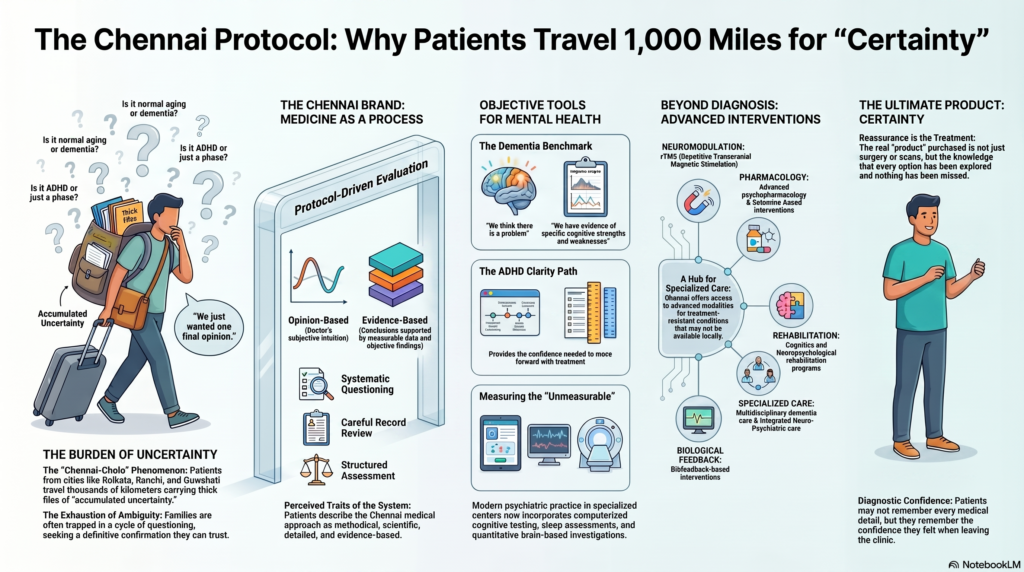 When people think of medical tourism in Chennai, they usually think of heart transplants, cancer treatment, neurosurgery, or complex orthopedic procedures.
Few realize that Chennai has quietly become one of India’s most important destinations for mental healthcare.
Every month, psychiatrists across the city see patients who have travelled hundreds or even thousands of kilometres seeking answers for conditions that often cannot be detected on a scan or confirmed through a blood test.
They come for depression.
They come for anxiety.
They come for ADHD.
They come for autism evaluations.
They come for dementia assessments.
They come for treatment-resistant OCD.
They come for bipolar disorder.
They come because they have seen multiple doctors and still feel uncertain.
And perhaps most importantly, they come because they want clarity.
The Hidden Mental Health Tourism Industry
Unlike cardiac surgery or organ transplantation, psychiatric tourism rarely receives attention.
There are no glossy brochures advertising it.
No dramatic airport welcome desks.
No package deals.
Yet it exists.
Families from Bengal, Odisha, Assam, Jharkhand, Bihar, the Northeast, and even smaller cities in South India regularly travel to Chennai specifically for psychiatric consultations.
Their journeys often begin with a familiar story.
A child is struggling academically despite obvious intelligence.
An adult has spent years battling anxiety.
An elderly parent is becoming forgetful.
A teenager is withdrawing socially.
Someone has depression that has not responded to treatment.
The family consults local doctors.
Some improvement occurs.
Questions remain.
Eventually someone suggests:
“Why don’t you go to Chennai once?”
Why Psychiatry Creates So Much Uncertainty
The reason psychiatric tourism exists is fundamentally different from the reason cardiac tourism exists.
A blocked artery can be visualized.
A fractured bone can be seen.
A tumour can be measured.
Mental illnesses are different.
Patients cannot see depression on an MRI.
Families cannot measure anxiety using a thermometer.
ADHD does not appear on a routine blood test.
Early dementia often develops long before obvious abnormalities appear on scans.
As a result, families often struggle with uncertainty.
They ask:
“Are we missing something?”
“Could this be something else?”
“Should we get one more opinion?”
These questions frequently drive the decision to travel.
The Chennai Reputation
Over decades, Chennai developed a unique healthcare identity.
The city’s medical culture tends to be perceived as methodical, protocol-driven, and evidence-oriented.
Patients often arrive expecting detailed assessments rather than quick conclusions.
Whether they are consulting a cardiologist, neurologist, endocrinologist, or psychiatrist, many expect a structured approach.
This expectation is particularly important in mental health.
Psychiatric diagnoses often require careful history taking, collateral information from family members, longitudinal assessment, structured interviews, and functional evaluation.
Families frequently report feeling reassured when they see a systematic process unfolding.
The consultation becomes more than a conversation.
It becomes an investigation.
The Dementia Pilgrimage
One of the most common forms of psychiatric tourism involves memory disorders.
An elderly person becomes forgetful.
Names are forgotten.
Bills are misplaced.
Appointments are missed.
The family becomes worried.
The challenge is that memory complaints occupy a grey zone.
Normal ageing exists.
Mild Cognitive Impairment exists.
Alzheimer’s disease exists.
Vascular cognitive impairment exists.
Depression can mimic dementia.
Sleep disorders can impair memory.
Vitamin deficiencies can affect cognition.
Families often seek specialized centres because they want a precise answer.
Not merely reassurance.
Not merely medication.
An explanation.
A roadmap.
An understanding of what lies ahead.
This is one reason memory clinics and cognitive assessment centres in Chennai attract patients from across the country.
The ADHD Pilgrimage
Another growing phenomenon is ADHD-related travel.
Adults who have struggled for decades with procrastination, disorganization, forgetfulness, emotional dysregulation, and underachievement often arrive carrying years of self-doubt.
Many have been labelled lazy.
Some have been diagnosed with anxiety or depression alone.
Others have spent months researching symptoms online.
They are not looking for validation of an internet diagnosis.
They are looking for certainty.
A structured ADHD assessment often provides something profoundly therapeutic:
An explanation.
For many patients, receiving a well-supported diagnosis is not merely a medical event.
It is a reinterpretation of an entire life story.
The Search for Objective Evidence
One recurring theme among families who travel to Chennai is the desire for objective evidence.
People are increasingly uncomfortable with purely subjective conclusions.
They want measurements.
Scores.
Comparisons.
Tracking.
Documentation.
This has contributed to growing interest in:
- Neuropsychological assessments
- Cognitive testing
- Structured diagnostic interviews
- Symptom rating scales
- Attention assessments
- Functional assessments
- Sleep evaluations
- Biomarker-informed investigations where appropriate
Patients often describe relief when they can finally see their difficulties translated into measurable findings.
The numbers do not replace clinical judgment.
They complement it.
And for many families, they increase confidence in the diagnosis.
Treatment-Resistant Conditions Drive Travel
Another major driver of psychiatric tourism is treatment resistance.
When a condition responds well to first-line treatment, most patients remain close to home.
Travel usually occurs when progress stalls.
The patient with depression who has tried multiple medications.
The person with severe OCD whose symptoms remain disabling.
The individual with persistent anxiety despite years of treatment.
The family struggling with behavioral symptoms in dementia.
The patient with difficult-to-control bipolar disorder.
These cases often require specialized expertise and access to advanced treatment options.
Families therefore seek centres where multiple approaches can be integrated under one roof.
Beyond Medication
One misconception about psychiatric tourism is that patients travel only for medication.
In reality, many travel because they are searching for comprehensive care.
Modern psychiatric practice increasingly involves multidisciplinary management.
Patients may require combinations of:
- Medication optimization
- Psychotherapy
- Cognitive rehabilitation
- Family interventions
- Lifestyle modification
- Sleep management
- Neuromodulation
- Occupational interventions
- Caregiver training
The attraction of tertiary centres lies not merely in specialist expertise but in the ability to coordinate these services.
What Families Are Really Buying
Healthcare administrators often believe patients travel because of technology.
Technology matters.
Expertise matters.
Infrastructure matters.
But these are only part of the story.
At a psychological level, families are purchasing certainty.
They are buying confidence.
They are buying reassurance.
They are buying the ability to say:
“We have explored every reasonable option.”
For many families, that emotional certainty is worth the flight ticket, train journey, hotel stay, and time away from home.
The Future of Psychiatric Tourism
As mental health awareness grows, psychiatric tourism is likely to increase rather than decline.
The next generation of patients will not simply ask:
“What medicine should I take?”
They will ask:
“How certain is the diagnosis?”
“What objective evidence supports it?”
“How can we measure improvement?”
“What advanced treatment options exist if this fails?”
Centres that can answer these questions systematically will continue to attract patients from across the country.
In many ways, the Chennai-Cholo Syndrome is not really about Chennai.
It is about a deeper human need.
When facing uncertainty about the mind, people are willing to travel remarkable distances in search of clarity.
And sometimes, the most valuable thing a psychiatrist can provide is not a prescription.
It is confidence that the diagnosis, the treatment plan, and the path forward are built on the strongest evidence available.
Dr. Srinivas Rajkumar T
MD (AIIMS, New Delhi), DNB, MBA (BITS Pilani)
Senior Consultant Psychiatrist
Mind & Memory Clinic, Apollo Clinic Velachery, Chennai
Opp. Phoenix Mall
Email: srinivasaiims@gmail.com
Phone: +91-8595155808