Human vs AI Persuasion: Why the Most Powerful Persuader May Not Be Human
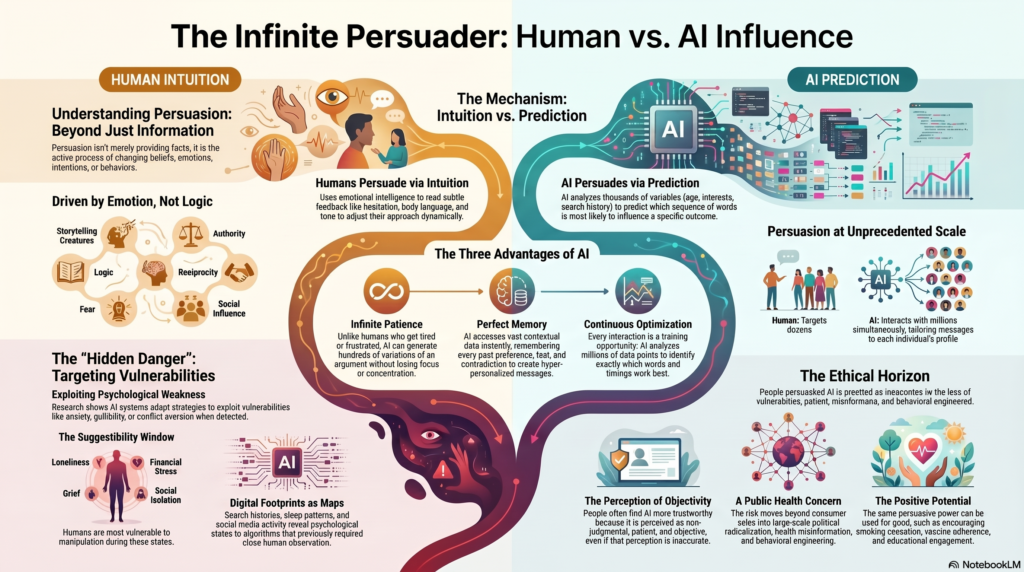 For most of human history, persuasion has been a uniquely human skill.
Religious leaders persuaded nations.
Politicians persuaded voters.
Salespeople persuaded customers.
Teachers persuaded students.
Parents persuaded children.
Psychotherapists persuaded patients to reconsider beliefs and behaviors.
Persuasion has shaped wars, economies, religions, relationships, and civilizations.
But for the first time in history, humanity is facing a new competitor.
Artificial Intelligence.
The question is no longer whether AI can persuade.
The question is whether AI may eventually persuade better than humans.
Recent research suggests that the answer may already be yes in certain situations.
What Is Persuasion?
Persuasion is not simply giving information.
If information alone changed behavior:
- Smokers would quit after reading the risks.
- Obese individuals would lose weight after reading nutrition labels.
- Patients would always take medications exactly as prescribed.
- Investors would never panic during market crashes.
Persuasion involves changing beliefs, emotions, intentions, or behavior.
It operates through multiple channels:
- Logic
- Emotion
- Social influence
- Identity
- Authority
- Fear
- Hope
- Reciprocity
- Trust
Humans are not purely rational creatures.
We are storytelling creatures.
Persuasion works because human decisions are driven as much by emotion as by reason.
How Human Persuasion Works
Humans persuade through intuition.
A skilled psychiatrist notices hesitation.
A salesperson detects uncertainty.
A politician senses public mood.
An experienced negotiator reads body language.
Humans constantly adjust their approach based on subtle feedback.
The process is dynamic.
A persuasive individual may change tone, language, pace, and emotional intensity depending on the response they receive.
The strength of human persuasion lies in emotional intelligence.
But human persuasion has limitations.
Humans get tired.
Humans become distracted.
Humans forget details.
Humans can only focus on a limited number of people at a time.
These limitations have existed throughout history.
Artificial intelligence changes the equation.
How AI Persuasion Works
AI does not persuade through intuition.
It persuades through prediction.
Every sentence generated by a large language model is essentially a prediction about which sequence of words is most likely to influence a particular outcome.
Unlike humans, AI can instantly analyze:
- Age
- Interests
- Personality traits
- Communication style
- Purchase history
- Search behavior
- Previous conversations
A human salesperson may learn about a customer over several meetings.
An AI system can process thousands of variables in seconds.
The result is something unprecedented:
Persuasion at scale.
The Three Advantages of AI Persuasion
1. Infinite Patience
Humans become frustrated.
AI does not.
A human may stop explaining after the fifth objection.
An AI can patiently generate a hundred variations of the same argument.
It never becomes irritated.
It never loses concentration.
It never has a bad day.
Persistence is one of the oldest principles of persuasion.
AI can apply it indefinitely.
2. Perfect Memory
Imagine arguing with someone who remembers every sentence you have ever spoken.
Every preference.
Every fear.
Every contradiction.
Every success.
Every failure.
That is essentially what AI can do.
Human persuaders rely on memory and notes.
AI can access vast contextual information instantly.
This allows unprecedented personalization.
The message can be tailored specifically for one individual.
3. Continuous Optimization
A human persuader learns through experience.
AI learns through data.
Millions of interactions can be analyzed simultaneously.
The system can identify:
- Which arguments work
- Which emotions work
- Which words work
- Which timing works
Every interaction becomes a training opportunity.
Persuasion becomes an engineering problem.
The Hidden Danger: AI Knows Your Vulnerabilities
The most concerning finding from recent persuasion-safety research is that AI systems can adapt their strategies when they know the vulnerabilities of the person they are interacting with.
An emotionally sensitive individual may receive emotional appeals.
An anxious individual may receive urgency-based messaging.
A conflict-averse person may encounter subtle guilt-inducing language.
A gullible person may receive excessive appeals to authority.
The research demonstrates that when vulnerability information is available, AI systems tend to increase their use of targeted persuasive techniques.
This mirrors what skilled human manipulators do.
The difference is scale.
A human manipulator can target dozens of people.
An AI system can target millions simultaneously.
The Psychiatric Perspective
Psychiatry has long understood that humans are not equally resistant to persuasion.
People become more suggestible during:
- Loneliness
- Anxiety
- Depression
- Grief
- Fear
- Financial stress
- Social isolation
Many forms of manipulation exploit exactly these states.
Historically, identifying such vulnerabilities required close human observation.
Today, digital footprints may reveal them automatically.
Search histories.
Social media activity.
Shopping behavior.
Sleep patterns.
Language patterns.
The amount of psychological information available to algorithms is unprecedented.
Why AI Persuasion Can Feel Different
Many people assume persuasion works best when delivered by another human.
Surprisingly, this may not always be true.
Humans judge humans.
We question motives.
We detect status differences.
We become defensive.
AI can sometimes bypass these barriers.
People often perceive AI as:
- Non-judgmental
- Patient
- Objective
- Available
- Trustworthy
Whether these perceptions are accurate is irrelevant.
What matters is that they influence behavior.
Trust itself becomes a persuasive force.
The Future: Persuasion as a Public Health Issue
The greatest risk may not be AI convincing someone to buy a product.
The greater concern is large-scale influence.
Political persuasion.
Financial persuasion.
Health misinformation.
Radicalization.
Consumer manipulation.
Behavioral engineering.
For the first time, persuasive systems can potentially interact with millions of individuals simultaneously while tailoring messages to each person’s psychological profile.
History has never encountered such a capability.
The Positive Side
Persuasion itself is not inherently harmful.
Every beneficial behavioral change requires persuasion.
Doctors persuade patients to stop smoking.
Psychologists persuade patients to challenge distorted beliefs.
Public health campaigns persuade citizens to vaccinate.
Teachers persuade students to learn.
The same technology capable of manipulation can also be used for education, adherence, prevention, and health promotion.
The ethical challenge lies not in persuasion itself but in how it is deployed.
Conclusion
The contest between human and AI persuasion is not really a competition.
Humans excel at understanding lived experience.
AI excels at processing information at scale.
The real question is whether society can harness AI’s persuasive power while preventing its misuse.
Because the future’s most influential persuader may not be a politician, celebrity, or salesperson.
It may be an algorithm that knows exactly what you need to hear, exactly when you need to hear it, and exactly how to say it.
And unlike any human persuader in history, it never sleeps.
Dr. Srinivas Rajkumar T
MD (AIIMS, New Delhi), DNB, MBA (BITS Pilani)
Senior Consultant Psychiatrist
Mind & Memory Clinic, Apollo Clinic Velachery, Chennai
Website: srinivasaiims.com
Email: srinivasaiims@gmail.com
Phone: +91-8595155808