From an Anaesthetic Booster to the First Antipsychotic: The Extraordinary Story of Chlorpromazine and the Birth of Modern Psychiatry
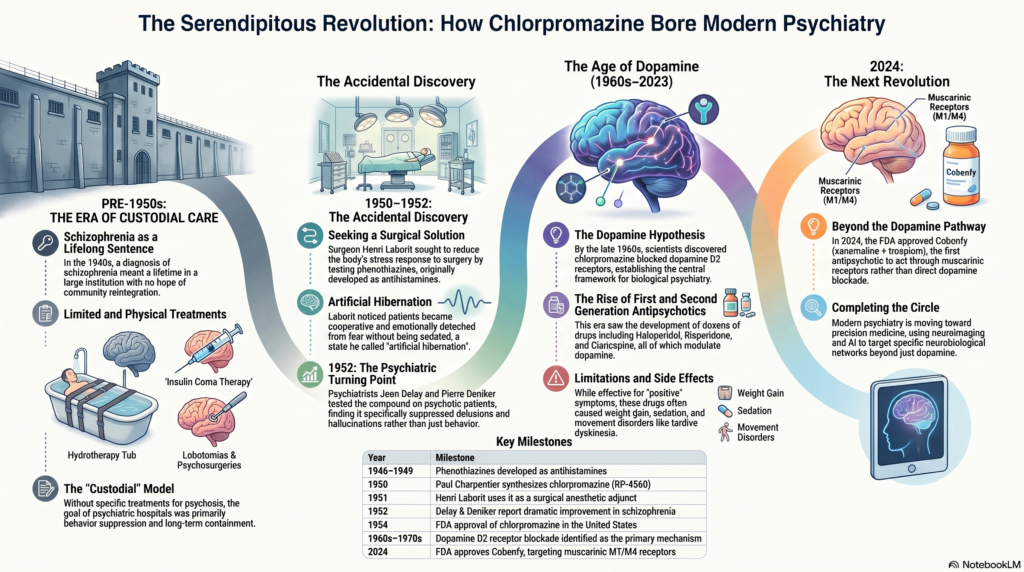 “Some of the greatest medical discoveries were never planned.”
Penicillin was discovered because of a contaminated culture plate.
Lithium was discovered while studying uric acid.
Sildenafil was being developed for angina before becoming Viagra.
And perhaps the most important discovery in psychiatry began with an anaesthetist trying to make surgery safer.
The story of chlorpromazine is not merely the history of a drug—it is the story of how modern biological psychiatry was born.
It transformed psychiatric hospitals, changed neuroscience forever, and laid the foundation for nearly every antipsychotic medication developed over the next seven decades.
Today, with the arrival of muscarinic therapies such as Cobenfy (xanomeline + trospium), psychiatry appears to be entering its next revolution. To appreciate where we are heading, we must first understand where it all began.
Psychiatry Before Chlorpromazine
Imagine practicing psychiatry in the 1940s.
A young man develops schizophrenia at age 22.
He begins hearing voices.
He believes strangers are plotting against him.
He becomes withdrawn and frightened.
Today, we would offer antipsychotic medication, psychosocial interventions, rehabilitation, and community care.
In 1948, however, none of these options existed.
Treatment consisted of:
- Sedatives
- Barbiturates
- Physical restraints
- Hydrotherapy
- Insulin coma therapy
- Metrazol-induced seizures
- Electroconvulsive therapy
- Psychosurgery (lobotomy)
Many patients spent decades in large psychiatric institutions.
Schizophrenia was widely regarded as a lifelong custodial illness.
The idea that a medicine could specifically reduce hallucinations and delusions simply did not exist.
The Search Was Never for a Psychiatric Drug
Ironically, chlorpromazine was never intended to treat mental illness.
The story begins with phenothiazines, compounds initially investigated for their antihistaminic properties.
During the late 1940s, surgeons were struggling with a major challenge.
Even successful operations often resulted in severe postoperative shock.
Patients remained anxious.
Stress hormones surged.
Mortality remained high.
French naval surgeon Henri Laborit believed that reducing the body’s stress response might improve surgical survival.
His concept was revolutionary.
Rather than simply deepening anaesthesia, he wanted to create a state of physiological calm.
Timeline: The Birth of Chlorpromazine
1946–1949
Scientists at Rhône-Poulenc Laboratories in France synthesized multiple phenothiazine derivatives while searching for improved antihistamines.
1950
Chemist Paul Charpentier synthesized compound RP-4560, later named chlorpromazine.
Nobody imagined that this molecule would change psychiatry forever.
At that time it was simply another experimental compound.
1951
Henri Laborit began using chlorpromazine alongside anaesthetic agents.
His intention was straightforward:
- reduce anxiety
- reduce surgical shock
- stabilize blood pressure
- improve postoperative outcomes
Instead, he observed something entirely unexpected.
The “Artificial Hibernation” State
Patients did not merely become sleepy.
They entered a remarkably unique state.
They remained:
- awake
- cooperative
- emotionally detached
- unconcerned about impending surgery
Laborit famously described this as:
“Artificial hibernation.”
Patients seemed emotionally liberated from fear without losing consciousness.
This was unlike sedation.
Unlike anaesthesia.
Unlike narcotics.
Unlike alcohol.
Something entirely different was happening.
Laborit immediately sensed the implications.
He repeatedly suggested that psychiatrists should investigate this remarkable compound.
Psychiatry Notices
At Paris’s Sainte-Anne Hospital, psychiatrists:
- Jean Delay
- Pierre Deniker
accepted Laborit’s challenge.
In 1952, they administered chlorpromazine to patients with severe psychosis.
The results stunned everyone.
What They Saw
Instead of simply becoming sedated, patients experienced:
- quieter minds
- fewer hallucinations
- reduced delusions
- less agitation
- improved organization of thought
- increased participation in conversation
- better self-care
Many chronic patients who had spent years institutionalized became manageable enough to participate in daily life.
This was unprecedented.
Psychiatry had never witnessed anything comparable.
Why Everyone Was Amazed
Most sedatives merely suppress behaviour.
Chlorpromazine appeared to suppress psychosis itself.
Patients weren’t simply sleeping.
They were thinking more clearly.
This distinction changed medicine forever.
The Beginning of Modern Psychopharmacology
Within only a few years:
Europe adopted chlorpromazine.
North America adopted chlorpromazine.
Asia adopted chlorpromazine.
Mental hospitals that once housed thousands of chronically psychotic patients began seeing increasing numbers discharged into the community.
The era of long-term custodial psychiatry had begun to decline.
Timeline of the Chlorpromazine Revolution
| Year | Milestone |
|---|---|
| 1946–1949 | Phenothiazines developed as antihistamines |
| 1950 | Paul Charpentier synthesizes chlorpromazine |
| 1951 | Henri Laborit introduces it as an anaesthetic adjunct |
| 1951 | “Artificial hibernation” described |
| 1952 | Delay and Deniker report dramatic improvement in schizophrenia |
| 1953 | Widespread psychiatric use begins in France |
| 1954 | FDA approval in the United States |
| Late 1950s | Chlorpromazine adopted worldwide |
| 1960s–1970s | Dopamine receptor blockade identified as its principal antipsychotic mechanism |
| 1970s onward | Development of haloperidol, fluphenazine, trifluoperazine and numerous other dopamine-based antipsychotics |
| 2024 | FDA approves Cobenfy—the first schizophrenia treatment acting primarily through muscarinic M1/M4 receptors rather than direct dopamine blockade. |
Understanding the Mechanism
Initially, nobody understood why chlorpromazine worked.
Researchers proposed numerous possibilities:
- sedation
- antihistamine action
- autonomic blockade
None explained its selective reduction of psychotic symptoms.
Everything changed in the late 1960s.
Scientists demonstrated that chlorpromazine blocked dopamine D₂ receptors.
This observation eventually evolved into the dopamine hypothesis of schizophrenia.
For decades this became the central framework of biological psychiatry.
Nearly every subsequent antipsychotic targeted dopamine.
Examples include:
- Haloperidol
- Fluphenazine
- Trifluoperazine
- Risperidone
- Olanzapine
- Quetiapine
- Ziprasidone
- Aripiprazole
- Lurasidone
- Cariprazine
Although their pharmacology differs, dopamine modulation remains a common therapeutic principle.
Chlorpromazine Did More Than Treat Schizophrenia
Its discovery transformed neuroscience itself.
Researchers began asking:
- What is dopamine?
- How do neurotransmitters regulate behaviour?
- Can chemicals alter thoughts?
- Can psychosis arise from altered brain signalling?
These questions accelerated research into neurotransmitters including serotonin, noradrenaline, GABA, glutamate and acetylcholine.
Modern psychopharmacology was born.
The Limitations Became Apparent
Despite its revolutionary impact, chlorpromazine was far from perfect.
Problems included:
- extrapyramidal symptoms
- tardive dyskinesia
- hyperprolactinaemia
- sedation
- anticholinergic effects
- orthostatic hypotension
- weight gain
Perhaps more importantly, dopamine antagonists primarily improved positive symptoms such as hallucinations and delusions.
Negative symptoms and cognitive impairment often remained inadequately treated.
This realization prompted the search for entirely different therapeutic pathways.
The Circle Comes Full Circle
Interestingly, the next major breakthrough again emerged from careful observation of neurobiology.
Rather than focusing solely on dopamine, researchers revisited the cholinergic system, particularly muscarinic M1 and M4 receptors.
Decades of preclinical and clinical work culminated in Cobenfy (xanomeline + trospium), approved by the FDA in 2024. Unlike chlorpromazine and most antipsychotics developed after it, Cobenfy does not rely on direct dopamine D₂ receptor blockade. Instead, it activates muscarinic M1 and M4 receptors, representing the first approved antipsychotic mechanism outside the traditional dopamine pathway.
In many ways, psychiatry has completed a full circle:
- 1950s: Serendipitous discovery leads to dopamine-centered therapy.
- 2020s: Advances in neuroscience enable targeted, mechanism-based cholinergic therapy.
Lessons Beyond Psychiatry
The chlorpromazine story teaches several enduring lessons:
- Curiosity often precedes discovery.
- Clinicians who carefully observe unexpected effects can transform medicine.
- Major advances may come from drugs developed for entirely different purposes.
- Scientific progress is rarely linear; hypotheses evolve as evidence accumulates.
- Every generation should remain open to challenging established paradigms.
Looking Ahead
Today, psychiatry is entering another exciting phase.
Precision medicine, neuroimaging, quantitative EEG (qEEG), biomarkers, pharmacogenomics, digital phenotyping and artificial intelligence are reshaping how we understand mental illness. Future treatments may be selected based not only on symptoms but also on an individual’s underlying neurobiology.
If the twentieth century belonged to dopamine, the coming decades may see a broader integration of cholinergic, glutamatergic, GABAergic and other network-based approaches.
Final Thoughts
When Paul Charpentier synthesized chlorpromazine in 1950, he was creating an experimental chemical—not a psychiatric revolution.
When Henri Laborit used it to reduce surgical shock, he sought better anaesthesia—not a treatment for schizophrenia.
When Delay and Deniker administered it to psychotic patients, they could not have predicted that they were witnessing one of the greatest turning points in medical history.
The story of chlorpromazine reminds us that transformative discoveries often emerge where curiosity meets careful observation. It also serves as a reminder that psychiatry continues to evolve. Just as one unexpected observation reshaped the field in the 1950s, today’s advances in neuroscience and precision therapeutics may define the next era of care.
About the Author
Dr. Srinivas Rajkumar T, MD (AIIMS, New Delhi), DNB, MBA (BITS Pilani)
Senior Consultant Psychiatrist
Mind & Memory Clinic, Apollo Clinic Velachery, Chennai
Special interests: ADHD, Autism, Dementia, Neuropsychiatry, Objective Cognitive Assessment, qEEG, Neurofeedback, and AI-assisted precision psychiatry.