Cognitive Behavioural Therapy, or CBT, is a practical psychological treatment used for problems such as anxiety, depression, excessive worry, panic, stress and many other emotional difficulties.
The central idea behind CBT is surprisingly simple:
What we think, what we feel in our body, how we feel emotionally, and what we do are all connected.
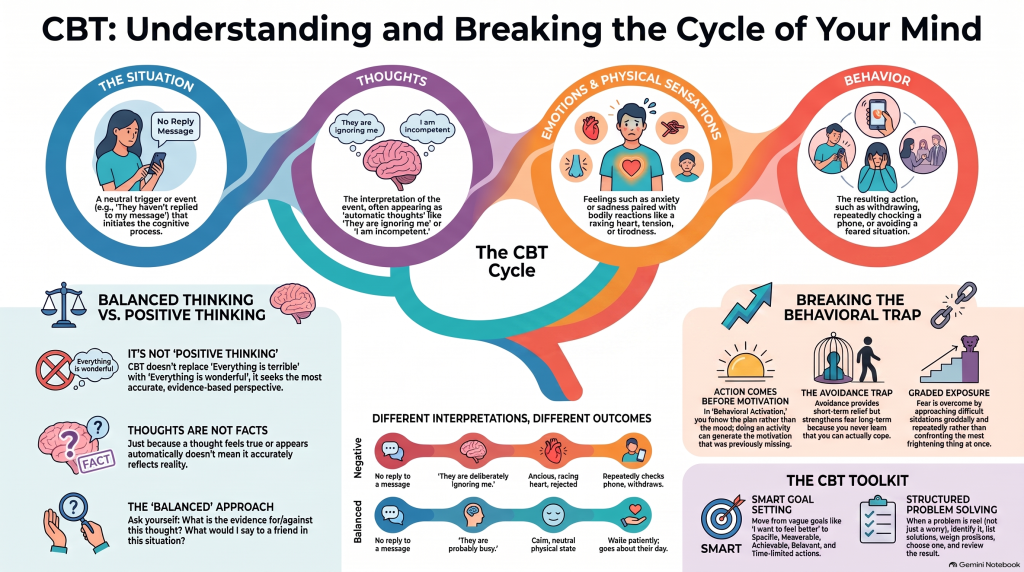
A difficult situation can trigger a thought. That thought can change our emotions and physical sensations. Those feelings then influence our behaviour. What we do next can either help the problem settle—or keep the cycle going.
CBT helps us identify these patterns and gradually change the parts that are keeping the problem alive.
The Same Situation Can Produce Different Reactions
Imagine sending an important message and receiving no reply for several hours.
The situation is simply:
“They haven’t replied.”
One person may think:
“They are probably busy.”
Another may think:
“I must have upset them.”
Someone else may think:
“They are deliberately ignoring me.”
The event is exactly the same.
But the interpretation is different.
And that interpretation can influence what happens next.
If you think “They are deliberately ignoring me,” you may feel anxious or rejected. Your heart may race. You may repeatedly check your phone, send more messages or withdraw from that person.
This creates the basic CBT cycle.
The CBT Model
A useful way to understand CBT is:
Situation
↓
Thoughts
“What does this mean?”
↓
Emotions
Anxiety, sadness, anger, guilt
↓
Physical sensations
Racing heart, tension, tiredness, sweating
↓
Behaviour
Avoiding, withdrawing, checking, escaping
And importantly, these factors can influence one another in both directions.
So CBT does not work only with thoughts.
It works with:
Thoughts + Emotions + Body + Behaviour
Automatic Thoughts
Many thoughts appear so quickly that we hardly notice them.
CBT calls these automatic thoughts.
Examples include:
“Something bad is going to happen.”
“I won’t be able to cope.”
“Everyone will think badly of me.”
“There is no point trying.”
With anxiety, we may overestimate danger and underestimate our ability to cope.
With depression, our thinking may become increasingly negative about:
- ourselves
- our situation
- other people
- the future
These thoughts can feel completely true simply because they appear automatically and repeatedly.
CBT teaches us to slow this process down and examine them.
CBT Is Not Positive Thinking
This is an important distinction.
CBT does not ask you to replace:
“Everything is terrible”
with:
“Everything is wonderful.”
Instead, it asks:
“What is the most balanced and realistic way of looking at this?”
For example:
Automatic thought:
“I made a mistake in my presentation. Everyone must think I’m incompetent.”
CBT might ask:
- What evidence supports this?
- What evidence goes against it?
- Am I assuming that I know what other people are thinking?
- Am I judging my entire performance based on one mistake?
- What would I say to a friend in the same situation?
A more balanced thought could be:
“I made one mistake, but that does not mean the whole presentation was bad or that everyone thinks I am incompetent.”
That is not artificially positive.
It is simply more accurate.
Behaviour Is Equally Important
Sometimes changing behaviour can be even more important than changing a thought.
Consider depression.
Low mood can reduce motivation.
We may gradually:
- stop meeting friends
- exercise less
- postpone work
- abandon hobbies
- spend more time alone
- stay in bed longer
Initially, doing less may feel easier.
But gradually we lose opportunities for:
- enjoyment
- achievement
- connection
- confidence
- activity
The result can be:
Low mood → Reduced activity → Less pleasure and achievement → Even lower mood
CBT uses behavioural activation to break this cycle.
One useful principle is:
Follow the plan, not always the mood.
We do not necessarily wait for motivation before beginning an activity.
Sometimes action comes first and motivation follows.
Why Avoidance Can Make Anxiety Stronger
Avoidance is another major target in CBT.
Imagine becoming anxious in a crowded supermarket.
You immediately leave.
Your anxiety falls.
The brain learns:
“Leaving protected me.”
The next time you enter a supermarket, the fear returns.
You escape again.
Again, anxiety drops.
This gives immediate relief—but it may strengthen the fear in the longer term.
You never get the opportunity to discover:
“I was anxious, but I could cope.”
For this reason CBT often uses graded exposure.
Instead of confronting the most frightening situation immediately, feared situations are approached gradually and repeatedly.
Over time the person learns:
Anxiety is uncomfortable, but it does not necessarily mean danger.
CBT Is a Toolkit
CBT is not one single technique.
Different problems require different tools.
Common CBT techniques include:
- identifying thoughts, emotions and behaviours
- setting clear goals
- behavioural activation
- graded exposure
- worry management
- structured problem solving
- identifying automatic thoughts
- examining evidence
- cognitive restructuring
- behavioural experiments
The aim is to build a personal psychological toolkit.
Setting Goals
A vague goal such as:
“I want to feel better”
is difficult to measure.
A more useful goal might be:
“I will meet a friend once this weekend.”
Similarly:
“I want to stop being anxious”
may become:
“I will spend 15 minutes in the supermarket twice this week without leaving immediately when anxiety begins.”
CBT therefore often uses SMART goals:
**Specific
Measurable
Achievable
Relevant
Time-limited**
A useful question is:
“If treatment were working, what would I actually be doing differently?”
Problem Solving Versus Worrying
Not every worry needs to be challenged as an irrational thought.
Sometimes there is a genuine problem that requires action.
CBT can then use structured problem solving:
Identify the problem
↓
List possible solutions
↓
Consider advantages and disadvantages
↓
Choose a solution
↓
Make a plan
↓
Do it
↓
Review what happened
This helps convert repetitive worrying into useful action.
CBT Looks for Vicious Cycles
One of the most useful questions in CBT is:
“What is keeping this problem going?”
For example:
Stress
↓
Poor sleep
↓
Tiredness
↓
Less activity
↓
Lower mood
↓
More negative thinking
↓
Further withdrawal
Or in panic:
Heart beats faster
↓
“Something is seriously wrong”
↓
Fear increases
↓
Adrenaline increases
↓
Heart beats even faster
↓
“This proves something is wrong”
↓
More panic
CBT tries to identify where we can interrupt the cycle.
Sometimes we change the thought.
Sometimes the behaviour.
Sometimes avoidance.
Sometimes lifestyle, sleep or problem solving.
Often we work on several parts together.
CBT Is an Active Therapy
CBT is not simply talking about problems.
Understanding the problem is important—but CBT repeatedly asks:
“What can we practise differently?”
This may involve:
- keeping a thought record
- monitoring anxiety or mood
- scheduling activities
- practising exposure
- testing predictions
- challenging automatic thoughts
- solving practical problems
- reviewing what worked
This is why practice between therapy sessions is important.
CBT is a skill.
And like any skill, it improves through repetition.
A Few Important CBT Principles
Thoughts are not always facts.
A thought can feel convincing and still be inaccurate.
Feelings are real, but they do not always tell us exactly what is happening.
Feeling unsafe does not necessarily mean we are in danger.
Avoidance can reduce anxiety today while strengthening it tomorrow.
Short-term relief is not always the same as long-term recovery.
Action can sometimes come before motivation.
We do not always need to feel ready before taking a useful step.
The Ultimate Goal of CBT
Good CBT gradually helps a person become better at understanding and managing their own patterns.
Instead of automatically reacting, we learn to ask:
What happened?
What went through my mind?
What emotion did I experience?
What happened in my body?
What did I do?
Did that behaviour help only for a few minutes, or did it help me in the longer term?
Is there another way of looking at this?
What could I try differently next time?
That is the essence of CBT:
**Notice the pattern.
Understand the cycle.
Change one part.
Observe what happens.
Practise again.**
Over time, these relatively small changes in thinking and behaviour can produce meaningful changes in emotional wellbeing.
A Note From The Author
In clinical practice, I often explain CBT as a way of understanding how the mind has learned to respond to a particular situation—and how it can learn a different response.
The goal is not to tell patients simply to “think positively.” It is to understand the individual pattern maintaining anxiety, depression, avoidance, panic or repetitive worry and select the appropriate intervention.
Depending on the person, treatment may include CBT techniques alongside medication, lifestyle interventions or other psychological and technology-assisted approaches when clinically appropriate.
Dr. Srinivas Rajkumar T
Senior Consultant Psychiatrist, Apollo Hospitals
Assistant Professor of Psychiatry, SBMCH, Chennai
ATTN Clinic — Attention. Understood.
Apollo Clinic, opposite Phoenix Market City, Velachery, Chennai
Appointments: +91 85951 55808
Website: srinivasaiims.com
Medical disclaimer: This article is intended for education and does not replace individualized psychiatric or psychological assessment and treatment.