Beyond the Psychiatric Diagnosis: The Emerging Science of Blood Biomarkers, Multi-Omics, and Precision Psychiatry
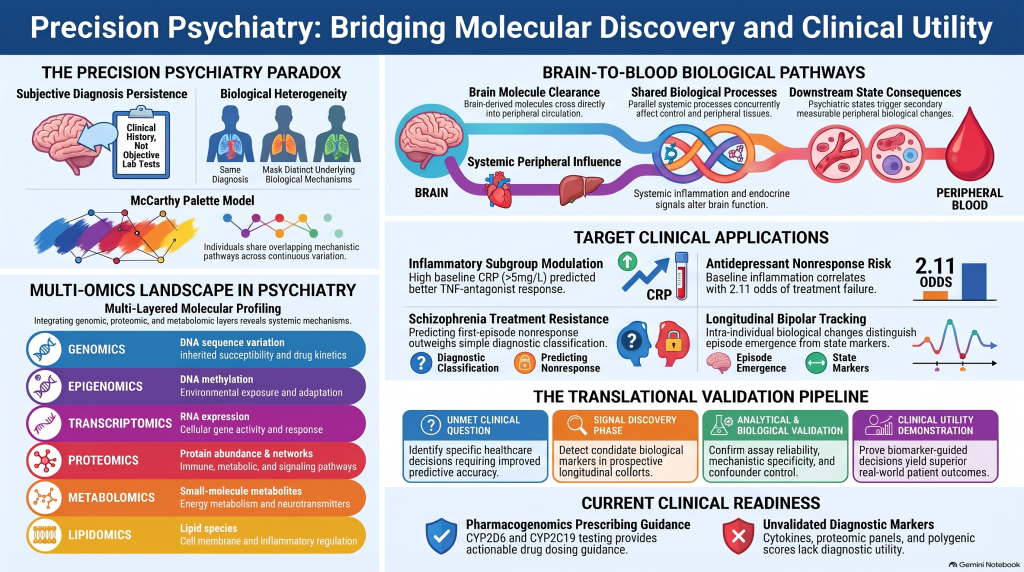
Can blood tests predict psychiatric illness, treatment response, or relapse? A scientific review of molecular biomarkers and the future of precision psychiatry.
Introduction: Psychiatry’s Search for Biological Precision
Modern psychiatry faces a remarkable scientific paradox.
We understand more about the genetics, neurobiology, immune mechanisms, neural circuits, and molecular pathways associated with psychiatric disorders than at any previous point in history. Yet the diagnosis of depression, schizophrenia, bipolar disorder, ADHD, and most other psychiatric conditions continues to depend primarily on clinical history, behavioural observation, and symptom-based diagnostic criteria.
This is not necessarily a weakness of clinical psychiatry. Mental disorders involve disturbances in subjective experience, cognition, emotion, and behaviour—phenomena that cannot always be reduced to a single laboratory measurement.
Nevertheless, the absence of reliable biological markers creates important limitations.
Two patients with the same diagnosis may respond very differently to identical treatments. Clinical improvement may take weeks to become apparent. Treatment resistance is often recognized retrospectively, after several unsuccessful interventions. Relapse may be detected only after symptoms become sufficiently severe to disrupt functioning.
The promise of precision psychiatry is therefore not merely to replace subjective diagnosis with objective laboratory tests. It is to develop biological measurements capable of answering questions that clinical assessment alone cannot answer reliably.
A major review published in the November 2026 issue of JAMA Psychiatry by Yap and colleagues, titled “Optimizing Study Design for Clinically Useful Peripheral Molecular Biomarker Discovery in Psychiatry,” provides an important framework for understanding why this goal has remained elusive.
Its central argument is that technological sophistication cannot compensate for fundamental weaknesses in research design.
A study measuring a million molecular features may be less clinically informative than one measuring a handful of carefully selected biomarkers in a well-characterized longitudinal cohort.
The critical issue is not simply how much biological information we can collect, but whether that information corresponds to a clinically meaningful process.
This article examines the review alongside emerging research in psychiatric genetics, inflammation, proteomics, metabolomics, pharmacogenomics, neuroimaging, and artificial intelligence.
1. From Descriptive Psychiatry to Biological Stratification
The history of psychiatric classification has largely been the history of attempts to improve diagnostic reliability.
Modern diagnostic systems have made it possible for clinicians to communicate using standardized definitions of depressive episodes, manic episodes, psychosis, anxiety disorders, and neurodevelopmental conditions.
However, reliability does not necessarily establish biological validity.
Two clinicians may reliably identify the same syndrome without knowing whether the patients sharing that syndrome have the same underlying pathophysiology.
This distinction is fundamental to biomarker research.
In oncology, the discovery of molecular subtypes transformed several previously broad diagnostic categories into biologically stratified diseases. Tumours that appear similar histologically may differ in receptor expression, molecular drivers, prognosis, and treatment response.
Psychiatry has not yet achieved comparable routine molecular stratification for its major disorders.
The difficulty arises partly because psychiatric syndromes are extraordinarily complex. Genetic liability, developmental experience, immune function, neuroendocrine regulation, environmental stress, and neural circuit activity interact across the lifespan.
Consequently, a psychiatric diagnosis may represent the final common behavioural expression of several different biological processes.
Complexity Versus Heterogeneity
The Yap review distinguishes biological complexity from heterogeneity.
Complexity implies that multiple contributing mechanisms operate within an illness, with different weights across individuals.
Heterogeneity implies that the same diagnostic label may include genuinely distinct biological subgroups.
These explanations are not mutually exclusive.
The review discusses the McCarthy palette model, in which individuals possess varying contributions from multiple mechanistic pathways rather than belonging necessarily to completely separate biological categories.
This model has important implications for molecular research.
A cluster identified by machine learning does not automatically represent a biologically real subtype. Clustering algorithms can divide continuous variation into groups even when no natural biological boundary exists.
Psychiatric subtypes should therefore ideally be supported by converging evidence from genetics, molecular pathways, clinical course, treatment response, and independent replication.
A clinically useful biological subtype should explain something important: why an illness develops, why it progresses differently, or why a treatment works in one group but not another.
2. Why Peripheral Biomarkers Are Attractive—and Biologically Difficult
Peripheral biomarkers are measurements obtained from tissues or fluids outside the central nervous system, particularly blood, saliva, and urine.
They are attractive because they are relatively accessible, repeatable, and potentially scalable.
However, the brain is not simply a smaller version of the bloodstream.
The blood–brain barrier, tissue-specific gene expression, cellular composition, and local neuroimmune signalling create substantial differences between central and peripheral biology.
Yap and colleagues identify four possible relationships between peripheral molecular measurements and neuropsychiatric processes.
Pathway 1: Brain-Derived Molecules Entering the Bloodstream
Certain molecules originating in the central nervous system may become detectable in peripheral circulation.
This approach has already demonstrated clinical potential in neurodegenerative disorders, particularly Alzheimer’s disease.
However, psychiatric disorders generally lack equally well-established molecular pathologies that can serve as diagnostic anchors.
Pathway 2: Peripheral Biological Processes Affecting Brain Function
Systemic inflammation, metabolic disturbances, endocrine dysfunction, and immune-mediated mechanisms may influence neural functioning.
Examples include thyroid dysfunction, hypoglycaemia, hepatic encephalopathy, and immune-mediated neurological conditions.
These illustrate how peripheral physiological changes can produce neuropsychiatric manifestations.
Pathway 3: Shared Biological Mechanisms
A biological process may influence both peripheral tissues and the brain.
For example, genetic regulation or inflammatory signalling could contribute to molecular changes in both compartments.
However, a correlation between blood and brain measurements does not automatically establish a causal relationship.
Pathway 4: Peripheral Consequences of Psychiatric States
A psychiatric condition may produce measurable physiological consequences.
Severe anorexia nervosa, for example, can cause nutritional and metabolic abnormalities.
These measurements may be valuable for monitoring physical health and illness severity without necessarily identifying the underlying psychiatric mechanism.
The essential distinction is between a causal biomarker, a correlated biological process, and a downstream consequence of illness.
This distinction must guide both research design and clinical interpretation.
3. The Multi-Omics Revolution in Psychiatry
Modern biomarker discovery increasingly uses high-throughput molecular technologies capable of examining thousands of biological features simultaneously.
These technologies are collectively described as omics.
Genomics
Genomics examines DNA sequence variation and inherited biological susceptibility.
Genome-wide association studies have identified numerous genetic variants associated with schizophrenia, bipolar disorder, depression, ADHD, and other psychiatric conditions.
However, most common psychiatric disorders are highly polygenic.
Each individual genetic variant generally contributes only a small amount to overall susceptibility.
Genetic information may therefore be more useful for risk stratification or understanding biological pathways than for establishing a definitive diagnosis.
Epigenomics
Epigenomics examines mechanisms regulating gene expression without changing the underlying DNA sequence.
DNA methylation is one of the most extensively studied examples.
Epigenetic changes may reflect interactions among genetic susceptibility, environmental exposures, ageing, stress, and physiological processes.
However, peripheral epigenetic patterns are strongly influenced by cellular composition, smoking, medication exposure, and other confounders.
A blood-based epigenetic association should not automatically be interpreted as evidence of an equivalent change in the brain.
Transcriptomics
Transcriptomics measures RNA expression and provides information about gene activity.
It may help identify changes in immune signalling, cellular stress responses, and other biological pathways.
However, RNA expression varies across tissues, cell populations, and physiological states.
Proteomics
Proteomics examines protein abundance, modification, and interaction.
Proteins are particularly attractive biomarkers because they participate directly in biological signalling and cellular function.
Advances in mass spectrometry and affinity-based technologies have expanded the number of proteins that can be measured from biological samples.
Psychiatric proteomic research has investigated inflammatory proteins, complement pathways, extracellular matrix proteins, and molecules involved in cellular signalling.
Metabolomics
Metabolomics examines small molecules reflecting biochemical activity.
Potentially relevant pathways include:
- Tryptophan–kynurenine metabolism
- Amino acid metabolism
- Lipid metabolism
- Mitochondrial energy production
- Oxidative stress
- Neurotransmitter-related metabolic pathways
These pathways may provide insight into biological processes associated with psychiatric symptoms.
However, metabolic profiles are influenced by diet, physical activity, sleep, medications, renal function, liver function, and systemic illness.
Lipidomics
Lipidomics focuses on lipid molecules involved in cellular membranes, energy metabolism, inflammatory signalling, and neural function.
Lipidomic changes have been investigated in schizophrenia, bipolar disorder, and depression.
Their interpretation requires particular caution because psychotropic medications and metabolic comorbidities can substantially alter lipid profiles.
Multi-Omics Integration
Combining genomics, epigenomics, transcriptomics, proteomics, and metabolomics may provide a more comprehensive picture of biological processes.
However, integrating more data does not automatically produce better predictions.
Every additional molecular layer introduces measurement variability, computational complexity, and opportunities for confounding.
The central challenge is to identify biologically meaningful relationships that remain reproducible across independent populations.
4. Inflammation and Depression: A Promising but Unresolved Field
Inflammatory biomarkers have received considerable attention in depression research.
Frequently studied molecules include:
- C-reactive protein (CRP)
- Interleukin-6 (IL-6)
- Tumour necrosis factor-alpha (TNF-α)
- Interleukin-1 beta (IL-1β)
- Other cytokines and immune-related proteins
There is substantial biological plausibility for an association between immune activation and depressive symptoms.
Inflammatory signalling can influence neurotransmitter metabolism, neuroendocrine function, sleep, appetite, motivation, and reward processing.
Experimental immune activation can produce behavioural changes resembling aspects of depression, including fatigue, reduced activity, and anhedonia.
However, several important questions remain unanswered.
Does inflammation cause depression in a biologically distinct subgroup?
Does it represent a consequence of chronic stress, obesity, disturbed sleep, or other physiological processes?
Can inflammatory markers predict which antidepressant will work?
And most importantly, does measuring these markers improve clinical outcomes?
The Infliximab Trial
A landmark randomized controlled trial by Raison and colleagues investigated infliximab, a TNF antagonist, in patients with treatment-resistant depression.
The study included 60 participants.
There was no significant overall antidepressant advantage of infliximab over placebo.
However, exploratory analyses suggested that baseline inflammatory status might influence treatment response.
Among patients with elevated baseline hs-CRP above 5 mg/L, response rates were numerically higher with infliximab than placebo.
The subgroup comparison itself was not statistically significant, although an interaction involving baseline inflammation was identified.
This suggested that inflammatory status might be more relevant than depression diagnosis alone when investigating immune-targeted treatment strategies.
However, the findings did not establish infliximab as a routine antidepressant treatment or CRP as a validated treatment-selection biomarker.
What Do Recent Meta-Analyses Suggest?
Recent meta-analyses have produced mixed findings.
A 2026 meta-analysis involving 17 studies and 1,535 participants reported an association between elevated baseline inflammatory markers and antidepressant nonresponse, with a pooled odds ratio of approximately 2.11.
However, another updated meta-analysis involving 24 studies found that individual baseline inflammatory markers, including CRP, did not consistently distinguish antidepressant responders from nonresponders in the primary pooled analyses.
These differences illustrate a fundamental problem.
Studies vary in how they define inflammation, treatment response, clinical severity, medication exposure, and relevant confounders.
Pooling multiple inflammatory molecules into a single category may also produce different conclusions from examining individual markers separately.
The evidence supports inflammation as an important research domain, but not as a validated standalone method for diagnosing depression or selecting antidepressant treatment.
5. Schizophrenia: The Opportunity to Predict Treatment Resistance
Schizophrenia biomarker research has historically focused on identifying biological differences between patients and healthy controls.
However, such comparisons may have limited clinical usefulness.
The more important questions concern prognosis and treatment selection.
Which patient experiencing first-episode psychosis will develop persistent symptoms?
Who will respond to the first antipsychotic?
Who is likely to develop treatment resistance?
Could biological measurements support earlier recognition of patients who may require clozapine?
These questions have direct clinical relevance.
A 2025 scoping review of protein biomarkers for schizophrenia concluded that available evidence remained insufficient to support routine clinical implementation.
The review identified substantial methodological heterogeneity and difficulties establishing biological specificity.
Why Treatment Resistance Is a Better Research Target
Treatment resistance provides a more clinically meaningful endpoint than schizophrenia diagnosis alone.
A prospective study could enrol patients during first-episode psychosis, collect baseline biological samples, and follow treatment outcomes using standardized definitions.
The central comparison would involve patients who subsequently develop treatment resistance and those who achieve adequate treatment response.
This design would be more informative than comparing chronically medicated patients with healthy volunteers.
It could also help distinguish biological vulnerability from molecular changes caused by illness progression or medication exposure.
The Yap review identifies treatment resistance as a promising biomarker research target because clinical recruitment and research recruitment can occur at approximately the same stage of illness.
The ultimate objective is not simply to identify a schizophrenia-associated protein.
It is to identify biological information that improves the timing and selection of treatment.
6. Bipolar Disorder: A Model for Longitudinal Biomarker Research
Bipolar disorder offers a particularly attractive framework for longitudinal biomarker discovery.
The illness involves recurrent and often clinically recognizable changes in mood, activity, sleep, energy, and behaviour.
Patients may move between euthymia, depression, hypomania, and mania.
These transitions create opportunities to examine state-dependent biological variation.
A prospective study could collect repeated samples during euthymia, emerging mood symptoms, established episodes, and recovery.
Researchers could then examine whether specific molecular changes consistently accompany or precede mood episodes.
Potential pathways include:
- Circadian regulation
- Inflammatory signalling
- Neuroendocrine activity
- Oxidative stress
- Mitochondrial metabolism
- Neuroplasticity-related signalling
However, biological measurements are also influenced by lithium, antipsychotics, anticonvulsants, sleep deprivation, substance use, and metabolic comorbidities.
Repeated measurements within the same individual may help reduce the influence of stable interindividual differences.
State Biomarkers Versus Predictive Biomarkers
A biomarker that changes during mania may help characterize the current physiological state.
But predicting mania requires demonstrating that the biological change occurs before the clinical episode.
This distinction is crucial.
A measurement that becomes abnormal only after symptoms are obvious may offer little advantage over clinical assessment.
A measurement that reliably changes before symptoms become clinically apparent could potentially support earlier intervention.
The first clinically useful biomarker for bipolar disorder may therefore be a relapse-prediction tool rather than a diagnostic blood test.
7. Pharmacogenomics: An Existing Example of Precision Psychiatry
Pharmacogenomics occupies a distinct position in psychiatric biomarker research.
Unlike many exploratory molecular signatures, certain pharmacogenetic associations have already progressed into clinical prescribing recommendations.
The strongest examples involve genes affecting drug metabolism.
CYP2D6, CYP2C19, and CYP2B6
These genes encode enzymes involved in the metabolism of several antidepressants.
Genetic differences can influence drug exposure, tolerability, and dosing requirements.
The 2023 Clinical Pharmacogenetics Implementation Consortium guideline provides recommendations for using relevant CYP2D6, CYP2C19, and CYP2B6 results when prescribing selected serotonin reuptake inhibitors.
However, the same guideline does not support prescribing decisions based on SLC6A4 or HTR2A genotyping because the available evidence is insufficient.
This distinction is important.
Predicting drug metabolism is not the same as predicting antidepressant efficacy.
A patient may metabolize a drug rapidly or slowly without that information fully explaining whether the medication will successfully treat the underlying psychiatric disorder.
Polygenic Risk Scores
Polygenic risk scores combine information from numerous genetic variants associated with a particular condition or outcome.
They have improved understanding of psychiatric genetic architecture.
However, their clinical predictive performance remains limited.
A 2024 systematic review of psychiatric pharmacogenomic scores found that polygenic scores alone explained only a relatively small proportion of variation in treatment outcomes.
Combining genetic and clinical information improved prediction in some models, but performance remained insufficient for broad routine implementation.
Another important limitation is ancestry representation.
Many psychiatric genetic datasets are dominated by populations of European ancestry.
Predictive models developed in these populations may not generalize reliably to Indian or other underrepresented populations.
Locally validated research is therefore essential before applying such models to routine clinical decisions.
8. Combining Molecular Biomarkers With EEG, Neuroimaging, and Cognitive Testing
Peripheral molecular measurements provide only one window into psychiatric biology.
Other technologies measure different aspects of brain function and behaviour.
Electroencephalography measures electrical activity.
Functional neuroimaging examines brain activity and connectivity.
Structural imaging provides information about brain anatomy.
Neuropsychological testing evaluates cognitive performance.
Wearable devices can measure sleep, activity, and physiological patterns over time.
These measurements are potentially complementary.
A molecular marker may reflect inflammatory or metabolic activity, while EEG or neuroimaging may capture functional neural changes.
The scientific opportunity lies in determining whether combining these modalities improves prediction beyond any individual measurement.
Antidepressant Neuroimaging Research
The EMBARC research programme provides an example of biomarker studies directed toward treatment response.
A 2024 analysis examined whether early changes in cerebral blood flow following sertraline or placebo treatment were associated with subsequent antidepressant outcomes.
The study identified early perfusion changes associated with later symptom improvement.
This illustrates the possibility that biological responses shortly after treatment initiation may provide information about subsequent clinical outcomes.
However, further validation is necessary before such findings can guide routine prescribing.
Implications for ADHD
ADHD presents particular challenges for objective biomarker development.
Inattention, impulsivity, and executive dysfunction can arise from several interacting influences.
These include neurodevelopmental vulnerability, sleep disturbances, anxiety, depression, trauma-related symptoms, learning disorders, and environmental demands.
Potential objective measurements include continuous performance testing, EEG spectral features, theta–beta ratio, neuroimaging, and digital behavioural assessments.
However, none independently establishes ADHD across the full range of clinical presentations.
A future multimodal approach could combine developmental history, structured clinical interviews, validated rating scales, cognitive testing, sleep assessment, and selected biological measurements.
But every additional measurement must demonstrate incremental clinical value.
The question is not whether a test produces an objective number.
The question is whether that number improves diagnosis, prognosis, or treatment decisions beyond existing clinical assessment.
Importantly, the Yap review focuses on peripheral molecular biomarkers. Its findings should not be interpreted as validating qEEG, continuous performance testing, or neuroimaging as standalone psychiatric diagnostic tools.
9. Artificial Intelligence and the Problem of Confounding
Artificial intelligence and machine learning can analyse enormous multidimensional datasets.
These technologies may identify patterns among thousands of molecular features that would be difficult to detect using conventional statistical methods.
However, psychiatric biomarker datasets present special challenges.
A model may appear to distinguish patients with schizophrenia from healthy controls while actually learning differences in medication exposure, smoking, body mass index, laboratory processing, or recruitment site.
This is especially problematic when training and validation datasets share similar confounding structures.
A model may achieve impressive classification accuracy without identifying a disease-specific biological signal.
Statistical Accuracy Is Not Clinical Utility
A predictive model should be evaluated using more than classification accuracy.
Important questions include:
- Does the model perform reliably in independent populations?
- Does it remain accurate across different demographic groups?
- Does it improve upon standard clinical assessment?
- Is it sufficiently calibrated for individual clinical decisions?
- Does its use improve patient outcomes?
- Is it affordable and practical to implement?
A model predicting antidepressant response may achieve impressive retrospective performance.
But unless using the prediction improves treatment outcomes compared with standard care, its clinical value remains uncertain.
The distinction between statistical prediction and demonstrated clinical utility is fundamental.
10. The Validation Bottleneck in Psychiatric Biomarker Research
An important commentary published in JAMA Psychiatry in November 2026, titled “The Validation Bottleneck for Psychiatric Biomarkers,” complements the arguments presented by Yap and colleagues.
Pedraz-Petrozzi and colleagues emphasize that psychiatry’s difficulty is not simply a shortage of candidate biomarkers.
The field also lacks sufficiently developed systems for establishing reproducibility, biological validity, clinical relevance, and improved patient outcomes.
A promising biomarker must progress through several stages.
Stage 1: Discovery
Researchers identify a candidate biological signal associated with a clinically meaningful condition or outcome.
Stage 2: Analytical Validation
The measurement must demonstrate adequate accuracy, precision, stability, and reproducibility.
Stage 3: Biological Validation
Researchers must determine whether the signal reflects the intended biological process rather than confounding or downstream consequences.
Stage 4: Clinical Validation
The biomarker must demonstrate reliable performance in the patient population where it will eventually be used.
Stage 5: Clinical Utility
Using the biomarker must improve a clinical decision or patient outcome.
Stage 6: Implementation
The test must be practical, accessible, affordable, and supported by quality assurance.
A biomarker may perform well during initial discovery yet fail at any subsequent stage.
This explains why the psychiatric literature contains numerous candidate biomarkers but relatively few validated clinical applications.
11. Why Longitudinal Study Design May Be the Most Important Breakthrough
One of the strongest recommendations from the Yap review is to prioritize longitudinal designs when investigating state-dependent biomarkers.
Traditional case-control studies compare patients with established psychiatric disorders against healthy individuals.
These studies may identify associations but often cannot determine whether biological differences preceded illness, resulted from illness, or reflected medication and lifestyle factors.
Longitudinal studies address a different question.
How does a biological measurement change as a patient moves between clinically meaningful states?
For example, a study of bipolar disorder could obtain samples during euthymia, before relapse, during an episode, and following recovery.
A schizophrenia study could collect biological samples before treatment initiation and follow patients through successive treatment trials.
A depression study could examine molecular measurements before antidepressant initiation, during early treatment, and after clinical response or nonresponse becomes apparent.
Such designs may help distinguish stable vulnerability from dynamic illness activity.
They also create opportunities for personalized prediction.
The Value of Within-Individual Comparisons
Individuals differ substantially in their baseline biological measurements.
A molecular concentration considered elevated relative to a population reference range may be normal for a particular individual.
Conversely, a clinically meaningful change within an individual may remain inside the population reference range.
Repeated measurements can help identify these relative changes.
This approach may be particularly valuable in recurrent psychiatric illnesses, where patients move between different clinical states.
However, within-individual studies also require careful attention to natural biological variation, sampling intervals, medication changes, and environmental influences.
12. A Research Agenda for Indian Psychiatry
India has substantial opportunities to contribute to clinically meaningful psychiatric biomarker research.
Large and diverse patient populations, tertiary-care psychiatric services, longitudinal outpatient follow-up, and growing laboratory infrastructure create possibilities for pragmatic research.
However, studies should be designed around clinically important and feasible questions.
Three promising areas include:
Bipolar disorder: Identifying biological changes associated with impending mood episodes.
Schizophrenia: Predicting antipsychotic treatment resistance during early illness.
Major depressive disorder: Identifying biological predictors of antidepressant response and nonresponse.
A multicentre research programme could incorporate standardized clinical assessments, routine laboratory investigations, carefully timed biospecimen collection, medication exposure records, metabolic parameters, and repeated clinical outcomes.
Illustrative Study: Predicting Relapse in Bipolar I Disorder
A proposed longitudinal study could recruit adults with bipolar I disorder during euthymia.
Participants could undergo structured clinical assessment, standardized mood ratings, sleep and activity monitoring, and repeated biological sampling.
Candidate molecular measurements might include inflammatory proteins, selected metabolic markers, and proteomic features.
Patients could be followed for 12–24 months, with additional assessments around clinically significant mood changes.
The primary outcome would be prospectively defined manic or depressive relapse.
Researchers could then examine whether biological changes improve relapse prediction beyond clinical symptoms, sleep patterns, and previous illness history.
Such a design would require formal sample-size estimation, predefined outcomes, standardized laboratory procedures, and independent validation.
It represents a proposed research direction rather than an established clinical protocol.
Why Indian Population Validation Matters
Biological measurements are influenced by genetic ancestry, diet, metabolic health, environmental exposures, and healthcare access.
A biomarker developed in a predominantly European population may not demonstrate identical performance in Indian patients.
Similarly, laboratory reference ranges and predictive models may require local calibration.
Developing representative Indian longitudinal cohorts could therefore contribute substantially to the global evidence base.
13. What Is Clinically Useful Today?
Despite considerable scientific progress, most proposed psychiatric molecular biomarkers remain investigational.
Selected pharmacogenetic tests already have actionable prescribing guidance.
Routine metabolic, endocrine, haematological, and biochemical investigations remain important for identifying medical contributors to psychiatric symptoms and monitoring medication safety.
However, inflammatory cytokine panels are not validated as routine diagnostic tests for depression.
Proteomic signatures are not established for diagnosing schizophrenia.
Metabolomic profiles are not validated for routine diagnosis of bipolar disorder.
Polygenic risk scores do not currently provide sufficient predictive accuracy for broad psychiatric diagnostic use.
Similarly, multimodal AI biomarker systems require further prospective validation before routine implementation.
The distinction between a research association and a clinically validated test must remain clear.
14. The Future: From Static Diagnosis to Dynamic Biological Understanding
The most important conceptual development in psychiatric biomarker science may be the movement away from a purely diagnostic objective.
A blood test that distinguishes schizophrenia from healthy controls might have limited value if comprehensive clinical assessment already establishes the diagnosis reliably.
In contrast, a test that predicts treatment resistance before several unsuccessful antipsychotic trials could potentially change management.
A biomarker that identifies emerging relapse risk before a manic episode becomes clinically apparent could support earlier intervention.
A molecular signature that reliably predicts antidepressant response might reduce prolonged periods of ineffective treatment.
These are not yet established capabilities. They represent clinically meaningful research targets.
The shift is from biological classification as an end in itself toward biological information that improves decisions.
It also acknowledges that psychiatric disorders are dynamic.
Biological vulnerability, current illness activity, treatment effects, environmental exposures, and recovery processes may each contribute differently over time.
A future precision psychiatry model may therefore rely less on one-time testing and more on integrating longitudinal clinical and biological measurements.
Conclusion: The Future of Psychiatry Will Be Biologically Informed, Not Biologically Reduced
The scientific literature increasingly supports a more sophisticated understanding of psychiatric biomarker discovery.
Genomics has clarified the polygenic architecture of mental disorders.
Proteomics and metabolomics are identifying molecular pathways associated with psychiatric states.
Inflammatory research suggests that some biological processes may influence treatment response.
Pharmacogenomics has already produced selected actionable prescribing recommendations.
Yet these advances have not produced validated, broadly applicable blood tests for diagnosing major psychiatric disorders.
The 2026 review by Yap and colleagues provides an important explanation: biological discovery is inseparable from research design.
The commentary by Pedraz-Petrozzi and colleagues adds a second lesson: discovery must be followed by rigorous validation and evidence of improved patient outcomes.
Together, these publications point toward a more disciplined future for precision psychiatry.
The most successful biomarkers may not be those that reproduce existing diagnostic labels.
They may instead identify biological vulnerability, predict clinically important transitions, stratify treatment response, and monitor recovery.
Psychiatry does not need to abandon clinical phenomenology to embrace molecular science.
It needs to connect the two more effectively.
The ultimate success of psychiatric biomarkers will not be measured by how many molecules we discover, but by how many patients receive earlier, safer, and more effective care because of them.
References
- Yap CX, Henders AK, Wray NR, Upthegrove R. Optimizing Study Design for Clinically Useful Peripheral Molecular Biomarker Discovery in Psychiatry: A Review. JAMA Psychiatry. 2026;83(11):1176–1186. doi:10.1001/jamapsychiatry.2026.2299.
- Pedraz-Petrozzi B, Manji H, Upthegrove R, Leboyer M. The Validation Bottleneck for Psychiatric Biomarkers. JAMA Psychiatry. Published November 18, 2026. doi:10.1001/jamapsychiatry.2026.3583.
- Smith BJ, Guest PC, Martins-de-Souza D. Maximizing Analytical Performance in Biomolecular Discovery with LC-MS: Focus on Psychiatric Disorders. Annual Review of Analytical Chemistry. 2024;17:25–46. doi:10.1146/annurev-anchem-061522-041154.
- Berdeville CHSF, et al. A Scoping Review of Protein Biomarkers for Schizophrenia: State of Progress, Underlying Biology, and Methodological Considerations. Neuroscience & Biobehavioral Reviews. 2025;168:105949. doi:10.1016/j.neubiorev.2024.105949.
- Raison CL, et al. A Randomized Controlled Trial of the Tumor Necrosis Factor Antagonist Infliximab for Treatment-Resistant Depression: The Role of Baseline Inflammatory Biomarkers. JAMA Psychiatry. 2013;70(1):31–41.
- Bousman CA, et al. CPIC Guideline for CYP2D6, CYP2C19, CYP2B6, SLC6A4, and HTR2A Genotypes and Serotonin Reuptake Inhibitor Antidepressants. Clinical Pharmacology & Therapeutics. 2023;114(1):51–68. doi:10.1002/cpt.2903.
- Sharew NT, et al. Pharmacogenomic Scores in Psychiatry: Systematic Review of Current Evidence. Translational Psychiatry. 2024;14:322.
- Dang Y, et al. Early-Treatment Cerebral Blood Flow Change as a Predictive Biomarker of Antidepressant Treatment Response: Evidence From the EMBARC Clinical Trial. Psychological Medicine. 2024;54(11):3053–3062. doi:10.1017/S0033291724001156.
- Possidente C, et al. Inflammatory Protein Markers and Treatment Outcomes Across Mood and Psychotic Disorders: A Systematic Review and Meta-Analysis. Brain, Behavior, and Immunity. 2026;138:106874. doi:10.1016/j.bbi.2026.106874.
- Peripheral Inflammatory Biomarkers as Predictors of Antidepressant Treatment Response in Major Depressive Disorder: An Updated Systematic Review and Meta-Analysis. 2026. PubMed PMID: 42763552.
- Blood-Based Proteomics for Schizophrenia: Candidate Biomarkers for Risk Assessment and Precision Psychiatry. 2026. PubMed Central: PMC13643384.
- The Role of Inflammatory Markers as Predictors of Response to Antidepressants in Major Depressive Disorder: A Meta-Analysis. 2026. PubMed Central: PMC13203315.
This article is an educational narrative synthesis of published psychiatric biomarker research, including the 2026 JAMA Psychiatry review by Yap and colleagues. Proposed research directions and clinical interpretations are distinguished from established diagnostic and treatment recommendations.