A Doctor at Your Doorstep in 90 Minutes: Innovation or the Industrialisation of Medicine?
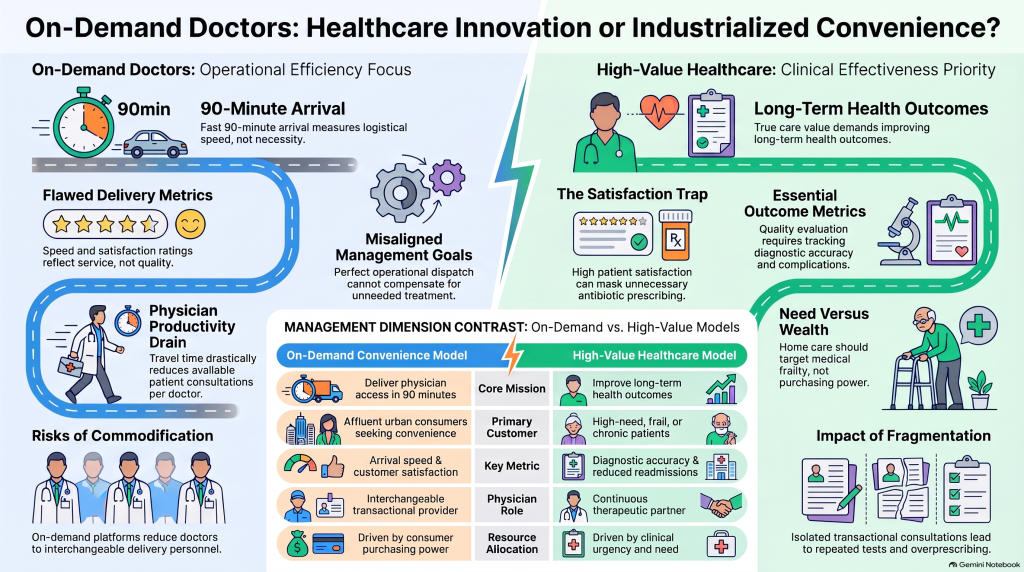
Examining the Future of Healthcare Through Peter Drucker’s Management Philosophy
The emergence of 90-minute doctor-at-home services is being presented as the next major innovation in healthcare delivery.
The proposition is appealing: book a consultation, and a doctor arrives at your doorstep within a specified time. No travelling, no waiting rooms, and minimal disruption to your daily routine.
From a consumer convenience perspective, it is an attractive business model.
But from the perspective of healthcare management, clinical quality and medical ethics, it raises a more fundamental question:
Are we solving an important healthcare problem, or are we simply delivering an existing service faster and at a higher price?
Peter Drucker, widely regarded as the father of modern management, provides a useful intellectual framework for examining this question.
His ideas about effectiveness, organisational purpose, knowledge workers, resource allocation and customer value are particularly relevant to the increasing commercialisation of healthcare.
1. Efficiency Versus Effectiveness: The Fundamental Management Error
One of Drucker’s most important contributions was distinguishing efficiency from effectiveness.
“Efficiency is concerned with doing things right. Effectiveness is doing the right things.”
Consider a healthcare organisation promising a doctor at home within 90 minutes.
From an operational standpoint, this may be impressive.
The organisation must maintain sufficient physician availability, coordinate travel, optimise geographic coverage and ensure timely dispatch.
It might achieve an extraordinary operational performance record, with 95% or more of consultations beginning within the promised time.
But has healthcare improved?
That is an entirely different question.
Suppose a patient with a mild upper respiratory infection receives a home consultation within 90 minutes.
Would waiting until the next morning for a scheduled clinic appointment have changed the clinical outcome?
Was the home visit medically necessary?
Did the consultation improve diagnostic accuracy, reduce complications, or provide better continuity of care?
If the answers are largely negative, the organisation may have improved operational efficiency without meaningfully improving clinical effectiveness.
The danger is that healthcare organisations may become exceptionally efficient at delivering services whose incremental clinical value has never been established.
Drucker’s philosophy reminds us that operational excellence is valuable only when it serves an appropriate objective.
2. What Business Are We Really In?
Drucker believed that organisations must clearly define their mission.
This principle is especially important in healthcare because commercial success and clinical success are not necessarily identical.
A healthcare organisation might define its mission as providing the fastest possible access to a physician.
But is that truly the purpose of healthcare?
The fundamental purpose of medical care is to prevent illness where possible, diagnose disease accurately, relieve suffering, improve functioning, reduce complications and support patients over time.
Rapid access is one possible means of achieving these objectives.
It is not the objective itself.
Consider three patients:
Patient A: A healthy young adult with a mild fever and sore throat.
Patient B: An older adult with dementia, impaired mobility and multiple chronic illnesses.
Patient C: A middle-aged individual with sudden chest discomfort and breathlessness.
All three might request a doctor-at-home consultation.
Yet their clinical requirements differ enormously.
Patient A may be appropriately managed through a scheduled consultation or telemedicine, depending on the symptoms.
Patient B may derive substantial benefit from a planned home visit, medication review, functional assessment and caregiver counselling.
Patient C may require immediate emergency assessment and hospital transport. Waiting 90 minutes for a routine home visit could be dangerous.
The critical innovation is therefore not rapid physician delivery.
It is the ability to identify which patient needs which intervention, in which setting, and with what degree of urgency.
That is a clinically meaningful healthcare innovation.
3. Are We Measuring the Wrong Things?
Modern healthcare organisations increasingly rely on performance indicators.
Some are operational:
- Average booking-to-arrival time
- Number of consultations completed
- Patient satisfaction ratings
- Revenue generated per consultation
- Geographic coverage and utilisation
These measures can help managers run a service efficiently.
But they cannot, by themselves, establish the quality of medical care.
Imagine a service reporting that 98% of its doctors arrive within 90 minutes.
This is a commendable logistical achievement.
However, it tells us almost nothing about whether patients received appropriate treatment.
A more meaningful evaluation would examine diagnostic accuracy, avoidable prescribing, inappropriate investigations, adverse events, subsequent emergency visits and continuity of follow-up.
The difference is between measuring service delivery and measuring healthcare outcomes.
Drucker’s emphasis on results is particularly relevant here.
A healthcare organisation should not confuse what is easily measurable with what is clinically important.
Patient satisfaction also requires careful interpretation.
A patient may give an excellent rating because the doctor arrived quickly, communicated politely and prescribed medication.
Yet the prescribed medication might have been unnecessary.
Conversely, a physician who declines an inappropriate antibiotic prescription may receive a lower satisfaction score despite delivering better medical care.
Patient satisfaction is important, but it cannot replace independent measures of clinical quality.
4. The Productivity Paradox: Are We Using Doctors Efficiently?
Drucker devoted considerable attention to the productivity of knowledge workers.
Doctors are highly trained knowledge professionals whose primary contribution is clinical judgement, diagnostic reasoning and therapeutic decision-making.
Their value does not lie merely in physical availability.
Consider a physician working an eight-hour shift.
In a well-organised outpatient clinic, that physician might assess 15–25 patients, depending on case complexity, specialty and consultation duration.
In a home-based service, the same physician may spend considerable time travelling, waiting for access to residences and moving between appointments.
A typical home consultation might require:
- 30 minutes of clinical assessment
- 20–40 minutes of travel
- Additional time for documentation and coordination
These are illustrative figures, but the underlying issue is important.
A physician who could otherwise provide several consultations might complete substantially fewer home visits.
The economics may still work when patients pay premium prices.
But is this an efficient allocation of scarce medical manpower?
The opportunity cost matters, particularly in a country with significant disparities in healthcare access.
Premium convenience may increase revenue per physician-hour without necessarily increasing the total amount of healthcare delivered.
This does not mean home consultations are inherently inefficient.
For homebound, frail or medically vulnerable patients, the benefits may justify the additional resources.
The issue is whether home-based care is being allocated according to clinical need or primarily according to purchasing power.
5. Commercial Viability Is Not the Same as Healthcare Value
A 90-minute doctor-at-home service can be commercially attractive.
Affluent urban households may be willing to pay a substantial premium to avoid traffic, parking, waiting rooms and disruption to their schedules.
There is nothing inherently unethical about charging for convenience.
But a profitable healthcare service is not necessarily a clinically valuable healthcare innovation.
A service may generate revenue through consultation fees, diagnostics, medications and follow-up referrals.
This creates a potential conflict if commercial incentives favour greater service utilisation over clinically appropriate utilisation.
The sustainability of the model also deserves examination.
Maintaining rapid response times requires spare physician capacity, efficient dispatch systems and sufficient demand within relatively small geographic areas.
During low-demand periods, clinicians may remain underutilised.
During peak-demand periods, the pressure to meet arrival-time commitments may influence scheduling and consultation workflows.
Over time, organisations may face pressure to increase the number of appointments per physician, reduce costs or encourage additional revenue-generating services.
These are potential economic pressures, not inevitable consequences.
However, unless they are carefully managed, they can gradually influence clinical practice.
Drucker’s management philosophy would encourage examining whether the business model creates genuine value for patients while remaining operationally and financially sustainable.
A commercially successful service should not be mistaken for proof of clinical effectiveness.
6. The Risk of Turning Doctors Into Delivery Personnel
Perhaps the most concerning long-term consequence is the potential commodification of medical consultations.
In a platform-driven healthcare system, patients may begin choosing medical services according to arrival times, convenience, ratings and price.
The doctor becomes an interchangeable service provider.
The consultation becomes a transaction.
The therapeutic relationship risks becoming secondary.
This is particularly problematic for patients with chronic illnesses, psychiatric disorders and complex medical needs.
Good medical care frequently requires longitudinal observation.
The physician develops an understanding of the patient’s previous illnesses, medication responses, family circumstances, psychological vulnerabilities and changing clinical presentation.
That accumulated knowledge is often central to effective treatment.
Repeated consultations with unrelated physicians can result in fragmented care, inconsistent recommendations, repeated investigations and unnecessary medication changes.
Digital records can reduce these risks, but records alone do not reproduce the value of continuity and professional judgement.
A home-based model that preserves an established treating relationship may be beneficial.
A platform that merely dispatches whichever physician is available may offer convenience at the expense of continuity.
The distinction is fundamental.
Healthcare should not evolve into a series of isolated transactions when many of its greatest benefits depend on sustained professional relationships.
7. What Would Drucker Have Asked?
Drucker’s well-known framework of five essential organisational questions offers a practical way to evaluate these services.
What is our mission?
Is the objective to improve health outcomes and access for underserved patients, or primarily to provide premium convenience?
Who is our customer?
Are we targeting patients who genuinely struggle to access healthcare, or those who can afford an additional level of service?
Both groups may be legitimate customers, but their needs and the service’s purpose must be clearly distinguished.
What does the customer value?
Patients understandably value convenience, reliability, privacy and reduced waiting times.
However, healthcare organisations also have a professional responsibility to identify clinical needs that patients may not recognise.
What patients want immediately is not always identical to what produces the best health outcome.
What are our results?
Do patients experience better outcomes, fewer complications, reduced avoidable hospitalisations and improved continuity?
Or are the primary achievements faster arrival times, higher customer ratings and increased revenue?
What is our plan?
Can the organisation maintain clinical quality, appropriate staffing, affordability, medical governance and sustainable operations as the service expands?
These questions shift the discussion from technological novelty to genuine organisational effectiveness.
8. Not All Home-Based Healthcare Is the Same
It would be equally mistaken to reject home-based healthcare altogether.
There are strong clinical reasons to expand structured home services for selected populations.
Geriatric patients with frailty, patients requiring palliative care, individuals with severe mobility limitations and those needing rehabilitation may benefit significantly.
Home assessments can also reveal information that conventional consultations may miss.
For example, in dementia care, observing the patient’s living environment can help clinicians understand functional impairment, medication management, behavioural triggers and caregiver difficulties.
Similarly, multidisciplinary community mental health services may improve access and engagement for some patients with serious mental illness.
These are examples of healthcare being redesigned around genuine patient needs.
However, a structured home-care programme is not equivalent to a rapid, single-visit consultation service.
Their objectives, staffing, assessment methods, safety protocols and expected outcomes may differ substantially.
The important distinction is between bringing healthcare home because the patient needs it and bringing healthcare home simply because the patient can pay for it.
Neither convenience nor premium pricing automatically makes a service inappropriate. But clinical appropriateness must remain the primary consideration.
9. What Should the Future of Healthcare Actually Prioritise?
If healthcare organisations genuinely want to innovate, there are several areas in which improvements could produce far greater clinical value.
Reliable triage systems could distinguish emergency conditions from routine complaints.
Integrated medical records could reduce fragmented care.
Structured follow-up systems could identify patients who fail to improve.
Clinical decision-support tools could help reduce diagnostic errors and unnecessary investigations.
Community nursing teams could improve chronic disease management.
Telemedicine could provide access without requiring physician travel when a physical examination is unnecessary.
Home visits could be reserved or prioritised for patients whose clinical or functional circumstances justify them.
These interventions may be less marketable than a 90-minute arrival guarantee.
But they are potentially more meaningful from a healthcare outcomes perspective.
This is the essential Druckerian question:
Are we innovating around what is easiest to sell, or around what most needs to improve?
10. Conclusion: Faster Is Not Always Better
The emergence of rapid doctor-at-home services reflects a broader transformation in healthcare.
Patients increasingly expect medical services to be accessible, convenient, responsive and personalised.
These expectations are legitimate.
Healthcare should not remain inefficient merely because traditional systems have always operated that way.
Yet the pursuit of convenience must not dilute the fundamental principles of medical practice.
For non-emergency conditions, an arbitrarily short arrival time is not necessarily an indicator of superior healthcare.
The greater risk is that organisations begin competing on delivery speed while paying insufficient attention to clinical outcomes, continuity, physician autonomy and resource utilisation.
Peter Drucker’s philosophy provides a useful warning against confusing operational achievement with organisational purpose.
A healthcare organisation can be highly efficient, profitable and technologically sophisticated while still failing to improve the outcomes that matter most.
The question is not whether a doctor can reach a patient’s home within 90 minutes.
The question is whether doing so provides better healthcare than the available alternatives.
If the answer is yes, the service represents meaningful innovation.
If the answer is no, it may simply represent the premium packaging of an existing medical service.
Final Reflection
The future of healthcare should not be defined by how quickly we deliver a doctor, but by how effectively we deliver care.
Medicine must become more accessible without becoming superficial, more efficient without becoming rushed, and more convenient without losing continuity.
A hospital or clinic is not a restaurant. A doctor is not a delivery executive. And a consultation is not a commodity.
The ultimate measure of healthcare innovation is not the speed of service delivery.
It is the improvement in human health that the service produces.
Intellectual references
- Drucker, P. F. The Effective Executive (1967).
- Drucker, P. F. Management: Tasks, Responsibilities, Practices (1973).
- Drucker, P. F. Managing the Non-Profit Organization: Principles and Practices (1990).
- Drucker, P. F., et al. The Five Most Important Questions You Will Ever Ask About Your Organization.