Primary, Secondary, and Tertiary Gains in Dissociative Disorders
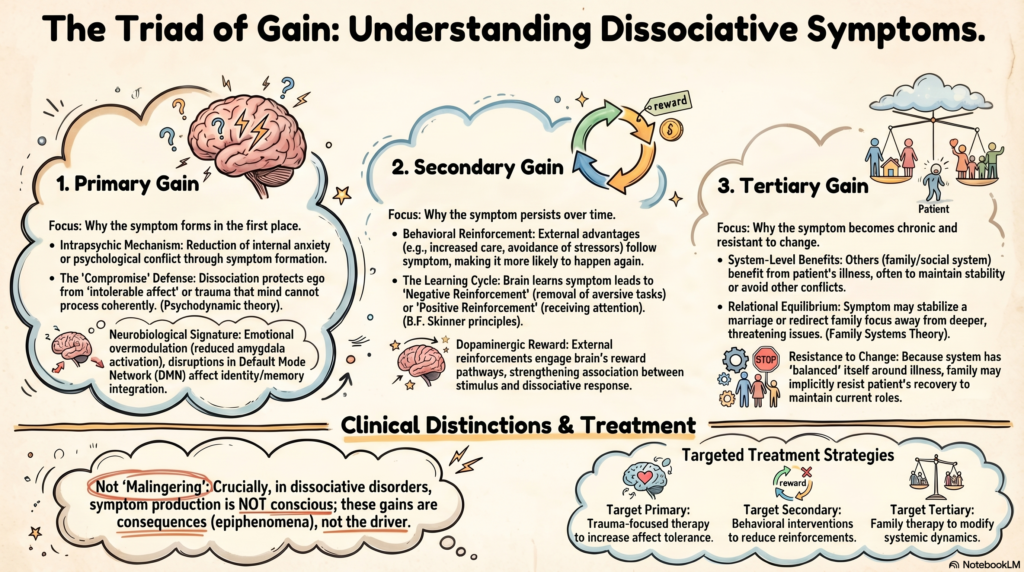 A precise, theory-driven and clinically grounded explanation
In dissociative disorders, the constructs of primary, secondary, and tertiary gain provide a multi-level explanatory framework integrating psychodynamic theory, learning theory, and systems theory. These concepts clarify why symptoms emerge, persist, and become resistant to treatment, without implying intentionality.
🧠 1. Primary Gain (Intrapsychic Mechanism)
Definition
Primary gain refers to the reduction of internal psychological conflict or anxiety achieved through symptom formation.
Theoretical basis
- Classical psychodynamic theory (Freud: symptom as compromise formation)
- Dissociation as a defense mechanism protecting the ego from intolerable affect
Mechanism
- Exposure to overwhelming affect (trauma, conflict)
- Failure of integrative processing (memory–affect–identity coherence)
- Activation of dissociation → functional compartmentalization of experience
This may involve:
- Amnesia (failure of retrieval of autobiographical memory)
- Depersonalization/derealization (altered self–environment integration)
- Identity fragmentation (in severe forms)
Neurobiological correlates
- Increased prefrontal inhibitory control over limbic regions
- Reduced amygdala activation in depersonalization (emotional overmodulation)
- Disruption in default mode network (DMN) integration
- Altered hippocampal–cortical connectivity affecting memory consolidation
👉 Primary gain explains symptom formation through affect regulation and conflict avoidance.
🔁 2. Secondary Gain (Behavioral Reinforcement)
Definition
Secondary gain refers to external advantages or reinforcements that follow the symptom and increase its likelihood of persistence.
Theoretical basis
- Operant conditioning (reinforcement principles)
- Behavioral models of illness maintenance
Associated with B. F. Skinner’s framework:
- Positive reinforcement → addition of rewarding stimuli
- Negative reinforcement → removal of aversive stimuli
Mechanism
Once the dissociative symptom occurs:
- It may lead to increased care, attention, or support
- It may facilitate avoidance of stressors (academic, occupational, interpersonal)
These consequences:
- Strengthen the stimulus–response association
- Increase the probability of recurrence and chronicity
Neurobehavioral substrate
- Engagement of reward pathways (dopaminergic systems)
- Learning of context–symptom contingencies
👉 Secondary gain explains symptom persistence via reinforcement learning.
👨👩👧 3. Tertiary Gain (System-Level Reinforcement)
Definition
Tertiary gain refers to benefits accrued by others (family/system) as a result of the patient’s illness, contributing to maintenance of the symptom.
Theoretical basis
- Family systems theory
- Concepts of homeostasis, role stabilization, and triangulation
Influenced by the work of:
- Murray Bowen
- Salvador Minuchin
Mechanism
The symptom assumes a functional role within the system:
- Maintains relational equilibrium
- Reduces overt conflict by redirecting focus
- Stabilizes roles (patient–caregiver dynamics)
This leads to:
- Implicit reinforcement of illness behavior
- Resistance to change at the system level
👉 Tertiary gain explains systemic embedding and chronicity.
🧩 Integrated Model
| Level | Domain | Mechanism | Clinical Role |
|---|---|---|---|
| Primary | Intrapsychic | Defense, affect regulation | Symptom formation |
| Secondary | Behavioral | Reinforcement (conditioning) | Symptom persistence |
| Tertiary | Systemic | Family homeostasis | Chronicity/resistance |
⚠️ Diagnostic Clarification
It is critical to distinguish these mechanisms from:
- Factitious Disorder
- Malingering
In dissociative disorders:
- Symptom production is not consciously motivated
- Gains are epiphenomena, not primary drivers
🛠️ Treatment Implications
Targeting Primary Gain
- Trauma-focused psychotherapy
- Integration of dissociated experiences
- Enhancing affect tolerance
Targeting Secondary Gain
- Behavioral interventions
- Reducing reinforcement contingencies
- Gradual functional restoration
Targeting Tertiary Gain
- Family-based interventions
- Modifying systemic reinforcements
- Restoring adaptive relational patterns
📌 Key Takeaway
- Primary gain → explains why the symptom forms
- Secondary gain → explains why it persists
- Tertiary gain → explains why it becomes entrenched
Together, they provide a comprehensive biopsychosocial model of dissociative symptomatology, integrating intrapsychic defense, learned behavior, and systemic dynamics.
🧠 Dissociative Disorders — DSM-5-TR & ICD-11 (Crisp Exam Sheet)
🔹 DSM-5-TR
- Dissociative Identity Disorder — 300.14 (F44.81)
≥2 identities + memory gaps + distress - Dissociative Amnesia — 300.12 (F44.0)
Autobiographical memory loss (trauma-related)
Specifier: with fugue - Depersonalization/Derealization Disorder — 300.6 (F48.1)
Depersonalization/derealization + intact reality testing - Other Specified Dissociative Disorder — 300.15 (F44.89)
- Unspecified Dissociative Disorder — 300.15 (F44.9)
🌍 ICD-11 (6B60–6B6Z)
- Dissociative Neurological Symptom Disorder — 6B60
Motor/sensory symptoms (conversion type) - Dissociative Amnesia — 6B61
- Trance Disorder — 6B62
- Possession Trance Disorder — 6B63
- Dissociative Identity Disorder — 6B64
- Partial Dissociative Identity Disorder — 6B65
- Depersonalization-Derealization Disorder — 6B66
- Other Specified Dissociative Disorder — 6B6Y
- Dissociative Disorder, Unspecified — 6B6Z
- DSM-5-TR: Narrower, conversion separate
- ICD-11: Broader, includes trance/possession + neurological type
✍️ About the Author
Dr. Srinivas Rajkumar T, MD (AIIMS, New Delhi), DNB, MBA (BITS Pilani)
Senior Consultant Psychiatrist
Apollo Clinic Velachery (Opp. Phoenix Mall)
✉ srinivasaiims@gmail.com 📞 +91-8595155808