MK-Ultra and Psychedelics: History, Myth, and Modern Science
 (An Excerpt from the Upcoming “Digital Handbook of Psychiatry”)
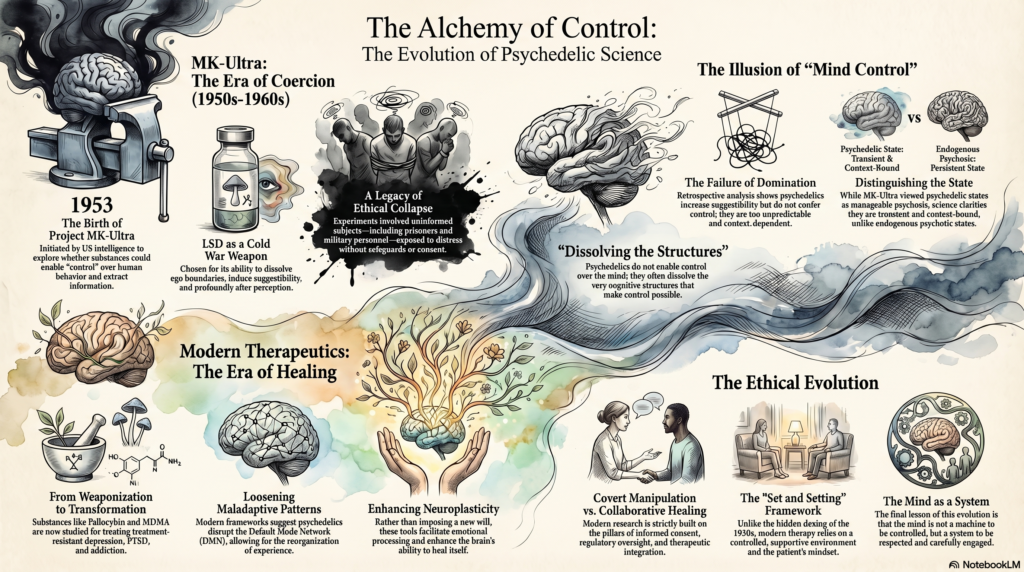
Few topics at the intersection of psychiatry, neuroscience, and society evoke as much fascination—and distortion—as the relationship between psychedelic substances and the Central Intelligence Agency’s covert program known as Project MK-Ultra.
To approach this subject clinically and scientifically, it is essential to separate historical fact, ethical failure, and modern therapeutic relevance.
🕰️ Historical Context: The Cold War and the Search for “Mind Control”
During the early Cold War era (1950s–1960s), there was widespread concern within US intelligence circles that adversaries had developed techniques for brainwashing, interrogation, and psychological manipulation.
In this climate, MK-Ultra was initiated (1953), with the goal of exploring whether substances could:
- Alter consciousness
- Extract information
- Weaken resistance
- Potentially enable “control” over human behavior
Among the substances studied, psychedelics—particularly LSD—occupied a central role.
🧪 Psychedelics in MK-Ultra: Scientific Curiosity Meets Ethical Collapse
Why LSD?
LSD was of interest because of its ability to:
- Profoundly alter perception
- Dissolve ego boundaries
- Induce suggestibility and emotional lability
From a modern lens, these effects reflect modulation of:
- Serotonergic (5-HT2A) systems
- Default Mode Network (DMN) activity
- Self-referential processing
However, within MK-Ultra, these properties were explored in deeply unethical ways.
Ethical Violations
Subjects were often:
- Uninformed (no consent)
- Administered substances covertly
- Exposed to psychological distress without safeguards
Populations included:
- Prisoners
- Psychiatric patients
- Military personnel
- Civilians
This represents a profound violation of what would later become core principles of medical ethics:
- Autonomy
- Informed consent
- Non-maleficence
🧠 The Illusion of “Mind Control”
Despite extensive experimentation, MK-Ultra failed in its primary aim.
Key Findings (Retrospectively Interpreted)
- Psychedelics increase suggestibility, but do not confer control
- They destabilize cognition, rather than organize it
- Effects are highly unpredictable and context-dependent
In essence:
Psychedelics do not enable control over the mind—they often dissolve the structures that make control possible.
🧠 Psychedelics and the Self: A Phenomenological Link
From a psychiatric perspective, psychedelic experiences often involve:
- Ego dissolution
- Altered sense of self
- Changes in perception of reality
This bears a superficial resemblance to:
- Depersonalization
- Psychosis-like experiences
- First Rank Symptoms (in extreme cases)
However, a critical distinction exists:
- Psychedelic states are transient, context-bound, and often reversible
- Psychotic states are endogenous, persistent, and structurally disorganizing
🔬 Modern Neuroscience: From Weaponization to Therapeutics
In a striking reversal, psychedelics have re-emerged in modern psychiatry—not as tools of control, but as agents of potential healing.
Current Research Areas
- Depression (treatment-resistant)
- PTSD
- Addiction
- End-of-life anxiety
Substances studied include:
- Psilocybin
- MDMA
- LSD (in controlled settings)
Mechanistic Insights
Modern frameworks suggest psychedelics:
- Disrupt rigid neural patterns (DMN disintegration)
- Enhance neuroplasticity
- Facilitate emotional processing
Rather than imposing control, they appear to:
Loosen maladaptive patterns and allow reorganization of experience
⚖️ Ethical Evolution: Lessons from MK-Ultra
The legacy of MK-Ultra serves as a stark reminder that:
Scientific curiosity without ethical grounding can lead to harm.
Modern psychedelic research is therefore built on:
- Informed consent
- Therapeutic setting (“set and setting”)
- Integration therapy
- Regulatory oversight
This represents a fundamental shift—from covert manipulation to collaborative healing.
🧩 Clinical Reflection
For the modern psychiatrist, MK-Ultra is not merely a historical curiosity.
It raises enduring questions:
- Can consciousness be manipulated?
- What is the boundary between pharmacology and experience?
- How do we ethically harness powerful tools that alter the mind?
The answer, perhaps, lies not in control—but in understanding.
🧭 Final Perspective
MK-Ultra sought to dominate the mind.
Modern psychiatry seeks to understand and heal it.
Psychedelics, once explored as instruments of coercion, are now being re-examined as tools for transformation—not by overriding the self, but by temporarily loosening its rigidities.
And in that shift lies an important lesson:
The mind is not a machine to be controlled,
but a system to be understood, respected, and carefully engaged.
📘 About the Author
Dr. Srinivas Rajkumar T, MD (AIIMS), DNB, MBA (BITS Pilani)
Consultant Psychiatrist & Neurofeedback Specialist
Mind & Memory Clinic, Apollo Clinic Velachery (Opp. Phoenix Mall)
✉ srinivasaiims@gmail.com 📞 +91-8595155808