Care Planning in Autism: Beyond Therapy to a Lifelong Plan for Health, Independence and Security
 The question families often postpone
Much of autism care begins with an immediate question:
What can we do for our child now?
Parents look for diagnostic assessments, speech therapy, occupational therapy, behavioural interventions, educational support and treatment for associated problems. These needs are important, particularly during childhood.
But there is another question that eventually becomes equally important:
Who will support my child when I am no longer able to do it?
For many families, this is one of the most difficult questions to ask.
It may feel premature when the child is three years old. It may feel frightening when the child is 13. And by the time the autistic person is 25 or 30, families sometimes realise that enormous effort has gone into therapy and education without creating a clear plan for adulthood.
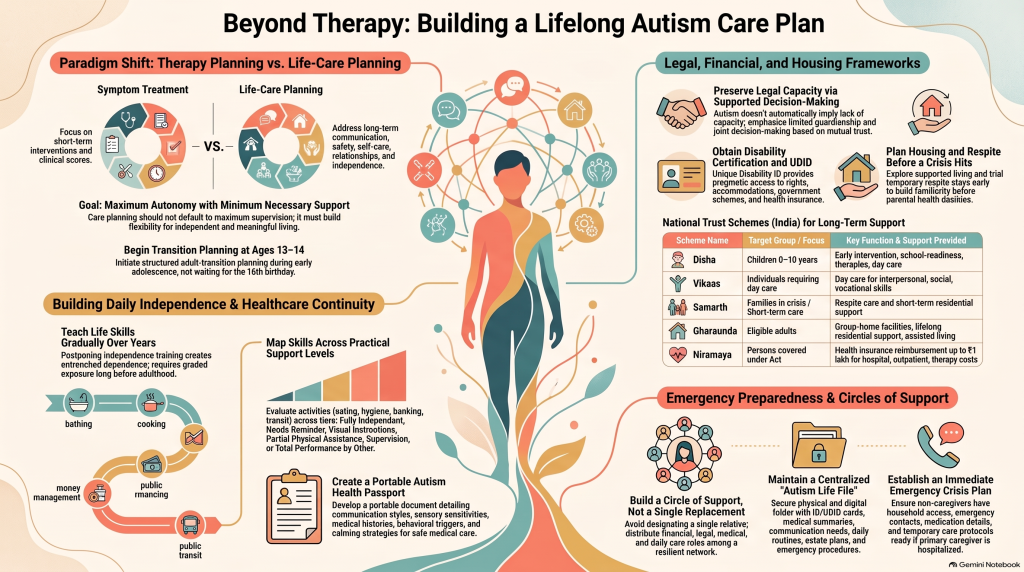
Autism care therefore needs to move beyond a treatment plan.
Families need a life-care plan.
The World Health Organization emphasises that autism encompasses a highly diverse group of people. Some autistic people will live completely independently, whereas others will require substantial or lifelong support. Importantly, an individual’s abilities and support needs can also change over time.
This means that future planning is not about assuming disability or dependence.
It is about building enough flexibility that the person can live as independently, safely and meaningfully as possible.
Autism care should begin with a future in mind
A child may be diagnosed with autism at three.
But that child will eventually become:
a school student,
an adolescent,
an adult,
possibly an employee,
a partner,
a person managing money,
a person travelling independently,
a person requiring medical care,
and eventually an ageing adult.
The healthcare system often concentrates disproportionately on the first few years after diagnosis.
Parents may spend enormous amounts of time and money asking:
Which therapy?
How many sessions?
ABA or developmental therapy?
Speech therapy twice or three times weekly?
Occupational therapy?
Medication?
School integration?
These questions matter.
But an equally important question is:
What abilities are we trying to build for life?
A therapy programme that improves a test score but does not improve communication, self-care, emotional regulation, relationships, participation or independence may have limited long-term value.
Good autism care therefore requires a shift from:
“How do we treat autism?”
to:
“What does this particular person need to live the best possible life?”
Care planning is not the same as treatment planning
A treatment plan usually concentrates on symptoms and interventions.
A comprehensive autism care plan asks much broader questions.
Can the person communicate pain?
Can they ask for help?
Can they safely cross a road?
Can they recognise dangerous situations?
Can they tolerate a medical examination?
Can they manage basic hygiene?
Can they prepare food?
Can they use money?
Can they travel?
Can they understand sexual boundaries?
Can they recognise exploitation?
Can they maintain friendships?
Can they work?
Can they live alone?
What happens if their mother is hospitalised tomorrow?
Who knows their medicines?
Who knows what triggers a behavioural crisis?
Where would they live if both parents suddenly became unavailable?
Those questions may ultimately matter more than another hour of therapy.
International guidance increasingly reflects this broader approach. NICE recommends that personalised autism plans consider strengths, skills, physical and mental health, family and social circumstances, education, employment, housing, challenging behaviour and coexisting conditions rather than focusing solely on core autistic characteristics.
The first principle: plan around the person, not around the diagnosis
No two autistic people require identical care plans.
Consider three individuals who all have an autism diagnosis.
One may complete university, work in software, live independently and need occasional support for anxiety, executive functioning and relationships.
Another may work with assistance, use public transport on familiar routes and manage many activities of daily living but require family support with finances and major decisions.
A third may have autism with intellectual disability, epilepsy and limited functional communication and require 24-hour supervision.
The diagnosis is the same.
The life-care requirements are completely different.
Therefore, the foundation of future planning should be an individual assessment of:
strengths + functional abilities + vulnerabilities + support requirements + personal preferences.
The objective should not automatically be maximum supervision.
It should be:
maximum autonomy with the minimum necessary support.
Build independence early—not suddenly at 18
One of the common mistakes in autism care is postponing independence training.
Parents understandably help their child because it is quicker.
They dress the child.
Feed them.
Carry their belongings.
Speak on their behalf.
Order food for them.
Handle all money.
Remind them about everything.
The difficulty is that a pattern that is reasonable at age six can become deeply entrenched by age 16.
Independence should therefore be taught gradually.
A child who cannot independently bathe at 18 should ideally not begin learning the skill for the first time at 18.
A teenager expected to handle money at 20 should start learning the concept of money considerably earlier.
Similarly, transport, cooking, communication with strangers, basic household responsibilities and self-management need graded exposure over years.
The important outcome is not:
“Can the parent perform this task for the child?”
It is:
“What is the least amount of assistance this person needs to perform the task?”
Think in terms of support levels
For every important life activity, care planning can identify one of several practical support levels.
The person may be fully independent.
They may perform the activity after a reminder.
They may need visual instructions.
They may require partial physical assistance.
They may require supervision.
Or another person may need to perform the task entirely.
This approach can be applied to eating, bathing, dressing, medications, cooking, shopping, transport, banking, communication, appointments, employment and personal safety.
Over time, the goal is to move as many activities as realistically possible toward greater independence.
Health planning must continue beyond childhood
Autism does not protect a person from ordinary medical illness.
In fact, some autistic people find healthcare environments particularly difficult because of sensory sensitivity, communication difficulties, fear of unfamiliar procedures or inability to describe symptoms.
Associated conditions can include epilepsy, ADHD, anxiety, depression, sleep disorders and other physical or developmental conditions. WHO specifically highlights the importance of integrated healthcare across the lifespan.
Every autistic person with significant support needs should therefore gradually develop a portable health profile or autism health passport.
NICE similarly recommends a health passport for autistic adults containing information that healthcare staff need to understand the person’s communication and support requirements.
Such a record can contain communication style, emergency contacts, diagnoses, medicines, allergies, previous adverse drug reactions, epilepsy information, sensory sensitivities, preferred methods of examination, behavioural warning signs and strategies that help the person remain calm.
This becomes especially valuable when the primary caregiver is suddenly unavailable.
Psychiatric care is part of autism care
Changes in behaviour should not automatically be attributed to autism.
A previously stable autistic adolescent who becomes aggressive, withdrawn, sleepless or self-injurious may have:
pain,
anxiety,
depression,
ADHD,
OCD,
sleep disturbance,
epilepsy,
medication effects,
bullying,
sensory overload,
family stress,
or another medical or psychiatric problem.
The care plan should therefore include access to professionals who understand both autism and mental health.
The transition from child to adult healthcare is particularly vulnerable to fragmentation. NICE recommends reassessing continuing needs during adolescence, planning transition before adulthood and involving the autistic young person directly wherever possible.
Transition planning should therefore begin years before the eighteenth birthday—not during the month before it.
Education should eventually become preparation for life
Academic achievement is important, but education for an autistic child should not be judged only by marks.
The long-term educational plan should ask:
What does this child need to know to function at 20?
For some students that may mean competitive academics and university preparation.
For others it may mean functional literacy, communication, vocational skills, daily living skills and supported employment.
For many, the ideal programme contains elements of both.
A child who can solve algebra but cannot independently buy lunch may need explicit adaptive-skills training.
Likewise, a young person with modest academic ability may nevertheless become highly employable if a particular strength—data entry, design, cooking, gardening, inventory work, computer skills, photography, crafts or another structured task—is identified and developed appropriately.
The goal should therefore gradually move from school readiness to life readiness.
Employment should be planned before school ends
The transition from school into adulthood can be abrupt.
Until late adolescence, the person’s day may be structured by parents and school.
Then school finishes.
Suddenly there may be no routine.
No peers.
No defined role.
No sense of productivity.
For autistic adults, meaningful occupation can include competitive employment, supported employment, self-employment, sheltered or assisted vocational environments, structured volunteering or meaningful day programmes depending on individual capability.
Employment planning should ideally begin during adolescence through vocational profiling.
Instead of asking only:
“What job can this person do?”
ask:
“Under what environmental conditions does this person function best?”
Some people perform exceptionally well when work is predictable, structured and technically focused but struggle in jobs requiring continuous social negotiation.
Environmental fit can therefore be as important as ability.
Financial planning is a clinical issue too
Families frequently underestimate the lifetime cost of disability-related support.
Planning should consider not just present therapy expenses, but future requirements such as:
housing,
caregivers,
medical care,
insurance,
transport,
daily living expenses,
vocational support,
assistive technology,
and inflation over several decades.
Parents should consider what happens if family income suddenly stops.
Life insurance, savings, investments, pensions, property arrangements and estate planning may all contribute to a long-term strategy.
In India, families may also qualify for disability-related tax provisions depending on the individual’s certification and the tax regime being used. For Assessment Year 2026–27, the Income Tax Department describes Section 80DD deductions of ₹75,000 for an eligible dependent person with disability and ₹1.25 lakh for severe disability; eligibility and tax-regime implications should be confirmed with a qualified tax adviser rather than assumed.
Financial planning should therefore involve more than simply leaving money behind.
The crucial question is:
Who will manage the money, under what rules, and for whose benefit?
A Will is important—but a Will alone may not be enough
Parents frequently assume:
“My other child will look after him.”
That is not a care plan.
Circumstances change.
Siblings may live abroad.
They may develop health problems.
They may have their own children.
Relationships within families may change.
A realistic plan requires explicit discussion.
Depending on family assets and the autistic person’s ability to manage finances, families may need advice about wills, trusts, nominations, ownership of property, banking arrangements and succession planning.
The American concept of a “Supplemental Needs Trust,” often discussed on US autism websites, should not simply be copied into Indian planning. Indian succession, trust, taxation and disability-benefit rules are different.
Families with significant assets should therefore obtain India-specific estate-planning advice from a lawyer and financial professional familiar with disability planning.
Autism does not automatically mean lack of legal capacity
This distinction is extremely important.
An autism diagnosis does not automatically mean that an adult cannot make decisions.
Indian disability law increasingly emphasises autonomy and supported decision-making.
Section 14 of the Rights of Persons with Disabilities Act, 2016 provides for limited guardianship when, despite adequate support, a person is unable to make particular legally binding decisions. The law defines limited guardianship as joint decision-making based on mutual understanding and trust, limited to particular periods or situations and operating according to the person’s will.
Therefore guardianship should not be viewed simply as:
“My autistic child turns 18, therefore I must take over all decisions.”
The better question is:
“Which decisions can this person make independently, which decisions can they make with support, and for which specific decisions is formal representation genuinely necessary?”
This preserves dignity while protecting vulnerable individuals.
The National Trust and legal guardianship
India also has a separate statutory framework through the National Trust for Welfare of Persons with Autism, Cerebral Palsy, Intellectual Disability and Multiple Disabilities Act, 1999.
The National Trust performs both welfare and legal functions, including legal guardianship through district-level Local Level Committees.
Parents, relatives and in specified circumstances registered organisations can apply for guardianship where it is genuinely required. The Local Level Committee considers whether guardianship is necessary and the purposes for which it is required.
Because the National Trust Act and the later RPwD framework interact, families contemplating guardianship should obtain individual legal advice rather than treating guardianship as a routine administrative step.
In Tamil Nadu, the state’s RPwD Rules designate the District Collector as the authority dealing with limited guardianship applications under Section 14.
Disability certification and UDID should not be forgotten
Where an autistic individual qualifies for disability certification, obtaining the appropriate documentation can become an important part of long-term planning.
India’s Unique Disability ID programme provides a national system through which disability certificates and UDID cards are issued by competent medical authorities. The stated objective is to facilitate access to government benefits and services.
Families sometimes postpone this because they dislike the term “disability.”
But certification should be viewed pragmatically.
It does not define the individual’s identity.
It may simply provide access to rights, accommodations, schemes and services that could become important later.
Government-supported care options should be understood early
The National Trust currently operates several programmes relevant to autism.
For young children, the Disha programme provides early-intervention and school-readiness services for eligible children aged 0–10 years, including therapies, family support and day care.
Vikaas provides structured day care designed particularly around interpersonal and vocational skills while also giving families caregiving support during the day.
Samarth provides respite and residential care, including support for families in crisis.
Gharaunda is designed around group-home and lifelong residential support for eligible adults, with an emphasis on care, dignity and assisted living.
These schemes should not be viewed only as options of last resort.
Understanding them early allows families to compare models of supported living before an emergency forces a decision.
Health insurance deserves special attention
The National Trust’s Niramaya Health Insurance Scheme currently provides eligible persons covered by the National Trust Act with reimbursement-based coverage up to ₹1 lakh.
Current benefits include defined coverage for hospitalisation, outpatient treatment, diagnostic investigations, ongoing therapies, dental preventive care, AYUSH treatment and transport, subject to scheme limits. Eligibility requires the relevant disability documentation and UDID or UDID enrolment documentation.
₹1 lakh is clearly not sufficient to fund lifelong disability care.
But it can form one component of a larger financial and healthcare strategy.
Housing must be planned before there is a crisis
Perhaps the most emotionally difficult component of autism planning is housing.
Where will the person live at 30?
At 50?
At 70?
For some people the answer will be their own home.
For others it may involve family-supported living, shared accommodation, supported apartments or structured group homes.
The worst time to make this decision is immediately after a parent dies or becomes seriously ill.
Families should therefore gradually explore alternatives while parents are still healthy.
For individuals who may eventually need supported accommodation, occasional respite stays can also serve another purpose: they allow the autistic person to develop familiarity with being supported by someone other than the parents.
This is psychologically important for both the individual and the family.
Create a circle of support, not a single replacement parent
A common plan is:
“When I die, his sister will take over.”
That places enormous responsibility on one person and creates vulnerability if circumstances change.
A more resilient approach is to create a circle of support.
Different people may handle different responsibilities.
One sibling may oversee finances.
Another relative may maintain regular social contact.
A professional may coordinate healthcare.
A supported-living service may manage daily care.
A legal representative may oversee specified decisions.
The objective is not to find another person who can perform everything the parent currently does.
It is to build a system that continues functioning even when one person becomes unavailable.
Parents also need a care plan
Long-term autism caregiving can be physically and psychologically demanding.
Parents sometimes organise every aspect of the autistic person’s life while neglecting their own health, relationships, finances and ageing.
That itself creates future risk.
If the entire care system depends on one exhausted 70-year-old parent, the system is fragile.
Respite care is therefore not a luxury.
It is part of responsible long-term planning.
International autism guidance explicitly recognises the importance of assessing caregiver needs, supporting siblings and families and providing respite or short breaks where appropriate.
Prepare an emergency plan
Every family caring for a person with substantial support needs should be able to answer one scenario:
What happens tonight if the primary caregiver suddenly cannot come home?
There should be another person who can access the house.
Someone should know the medicines.
Important documents should be findable.
Emergency contacts should be written down.
The person’s communication style and behavioural triggers should be documented.
There should be a temporary care arrangement.
For individuals with complex behavioural or psychiatric needs, a written crisis-management plan can also describe triggers, early warning signs, escalation patterns and interventions that are helpful or harmful. NICE specifically recommends this approach for autistic adults where relevant.
A practical Autism Life File
Families can maintain one physical and secure digital folder that travels with the person across adulthood.
It can contain:
- diagnostic and disability certificates, UDID details and identity documents;
- current medical summary, medicines, allergies, treating professionals and emergency contacts;
- communication preferences, sensory sensitivities, behavioural triggers and calming strategies;
- education, vocational and adaptive-function assessments;
- banking, insurance, nominations, estate-planning and relevant legal documents;
- guardianship or supported-decision arrangements where applicable;
- housing and respite-care preferences;
- a description of the person’s daily routine, food preferences, interests, sleep pattern and important relationships;
- an emergency plan specifying exactly who should be contacted and what should happen if the main caregiver becomes unavailable.
The file should not remain unchanged for ten years.
It should be reviewed regularly as the person develops.
Plan adulthood from adolescence
One of the most useful changes families can make is to treat the teenage years as a transition-development period.
By approximately 13–14 years, discussions can increasingly address:
daily living skills,
puberty and sexuality,
personal boundaries,
digital safety,
money,
travel,
work interests,
communication with unfamiliar people,
healthcare independence,
decision-making,
relationships,
and future living arrangements.
This is consistent with international transition guidance, which recommends beginning structured adult-transition planning by approximately 13–14 years for young people who will continue to require health or social-care support.
The transition should not happen on the eighteenth birthday.
It should occur gradually over several years.
The objective is not simply independence
Complete independence is not achievable—or even desirable—for everyone.
The real goal is a meaningful life.
That may include:
choice,
dignity,
relationships,
purpose,
safety,
community participation,
work or meaningful activity,
physical and mental healthcare,
and as much control over one’s own life as possible.
For some autistic adults this will mean living independently.
For others it will mean interdependence—living a meaningful life with structured support.
Both can represent successful outcomes.
From “therapy planning” to “life planning”
Perhaps the greatest change required in autism services is conceptual.
When a child is diagnosed, families are often handed a therapy list.
Speech therapy.
Occupational therapy.
Behavioural therapy.
Special education.
Follow-up.
But eventually the family needs something larger:
A Life-Care Plan
It should integrate:
Clinical care — medical, developmental and psychiatric needs.
Functional development — communication, self-care and adaptive skills.
Education and employment — meaningful learning and occupation.
Social life — relationships, recreation, community and sexuality.
Legal planning — autonomy, supported decision-making and guardianship where genuinely necessary.
Financial planning — income, insurance, assets and long-term care funding.
Housing — where and with whom the individual will live.
Succession planning — who coordinates care when parents cannot.
Emergency planning — what happens if the normal system suddenly fails.
This is the difference between preparing an autistic child for the next therapy session and preparing an autistic person for the next 60 years
The question every family should eventually answer
Parents understandably hope that they will always be there.
But good future planning requires asking a more difficult question:
“If I were suddenly unavailable tomorrow, would the people around my child know what to do?”
If the answer is no, the solution is not fear.
It is planning.
Start gradually.
Document what only the parent currently knows.
Build independence wherever possible.
Create relationships beyond the immediate family.
Secure appropriate disability documentation.
Understand benefits and insurance.
Plan money and property.
Explore employment and living arrangements.
Clarify legal decision-making.
Introduce alternative caregivers before an emergency.
And most importantly, involve the autistic person in these decisions to the greatest extent possible.
Because the ultimate purpose of autism care planning is not merely to guarantee that someone will look after the individual.
It is to build a system in which that individual can continue to have choice, dignity, safety, relationships, purpose and the greatest possible control over their own life—even when their parents are no longer there.
Legal, taxation, guardianship, insurance and government-scheme provisions can change and vary by individual circumstances and state. Families should obtain current professional advice before implementing financial or legal arrangements.