Psychological Operations (PsyOps): History, Methods, and Public-Domain Case Studies
 (An Excerpt from the Upcoming “Digital Handbook of Psychiatry”)
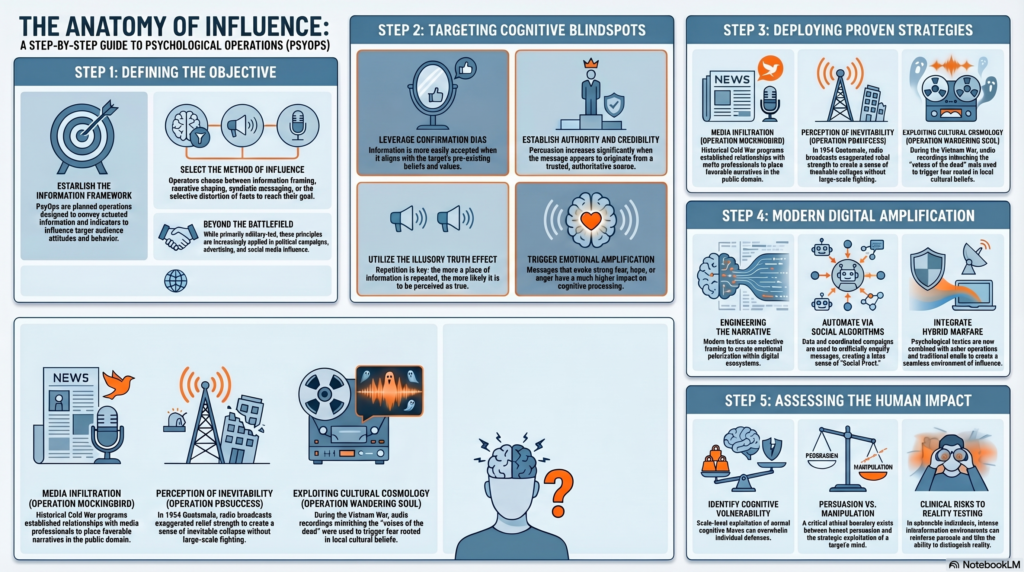
Psychological Operations—commonly termed PsyOps—occupy a complex space between military strategy, communication science, and human psychology. At their core, PsyOps are structured attempts to influence perceptions, emotions, and behavior in a target population.
Unlike overt force, PsyOps operate in the domain of belief, meaning, and interpretation.
Wars are not fought only on the battlefield—they are also fought in the mind.
🧠 What Are PsyOps?
PsyOps are formally defined as:
Planned operations to convey selected information and indicators to influence the attitudes and behavior of target audiences.
They may involve:
- Information framing
- Narrative shaping
- Symbolic messaging
- Emotional manipulation
- Selective disclosure or distortion of facts
While often associated with military or intelligence agencies such as the Central Intelligence Agency, similar principles are used in:
- Political campaigns
- Advertising
- Social media influence
🧠 The Psychological Foundations
PsyOps rely on well-established principles of human cognition:
1. Confirmation Bias
People accept information that aligns with pre-existing beliefs.
2. Authority and Credibility
Messages are more persuasive when perceived as coming from trusted sources.
3. Emotional Amplification
Fear, hope, and anger significantly increase message impact.
4. Repetition (Illusory Truth Effect)
Repeated information is more likely to be believed.
5. Social Proof
People adopt beliefs perceived as widely shared.
These mechanisms are not pathological—they are normal features of human cognition that can be strategically leveraged.
🕰️ Historical PsyOps in the Public Domain
📻 1. Operation Mockingbird (Media Influence)
Operation Mockingbird
Overview
A Cold War-era program involving relationships between intelligence agencies and media professionals.
Strategy
- Placement of favorable narratives
- Influence over journalistic framing
Insight
Demonstrates early recognition that media is a psychological battlefield.
🌍 2. Operation PBSuccess (Guatemala, 1954)
Operation PBSuccess
Strategy
- Radio broadcasts exaggerating rebel strength
- Dissemination of false military information
Psychological Effect
Created a perception of inevitable regime collapse, influencing behavior without large-scale military engagement.
📡 3. Radio Free Europe / Radio Liberty
Radio Free Europe
Radio Liberty
Strategy
- Broadcasting alternative political narratives into Eastern Bloc countries
Insight
Not purely misinformation—rather strategic framing of reality.
🪖 4. Operation Wandering Soul (Vietnam War)
Operation Wandering Soul
Strategy
- Audio broadcasts mimicking voices of the dead
- Exploited cultural beliefs about spirits
Psychological Target
Fear rooted in cultural cosmology
📄 5. Operation INFEKTION (Soviet Disinformation)
Operation INFEKTION
Strategy
- Spread claim that HIV/AIDS was a US bioweapon
Insight
Demonstrates how misinformation can be planted, amplified, and globalized
🧠 6. MK-Ultra (Behavioral Research Context)
Project MK-Ultra
While not a PsyOps campaign in the traditional sense, it reflects attempts to understand:
- Suggestibility
- Behavior under altered consciousness
- Limits of psychological manipulation
🧠 PsyOps in the Modern Era
Today, PsyOps have evolved into information warfare ecosystems:
Digital Amplification
- Social media algorithms
- Bots and coordinated campaigns
Narrative Engineering
- Selective framing
- Emotional polarization
Hybrid Warfare
- Combination of cyber, media, and psychological tactics
⚖️ Ethical and Clinical Considerations
From a psychiatric perspective, PsyOps raise important questions:
1. Vulnerability of Cognition
Normal cognitive biases can be exploited at scale.
2. Boundary with Psychopathology
In vulnerable individuals, exposure to intense misinformation environments may:
- Reinforce paranoia
- Blur reality testing
3. Ethical Use of Influence
There is a fine line between:
- Persuasion
- Manipulation
🧭 A Balanced Understanding
It is important to avoid two extremes:
❌ Overestimation
Believing PsyOps can completely control populations
❌ Underestimation
Ignoring their influence on perception and behavior
The reality lies in between:
PsyOps can shape narratives and bias decisions,
but they do not eliminate individual agency.
🧩 Final Reflection
Psychological operations remind us of a fundamental truth:
Human beings do not respond to reality directly—
they respond to their interpretation of reality.
And that interpretation can be influenced.
For psychiatry, this has a deeper implication:
Understanding how beliefs are formed, sustained, and altered is not just a matter of geopolitics—it is central to understanding the human mind itself.
📘 About the Author
Dr. Srinivas Rajkumar T, MD (AIIMS, New Delhi), DNB, MBA (BITS Pilani)
Consultant Psychiatrist & Neurofeedback Specialist
Mind & Memory Clinic, Apollo Clinic Velachery (Opp. Phoenix Mall)
✉ srinivasaiims@gmail.com 📞 +91-8595155808