The Architecture of Action: Why Great Environments Make Good Behaviour Easier
 We often explain exceptional performance in terms of exceptional people.
They are more disciplined.
More motivated.
More creative.
More ambitious.
More productive.
But behavioural science suggests another possibility:
Perhaps some environments simply make useful behaviour easier to start.
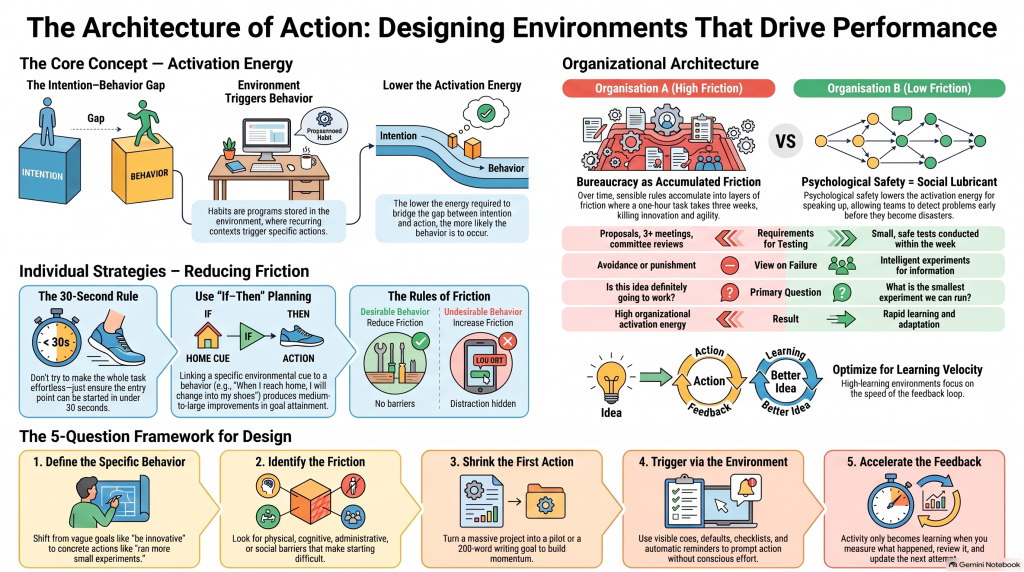
Think of it as activation energy.
In chemistry, a reaction may be energetically favourable and still not occur until enough energy is supplied to initiate it.
Human behaviour has a similar problem.
We may genuinely want to exercise, write, study, innovate, conduct an experiment or start a difficult project.
Yet between:
“I want to do this”
and
“I am doing this”
there is friction.
The scientific literature generally calls this phenomena things such as behavioural friction, action costs, choice architecture, situational cues and barriers to goal implementation, rather than “activation energy.”
But the metaphor is useful.
The lower the activation energy between intention and action, the more likely action becomes.
And this principle applies not only to individuals.
It may be one of the most important principles in the design of high-performing organisations, laboratories, hospitals, universities and startups.
Motivation Is Only Half the Story
A common mistake in behavioural change is assuming that strong intention should naturally produce strong action.
It often does not.
We can sincerely intend to:
- exercise regularly,
- eat better,
- finish a paper,
- study every evening,
- reduce phone use,
- implement a new clinical protocol,
- start a research project,
and still fail to do it.
Psychologists call this the intention–behaviour gap.
One of the clearest demonstrations comes from research on implementation intentions.
Instead of merely forming a goal—
“I will exercise more.”
—the individual links a specific environmental cue with a specific behaviour:
“When I reach home at 6 PM, I will change into my running shoes and walk for 20 minutes.”
A major meta-analysis of 94 independent tests found that these kinds of if–then plans produced a medium-to-large improvement in goal attainment. More recent reviews continue to show that linking behaviour to specific situational cues can improve initiation, attention control, prospective memory and other aspects of goal pursuit.
Why?
Because part of the decision has already been made.
The environment begins to trigger the behaviour.
Instead of asking yourself repeatedly:
“Should I do it now?”
the situation itself begins to answer:
“This is when I do it.”
That is environmental design.
Habits Live in Environments
Habit research makes the same point from another direction.
We tend to imagine habits as properties of individuals:
“I have good habits.”
“I have bad habits.”
But habits are deeply connected to recurring contexts.
Research reviewed by Wendy Wood and colleagues shows that repeated behaviour becomes associated with stable environmental cues. Once habits become established, behaviour can be initiated with relatively little conscious deliberation.
The environment effectively stores part of the behavioural programme.
Your morning coffee triggers checking the newspaper.
Entering the gym triggers a familiar exercise sequence.
Sitting at a particular desk triggers work.
Seeing the phone triggers checking messages.
Opening the refrigerator triggers a familiar food choice.
The important implication is that behavioural change is not merely about changing the person.
Sometimes we should change the cue architecture surrounding the person.
Friction Is Behaviourally Powerful
Suppose two behaviours are equally attractive.
Behaviour A takes one action to initiate.
Behaviour B requires six.
Over hundreds of repetitions, that apparently trivial difference becomes enormous.
This is why good environmental design follows two complementary rules:
For desirable behaviour:
Reduce friction.
For undesirable behaviour:
Increase friction.
Want to exercise?
Keep the shoes visible and the equipment ready.
Want to read?
Place the book where you normally reach for your phone.
Want to write?
Leave the document open to the exact place where you stopped.
Want healthier food choices?
Make the healthier option visible, prepared and convenient.
Want less social-media use?
Remove notifications, log out, move applications away from the home screen or keep the phone physically farther away.
None of these interventions dramatically changes motivation.
They change the cost of acting.
And human beings are remarkably responsive to small changes in cost.
Choice Architecture: The Environment Is Never Neutral
Behavioural economics provides another powerful framework: choice architecture.
Whenever choices are presented, somebody—or something—determines:
- what appears first,
- what is easiest,
- what is pre-selected,
- how many alternatives appear,
- what information is visible,
- and what happens if the individual does nothing.
These seemingly mundane design decisions influence behaviour.
Defaults are a classic example.
People frequently remain with default options rather than actively changing them. Research on choice architecture shows that defaults can affect behaviour partly through convenience, inertia, perceived recommendation and other psychological mechanisms.
The larger lesson goes far beyond default settings:
There is no behaviourally neutral environment.
Every environment makes some actions easier than others.
The question is whether this architecture has been designed intentionally.
A Simple Principle: Make the First 30 Seconds Easy
The entire behaviour does not need to become effortless.
Only the entry point needs to become easier.
Imagine the difference between:
“Write the research paper.”
and:
“Open the document and write one paragraph.”
Or:
“Exercise for an hour.”
versus:
“Put on your shoes and walk outside.”
Or:
“Develop the new service.”
versus:
“Run one small pilot with five users.”
Large goals generate uncertainty.
Small actions generate momentum.
A useful environmental-design question therefore is:
Can the desired behaviour begin within 30 seconds?
If not, what unnecessary friction can be removed?
The Same Principle Applies to Organisations
This becomes even more interesting at the organisational level.
Consider two organisations.
In Organisation A, testing a new idea requires:
- a proposal,
- three meetings,
- budget approval,
- several signatures,
- a committee review,
- and a presentation next month.
In Organisation B, someone asks:
“Can we test a small, safe version this week?”
Even if the people are equally intelligent, the organisations will behave very differently.
Organisation A has high organisational activation energy.
Organisation B has low organisational activation energy.
Over five or ten years, the difference can become enormous.
Bureaucracy Is Often Accumulated Friction
Every organisational rule usually has a reason.
One approval protects finances.
Another protects safety.
Another maintains quality.
Another ensures accountability.
Individually, each requirement may appear sensible.
But processes accumulate.
Eventually something that should require one hour requires three weeks.
This creates an important management principle:
Every additional step should justify the behavioural friction it creates.
The objective is not to eliminate governance.
That would be dangerous.
The objective is to distinguish between:
necessary safeguards
and
historical friction.
High-performing organisations repeatedly examine their processes and ask:
Does this step still protect something important?
If not, removing it lowers organisational activation energy.
Psychological Safety Is Another Form of Activation Energy
Not all friction is logistical.
Some of the most powerful friction is social.
Imagine noticing a problem at work.
You could raise it.
But doing so might embarrass your supervisor.
Perhaps your suggestion could be wrong.
Perhaps colleagues will think you are difficult.
Perhaps the organisation punishes people who challenge established practices.
Suddenly speaking one sentence requires enormous psychological energy.
This is where psychological safety becomes important.
Psychological safety does not mean eliminating standards or avoiding disagreement. It refers to an environment in which people can ask questions, admit uncertainty, report errors and raise ideas without disproportionate interpersonal fear. Research on learning organisations has repeatedly linked such environments with speaking up, learning and intelligent experimentation.
In behavioural terms:
Psychological safety lowers the activation energy for speaking.
And that can determine whether an organisation detects problems early or discovers them after they become disasters.
Make Experiments Cheap
Another characteristic of high-learning environments is that they make experimentation inexpensive.
When every new idea requires a massive investment, people understandably become conservative.
Instead of asking:
“Is this idea definitely going to work?”
a learning organisation asks:
“What is the smallest experiment that could tell us whether this idea is worth pursuing?”
This changes everything.
A proposal does not immediately become a ₹10-crore project.
It becomes a pilot.
A hospital does not immediately redesign an entire department.
It trials the workflow in one unit.
A university does not immediately restructure a curriculum.
It tests the intervention with one cohort.
A company does not build the entire product.
It tests whether users actually want the key function.
The objective of the experiment is not necessarily success.
The objective is information.
Failure and Experimentation Are Not the Same Thing
This distinction is important.
A culture encouraging experimentation should not become a culture that celebrates incompetence.
There is a major difference between:
an intelligent experiment that produces a negative result
and
a preventable error caused by ignoring established procedure.
Research on organisational learning emphasises precisely this distinction: experimentation necessarily involves uncertainty, while preventable failures in well-understood processes require a different response.
The ideal organisation therefore combines:
high standards + psychological safety + inexpensive experimentation.
That combination is far more powerful than simply telling employees to “innovate.”
Increase the Speed of the Feedback Loop
Low activation energy is only useful if action generates feedback.
Consider:
Idea → Action → Feedback → Learning → Better Idea
The faster this loop operates, the faster learning occurs.
A person conducting one meaningful experiment every week gets approximately:
52 learning opportunities per year.
Someone conducting one every month gets:
12.
Over five years:
260 versus 60.
The numbers are simplistic, of course.
But the compounding principle is important.
The competitive advantage may not come from having dramatically better initial ideas.
It may come from running more intelligent learning cycles.
Learning Velocity May Matter More Than Initial Intelligence
We tend to reward the person who appears to know the answer.
But in uncertain environments, another characteristic may be more valuable:
How quickly can you discover that your answer is wrong?
That requires a different culture.
Instead of:
Think until you are certain.
The principle becomes:
Think enough to design a safe experiment.
Then:
test → measure → update.
This resembles the logic of science itself.
A hypothesis becomes useful when it produces a testable prediction.
Likewise, an organisational idea becomes much more useful when it can produce an observable experiment.
Design for Action, Not Merely Intention
Many organisations inadvertently optimise for intention.
They produce:
- strategy documents,
- vision statements,
- committees,
- brainstorming sessions,
- planning retreats,
- presentations,
- mission statements.
All of these can be valuable.
But none necessarily produces behaviour.
A more useful question after every meeting is:
“What becomes easier to do tomorrow because of this meeting?”
If the answer is nothing, the organisation may have generated cognition without reducing activation energy.
A good meeting should ideally leave behind:
- a decision,
- an owner,
- a next action,
- a trigger,
- a deadline,
- or an experiment.
Otherwise the organisation repeatedly returns to the same conversation.
Reduce Decision Points
Another powerful principle is to remove unnecessary decisions.
Suppose exercising requires deciding:
What exercise?
How long?
Which clothes?
Which route?
What time?
Which equipment?
The accumulated decision burden itself becomes friction.
Compare that with:
Monday, Wednesday, Friday.
6:30 AM.
Shoes ready.
Same route.
30 minutes.
Now five decisions have disappeared.
This is another reason implementation intentions work: they move decisions upstream, when the person is planning calmly, instead of requiring repeated decisions at the exact moment action is required.
Move Intelligence Into the Environment
Perhaps the deepest principle of environmental design is this:
Do not require the brain to solve repeatedly what the environment can solve once.
Instead of remembering medication every day:
Use a pill organiser and alarm.
Instead of remembering every task:
Use an external task system.
Instead of deciding whether to exercise every morning:
Create a fixed schedule.
Instead of repeatedly explaining a clinical process:
Create a checklist.
Instead of relying on employees to remember safety procedures:
Design the workflow so that important steps cannot easily be skipped.
This is not weakness.
It is intelligent systems engineering.
The best systems do not demand perfect memory, perfect motivation and perfect attention from human beings.
They anticipate that human cognition is limited.
A Framework for Low-Activation-Energy Design
Whether designing your personal life, a laboratory, a clinic or an organisation, five questions are useful:
1. What behaviour do we actually want?
Not:
“Improve innovation.”
But:
“Run more small experiments.”
Not:
“Become healthier.”
But:
“Walk for 30 minutes five days per week.”
2. What makes starting difficult?
Look for:
- physical friction,
- cognitive friction,
- decision friction,
- administrative friction,
- financial friction,
- social friction,
- uncertainty,
- fear of failure.
3. Can the first action become smaller?
Turn:
Project
into:
experiment.
Turn:
exercise programme
into:
putting on shoes.
Turn:
write a book
into:
write 200 words.
4. Can the environment trigger the behaviour?
Use:
- visible cues,
- defaults,
- prepared tools,
- scheduled times,
- checklists,
- if–then plans,
- automatic reminders.
5. Can feedback arrive faster?
Without feedback, activity does not necessarily become learning.
Measure what happened.
Review it.
Update the next attempt.
Repeat.
The Environment Is Part of Human Performance
The traditional model of achievement is highly individualistic:
Motivation → Effort → Success
Behavioural science suggests a richer model:
Person × Environment × Friction × Feedback
The same individual can look extraordinarily productive in one environment and chronically unmotivated in another.
The difference may not be character.
It may be architecture.
A brilliant researcher surrounded by administrative friction may produce less experimentation.
An average team with excellent systems may continuously improve.
A motivated individual in a distraction-rich environment may struggle.
The same individual in an intelligently structured environment may flourish.
Stop Asking Only: “How Do We Motivate People?”
Sometimes that is the wrong question.
Ask instead:
What is preventing the desired behaviour from happening naturally?
What needs to be:
removed?
prepared?
automated?
made visible?
made smaller?
made safer?
made faster?
made the default?
And sometimes ask the reverse:
Which undesirable behaviour have we accidentally made incredibly easy?
This question is particularly powerful.
Modern environments have dramatically reduced the activation energy required for distraction.
Entertainment is one tap away.
Food can arrive at the door.
Shopping takes seconds.
Notifications actively seek our attention.
The environment is already being designed.
The only question is:
Who is designing it—and for whose objective?
The Ultimate Competitive Advantage: Shorten the Distance Between Thought and Action
Great environments do not eliminate thinking.
They prevent thinking from becoming a substitute for action.
They create a short pathway:
💡 Idea
↓
🧪 Small experiment
↓
📊 Feedback
↓
🧠 Learning
↓
🚀 Better experiment
And then the cycle repeats.
The principle applies equally to behavioural change and organisational innovation:
Reduce friction for what matters.
Increase friction for what distracts.
Make good behaviour the easy behaviour.
Make intelligent experimentation cheap.
Make feedback rapid.
Because ideas are common.
Intentions are common.
Plans are common.
What is rare is an environment in which the distance between:
“We should do this.”
and
“We have already started.”
is remarkably short.
That may be one of the most underrated advantages in human behaviour and organisational design.